Former soldier reveals Argentine torture in Falklands war

 'Be careful what you wish for': 'Obsession' director and star reflect on success

 Messi scores but Miami held by Nashville
 US Open champ Rybakina on top of world after injury scare

 Rybakina reigns serene as new world number one

 South Africa defeat New Zealand 43-28 to complete 3-1 series victory
 Rybakina triumphs in US Open, denies Sabalenka three-peat

 Japanese floating parking platform is designed to lift cars above floodwater

 Anthropic details Claude misuse as US targets major illicit online marketplace

 Fifth Circuit upholds dismissal of Jackson residents' constitutional water claims

 Winston County trash-debt prosecutions face challenge from civil-rights lawyers

 Marmot research gains over $140,000 from meme-coin fees alongside wildlife contest

 Queens residents seek renewed enforcement along Roosevelt Avenue

 United States beats Spain 76-66 to set up World Cup final against France

 Cristian Mungiu's Fjord examines a family's conflict with Norwegian child authorities

 Gilbert Arenas questions Jonathan Kuminga's decision to join Minnesota

 Arteta blasts 'unacceptable' Sunderland penalty despite Arsenal win

 Mbappe at the double as Real Madrid sink Rayo

 Arsenal extend perfect Premier League start as Chelsea, Liverpool held

 US survive Spain scare to book World Cup final clash with France

 Celine Dion makes long-awaited return to stage in Paris
 Werro crowned Ultimate queen, US sweep 100m races

 Venezuelans outside Caracas say capital not sharing blackout burden

 Danish WWII drama wins top prize at Venice festival
 Chelsea boss Alonso yearns for 'boring game' after Hull make their point
 Werro outguns Hodgkinson to win women's 800m at Ultimate

Some soldiers were buried up to their necks in snow, others tied to posts by their limbs.
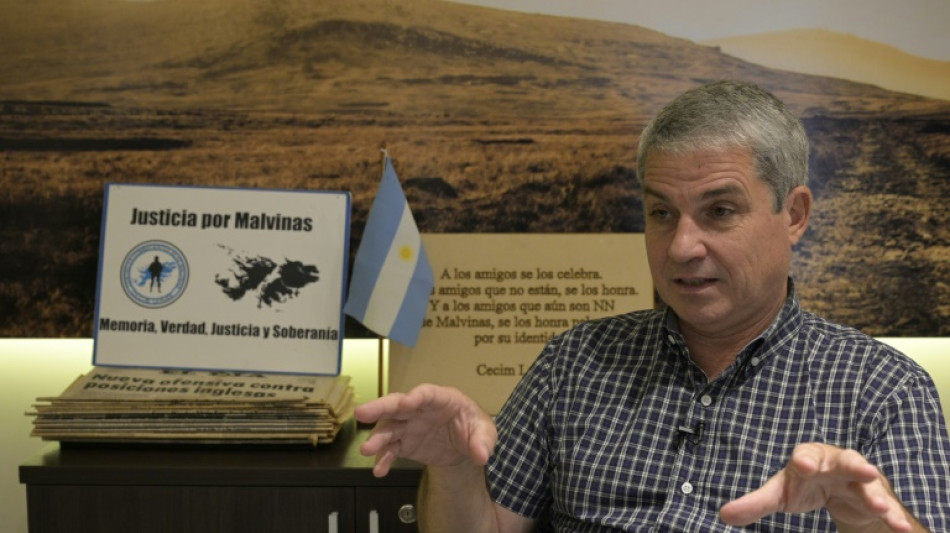
Badly trained and poorly equipped, Argentine soldiers suffered shocking conditions and even torture during the 1982 Falklands War -- but it was inflicted by their own officers.
"The dictatorship's methods were transported to the Falklands," said former fighter Ernesto Alonso, who has launched a case against Argentina's military command for torturing soldiers during the war.
"In many cases the Falklands situation was being stuck between two enemies," Alonso told AFP, ahead of the 40th anniversary of Argentina's disastrous invasion of the British-held South Atlantic archipelago.
On one side, the British were "killing our comrades in battle," and on the other, Argentine officers were torturing their own men.
The Center for ex-fighters in La Plata, Alonso's home town, has collected statements from dozens of former soldiers and in 2007 opened a court case against Argentina's military leaders for torture during the war.
"It was systematic, there was no precedent for what we went through in the Falklands where the state terrorism was exported," said Alonso.
"Over there the life of a sheep was worth more than a soldier... There were soldiers that died of hunger," added Alonso, who spoke of a "very traumatic experience."
"I was witness to the death of a soldier who was punished by sleeping outside of his position and one morning we found him between the rocks, covered by a poncho, almost frozen with convulsions. He did not survive the cold."
Alonso said he also saw "three soldiers tied to stakes in front of" barracks on Mount Longdon, near the eastern coast of the region.
Many Argentine soldiers came from warm climates and had never before experienced the biting cold of the Falklands' wind.
- 'Your whole body froze' -
The court case involves 180 incidents, with around 100 members of the military implicated, although only four are to be prosecuted.
The trial has been delayed while the Supreme Court of Argentina decides whether or not such torture constitutes a crime against humanity.
But the former fighters' testimonies in the case have exposed the brutality of their tormentors.
"They lay us on our backs, made us spread our arms into a T figure and tied our legs apart with rope. With the snow and the cold, your whole body froze," said one ex-soldier.
"I was ordered to be buried alongside three other soldiers up to our necks in a pit with no coat, no helmet, for more than 10 hours in extreme temperatures and without food," said another.
Temperatures in the Falklands can drop to minus six degrees Celsius (21 degrees Fahrenheit), with snow and frost common in addition to the freezing winds.
Some soldiers said they were forced to eat feces, given electric shocks and were left without helmets during British bombardments.
Argentina's public prosecutor's office said on Thursday it was incorporating new complaints to the file, including "immersion in icy water as a method of torture and cases of sexual abuse in an anti-Semitic context against 24 victims," following analysis of newly declassified military documents.
- 'Worst oppressive apparatus' -
Alonso was just 19 and enrolled in obligatory military service when dictator Leopoldo Galtieri sent an invasion force to the islands on April 2, 1982.
Argentina claims sovereignty over the Falklands, which Britain asserted control over in 1833 following earlier competing claims by the French and Spanish as well as the British.
Alonso arrived on the islands -- some 2,000 kilometers from his home in La Plata, in Argentina's northeast -- 10 days after the start of the invasion.
His company spent 64 days stationed on Mount Longdon, the site of a fierce battle just days before Argentina's surrender on June 14.
It was where 33 of the 649 Argentines who lost their lives during the war died.
Upon his return home he received no recognition nor psychological support.
"We were received by the worst oppressive apparatus of the dictatorship, and they imposed silence on us. That caused terrible damage," said Alonso.
But "talking was reparatory, we were able to transform our pain into a struggle."
Since the war, some 600 ex-fighters have died.
Alonso has been back to the islands five times since 2005. He has spearheaded a campaign to identify the bodies in around 100 unmarked graves in the Argentine cemetery at Darwin on the Falklands.
Successive Argentine governments have refused to repatriate the bodies, insisting they are already buried in Argentine territory.
Alonso is proud of the young men who fought with minimal training and inadequate weapons or clothing against the far more professional British armed forces.
But he does not want to "remain anchored" to the conflict.
Despite the horrors of war, Alonso still supports the state claim on the Falklands, as does 80 percent of the Argentinian population, according to surveys.
"The Falklands are much more than a war," said Alonso "The Falklands is in the DNA of all Argentines and clearly the dictatorship knew how to strike a chord in that DNA."
J.Gomez--AT