
Argentina's Falklands obsession thrives 40 years after war

 Garcia keeps WBC welterweight title by stopping Benn

 Lights out in Laos as electricity exports surge

 'This is the test': All eyes on US Fed to tackle high inflation

 Scars of Marawi siege linger as Philippines poll nears

 Trump turns to golf, family business on Irish visit's second day

 Best Online Gold Dealers in USA 2026 Rankings Released By Experts

 South Africa defeat New Zealand 43-28 to complete 3-1 series victory

 Rybakina triumphs in US Open, denies Sabalenka three-peat

 Mini 1998 GT pairs 161-hp engine with John Cooper Works chassis hardware

 GTA VI draws political criticism online as preorder estimates exceed five million

 Steven Strogatz weighs AI mathematics advances and their consequences for researchers

 Winston County trash-debt prosecutions face challenge from civil-rights lawyers

 Marmot research gains over $140,000 from meme-coin fees alongside wildlife contest

 Queens residents seek renewed enforcement along Roosevelt Avenue

 United States beats Spain 76-66 to set up World Cup final against France

 Cristian Mungiu's Fjord examines a family's conflict with Norwegian child authorities

 Gilbert Arenas questions Jonathan Kuminga's decision to join Minnesota

 Arteta blasts 'unacceptable' Sunderland penalty despite Arsenal win

 Mbappe at the double as Real Madrid sink Rayo

 Arsenal extend perfect Premier League start as Chelsea, Liverpool held

 US survive Spain scare to book World Cup final clash with France

 Celine Dion makes long-awaited return to stage in Paris

 Werro crowned Ultimate queen, US sweep 100m races

 Venezuelans outside Caracas say capital not sharing blackout burden

 Danish WWII drama wins top prize at Venice festival
Whether it is found in children's school books, on bank notes, murals and road signs, tattooed on people's bodies or even as an article in the constitution, Argentina's claim to the Falkland Islands is a national obsession.
Forty years since Argentina launched its disastrous invasion of the tiny South Atlantic archipelago, which covers 12,000 square kilometers (4,600 square miles), the political powers in the South American country show no signs of giving up hope of somehow claiming the islands, as well as the island of South Georgia.
"The recovery of the said territories and the full exercise of sovereignty... constitute a permanent and irrevocable objective of the Argentine people," says the Constitution, written in 1994.
Lying about 300 miles (480 kilometers) from the Argentine coast, the rocky wind-beaten islands are home to 3,500 mostly British people, some of whom can trace their ancestry on the islands back 10 generations.
It is officially a British Overseas Territory, but Argentina claims that the islands should be theirs.
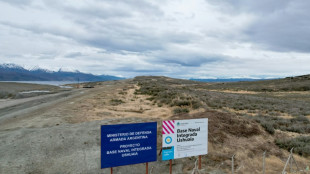
And wherever you travel in Argentina, there are constant reminders of the state policy: signs proclaiming "Las Malvinas son Argentinas," using the Spanish name for the Falklands and asserting ownership.
Murals also show the shape of the islands, often painted in the sky blue of the Argentine flag and with the words "We will return" emblazoned next to it -- a reference to the Argentine belief that it once had a settlement in the islands.
In many towns and cities, road signs specify the distance to the Falklands.
Every April 2, a day marking the Argentine invasion, school children sing the official 1941 hymn claiming the islands.
- Falklands bring Argentines together -
Throughout the country, football stadiums, towns, hundreds of roads and even the 50 pesos bill carry the name "Argentine Malvinas."
"Argentina is a complex country with many cracks, there are few issues that" bring people together, said Edgardo Esteban, director of the Malvinas Museum in Buenos Aires.
"The Falklands is one, it's like the national football team."
In a 2021 survey of 5,000 people, more than 81 percent said the country should continue to claim sovereignty over the islands. Only 10 percent said it should stop.
Governments also have been keen to continue, although not always in the same way.
Argentina has clung to a non-binding 1965 United Nations resolution that recognized a sovereignty dispute, dating back to the 1830s, and invited the Argentine and UK governments to negotiate a solution.
The South American country has been less enthusiastic to acknowledge the right to self-determination enshrined in the UN Charter -- and which the Falkland islanders exercised in 2013 when 99.8 percent of them voted to remain British.
Argentina long sought to achieve its claims by diplomatic means, but that was dramatically abandoned by the military dictatorship in its ill-fated 1982 invasion.
- 'A national claim' -
"What Europe cannot understand is how a people could hail the dictators" following the invasion, the 1980 Nobel Peace Prize winner Adolfo Perez Esquivel said recently.
"It was very difficult to explain that the Falklands were a national claim and not support for the dictatorship."
Following the war, which ended on June 14 with Argentina's surrender to a British expeditionary force sent by the government, there was a period when the issue was put on the back burner.
Diplomatic and commercial relations were reestablished in 1989, while the Argentines adopted an unsuccessful policy of trying to seduce the "kelpers," as the islands' inhabitants are known.
"But since 1982, the discourse on the Falklands has remained a prisoner to the scars of the war," said Esteban.
The Peronist governments of Nestor and Cristina Kirchner (2003-2015) used the Falklands issue as a rallying cry to drum up support, whereas the liberal Mauricio Macri (2015-2019) showed far less interest.
At the Malvinas Museum, created in 2014 under the government of Cristina Kirchner, the nationalist narrative is nourished for future generations.
And while the museum does mention the war, it prefers to focus on "geological unity," the "continental maritime shelf" or the pioneering presence of Argentine scientists in Antarctica to push its claims.
It even talks about elephant seals that have been traced making journeys between the islands and the South American continent.
Proof, it would seem, that even aquatic mammals support the Argentine claim to the Falklands.
E.Hall--AT