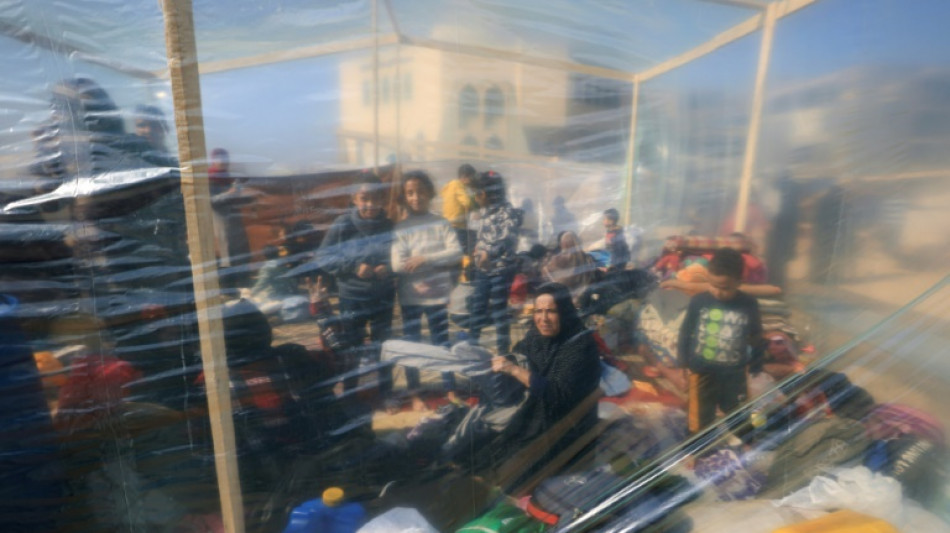
Displaced Palestinians forced to fend for themselves in Gaza's south / Photo: Mahmud HAMS - AFP

 Part of London's Oxford Street pedestrianised 'forever'

 Canadian youth seek climate action in landmark trial
 Trump blasts Norway over Nobel Peace Prize snub

 Japan PM vows swift response to wave of cyberattacks

 Stocks mostly rise before tech earnings, central bank calls
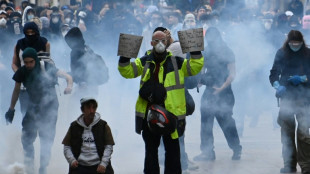 France's Macron to visit Marseille after protest violence

 German union slams Audi boss's appearance at Trump rally

 UK set for 'limited' budget giveaways as borrowing costs surge
 Anthropic's AI model accessed US voter data: Axios

 Malaysia's Johor reopens schools as haze eases

 Carragher says Fernandes benching was intended as public punishment

 Canada-EU summit seeks deepened alliance as US ties fray

 Senegal to host Youth Games, Africa's first ever Olympics
 ITV drama Adultery examines temptation, class and family consequences

 New levy on non-EU parcels kicks in November 1

 Saudi coalition says struck Houthi missile facilities after Riyadh airport attack

 Manchester United stand-in captain calls for change after Bournemouth loss

 Body recovered after ferry passenger reported overboard

 Dance in the Dark brings an immersive family adventure to Birmingham MAC

 China's Communist Party elite hold key talks on governance

 Redditch Santa fun run to return to Arrow Valley Park

 Obama links Trump trade policy to higher costs in Detroit speech

 Saudi coalition says intercepted missile after Houthis hit Riyadh airport

 'I feel so happy!': Ecstasy, relief among Brazil's Lula supporters

 Brazil's Lula clinches poll victory, Bolsonaro seeks to annul election

A plastic sheet rigged up as a tent, branches gathered from here and there to make a fire -- at the southern tip of Gaza, displaced Palestinians are settling in as best they can.
Thousands of Palestinians are fleeing Khan Yunis -- Gaza's main southern city, now surrounded by the Israeli army -- towards Rafah, less than 10 kilometres (six miles) away on the territory's closed border with Egypt.
Many among them had already been displaced once in recent weeks, heading south to escape heavy fighting between Israel and Hamas in the north.
"We arrived here with no shelter and got rained on last night. There isn't anything to eat -- no bread, no flour," Ghassan Bakr told AFP.
The grocery stores in Rafah, like elsewhere in Gaza, are empty. At the market, the farmers who can still cultivate their land sell tomatoes, onions, cabbages and other vegetables.
On a sidewalk, children throw themselves at a large pot of semolina prepared by a charity, scraping at the bottom with bowls and plastic containers.
Palestinians in the Gaza Strip are living in "utter, deepening horror", the UN's human rights chief said Wednesday, nearly two months after the start of the war, which has displaced around three-quarters of the territory's 2.4 million people.
The fighting was triggered by Hamas's bloody October 7 attack on Israel, during which 240 people were taken hostage and around 1,200 were killed, most of them civilians, Israeli authorities say.
The Hamas-run health ministry in Gaza said Tuesday that 16,248 people had been killed since Israel's campaign began, more than 70 percent of them women and children.
- 'No roofs, no walls' -
Makeshift tents have sprung up in the sandy wasteland between half-finished buildings, with lines strung between them for drying laundry.
All around are suitcases, stacks of firewood and displaced people wandering about with jerrycans, looking for water.
"There have been bombardments, destruction, leaflets dropping, threats and phone calls to evacuate and leave Khan Yunis, but to go where?" asked Khamis al-Dalu.
More than 80 percent of Gazans are either refugees or descendants of refugees who were driven out or left their land when Israel was founded in 1948.
"Where do you want us to go for God's sake?" Dalu continued, his temper flaring.
"We left Khan Yunis and now we're in tents in Rafah, with no roofs, no walls."
- 'Defenceless civilians' -
In Khan Yunis, the fighting continued on Wednesday. In otherwise deserted streets, a few remaining residents navigated the rubble left by Israeli strikes as the injured were ferried to hospitals.
"We were sitting and all of a sudden there was a strike. I was hit in the head by a falling stone," Hussein Abu Hamada told AFP.
"We're devastated, mentally overwhelmed," said Amal Mahdi, who also survived a raid. "We need someone to help us, to find a solution for us to get out of this situation."
On Wednesday afternoon, the Israeli army dropped leaflets over the city inscribed with a verse from the Koran: "And the flood seized them while they were wrongdoers" -- an apparent reference to the October 7 attack, dubbed Operation Al-Aqsa Flood by Hamas.
The Israeli army did not immediately respond to questions about the leaflets.
"What did we do wrong?" asked Umm Shadi Abu el-Tarabeech, in Rafah after being displaced from the north.
"We don't have guns, we're not terrorists and we haven't done anything bad. We're defenceless civilians. We've looked for refuge in one place after the other, and now they're dropping these?" she said.
"What is the purpose of these words?"
M.White--AT