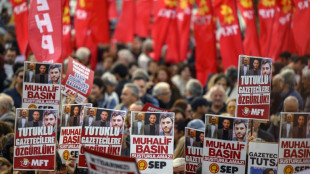
War brings hell to Gaza's pregnant women, nursing mums / Photo: Mai YAGHI - AFP

 Alexander Skarsgard and his viral 'Wicker' transformation

 Thousands protest in Turkey over journalists' arrests, media shutdowns

 Man City beaten by Aston Villa to end perfect Premier League start

 Luis Enrique says PSG unbothered by Lyon match switch
 US gymnast Richard wins floor exercise gold at worlds
 Moltzan upstages Shiffrin to win season-opening World Cup giant slalom
 Infantino says backed by 'vast majority' in bid for re-election

 Police fire tear gas as new French protests kick off

 Police fire tear gas as new French demonstrations kick off
 Tropical Storm Champi nears China after battering Taiwan, Japan

 'Weeks, not days' in Kompany recovery, say Bayern

 Unfair to compare us to Barca: Real Madrid's Mourinho
 North Korea's Kim makes unannounced visit to Chinese border city

 Fire breaks out at Hitler's mountain retreat, suspect arrested

 Marc Marquez wins Australian sprint as Martin crashes out
 North Korea's Kim calls for training world's 'strongest' military
 Brewers edge Rays to capture World Series opener
 France to deploy 70,000 police for fresh weekend protests
 Tatum delivers as Celtics down winless Knicks

 Romantasy fans ready for sleepless night as 'Court of Thorns and Roses' returns
 De Goede hat-trick as Canada defeat England again
 How to Build an Emergency Fund for Your Furry Best Friend

 5 Ways to Prepare Financially for Parenthood
 Ebola vaccine trial begins in DR Congo
 Travelling man Wade equals Prem try record

With eyes wide open and his tiny fists clenched tightly, Mohammed Kullab is just a few days old, having started life in Gaza amid the chaos of the Israel-Hamas war.
"Nobody should be born in such circumstances," sighed his mother Fadwa Kullab, who has sought shelter at a UN school building in Gaza's southern city of Rafah.
Kullab now has seven children but said Mohammed's "birth was the most difficult experience of my life".
Like other mothers of newborns AFP spoke to in Gaza, she said her baby son had been refusing her breast milk.
"I'm not eating well," Kullab said, stressing that she had successfully breastfed her other six children.
Breastfeeding mothers are advised to drink at least three litres (more than six pints) of water a day and eat well to produce sufficient milk -- but finding clean water and food in Gaza is becoming harder by the day.
The already poverty-stricken and long blockaded Palestinian territory was plunged into its worst ever war after its Hamas rulers launched their October 7 attack on Israel.
About 1,200 people were killed and 240 kidnapped, among them 35 children including a 10-month-old, Israeli officials say.
The war unleashed by the attack has seen Israel relentlessly bombard and besiege Gaza and launch a ground invasion.
More than 11,200 Palestinians have been killed, most of them women and children, according to the health ministry in Hamas-run Gaza.
Nearly two thirds of Gaza's 36 hospitals, already overwhelmed with war-wounded, have been knocked out of service due to a lack of fuel to power their generators.
Gaza City's biggest hospital Al-Shifa, packed with patients and displaced, is now inside a fierce urban combat zone, with its director reporting scores of dead buried in a mass grave in the complex.
Among those who died were seven premature babies in its disabled neonatal unit, Gaza's deputy health minister Youssef Abu Rish said.
- 'I could lose the baby' -
Countless new mothers in Gaza now fear the very worst, among them Kullab who said she feels helpless and unable to protect her children.
She has struggled to find baby formula and nappies, she said as she cradled her tiny son, swaddled in blankets.
Another woman, Najwa Salem, 37, said her newborn has jaundice, marked by yellowish skin and eyes. The condition can be worsened by low milk intake and dehydration and is often treated with daylight exposure.
To minimise the risk of neurological damage, Salem would like to take her infant boy outside, but said she hesitates because of the "rubbish piling up and the bombing".
Inside the UN school classroom Salem now shares with about 70 others, the mother worried because the scar from her Caesarian section had become infected.
Although she gave birth in a hospital, she said she was asked to leave after just one night "because they had too many wounded people to care for".
Outside, the huge amount of dust from the incessant bombing is causing breathing difficulties that spell special dangers for infants.
Another woman, eight-months-pregnant Umm Ibrahim Alayan, complained of coughing fits since she fled her neighbourhood as it was being bombarded.
Her intense coughing may have provoked the early contractions she has suffered, she said, her hands flitting nervously between her rounded belly and her face.
"I'm terrified, all I want to do is hold my baby in my arms," she said, sobbing. "I feel I could lose the baby at any moment."
- 'Utterly hellish conditions' -
The UN Population Fund's top official for the Palestinian territories, Dominic Allen, said pregnant women in Gaza "have nowhere to go, there is nowhere safe".
The UN says there are more than 50,000 pregnant women and an average of 180 births a day in Gaza, with a population of 2.4 million.
"We estimate that a minimum of 15 percent of these births will have complications, which will require basic or comprehensive obstetric care," Allen said.
The war is creating "a high-stress environment" likely to foster "complications of birth and may lead to miscarriages", he said.
The UN agency has cited the "nightmarish" case of one woman discharged just three hours after giving birth.
It said there were shortages of blood to treat postpartum haemorrhage and of antiseptic for stitches and treatment after umbilical cords are cut.
So far, the UN agency has managed to get 8,000 delivery kits into Gaza. They contain umbilical cord cutters, blankets for newborns, disposable sheets and other items.
But these only address a fraction of the need, and Gaza's health ministry says some women have been forced to give birth without a midwife in the overcrowded shelters.
"The nightmare in Gaza is much more than a humanitarian crisis, it's a crisis of humanity," said Allen.
One aid group still working in northern Gaza's heavily bombed Jabalia refugee camp is ActionAid, helping women inside the Al-Awda hospital which has been without power for days.
Surgeons there said they performed 16 C-sections on Sunday, without anaesthetic or other crucial supplies.
"Thousands of women in Gaza are risking their lives to give birth, undergoing Caesareans and emergency operations without sterilisation, anaesthesia or painkillers," said ActionAid's Riham Jafari.
"These women deserve quality healthcare and the right to give birth in a safe place. Instead, they are being forced to bring their babies into the world amid utterly hellish conditions."
T.Perez--AT