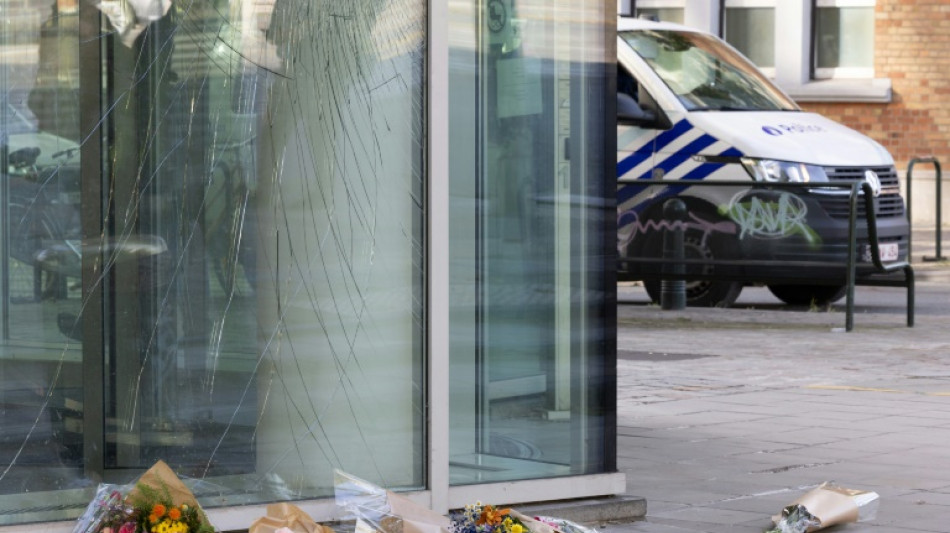
Deadly attacks put response of Europe's spies under spotlight / Photo: BENOIT DOPPAGNE - Belga/AFP

 Websites go dark as AI exposes critical security flaws
 Man Utd humiliated as Arsenal deny Bayern in Champions League
 Low-budget Brewers and Rays seek first World Series title
 Pitiful Man Utd display heaps pressure on Carrick
 Ohtani surgery 'not on the table': Dodgers chief
 eBay to slash 1,000 more jobs, around 9% of workforce
 Villa tame Viking to stay perfect in Champions League

 Tesla profits drop but top analyst estimates
 Angels drop Suzuki as manager after club's worst MLB season
 Washington orders US embassy staff, families to leave Saudi Arabia
 Musk's SpaceX results lift global stock markets
 NFL boss Goodell: Comfort level 'very high' for Paris game
 Fernandes laments 'mood of defeat' as Man Utd crumble in Como

 Maradona doctor was made 'scapegoat' for his death, Argentine court told
 Man Utd thrashed by Como in Champions League horror show
 UN experts urge Meta to safeguard political expression in Brazil election

 Websites go dark worldwide as AI exposes critical security flaws
 Defense in Maradona death trial seeks acquittal of doctor
 Jansen, Rabada put South Africa in sight of win over Australia

 Low Rhine weighed on German growth: central bank
 OpenAI says its AI agents disabled their own safety monitors
 Alldritt returns as France call up seven newcomers for Nations Championship
 UN issues call to arms to combat off-the-charts El Nino
 Nigeria Ebola case matches DR Congo strain
 Musk's SpaceX helps launch stock market gains
Two attacks in recent days in Belgium and France have come against a backdrop of tension in European societies over the war between Israel and Hamas, posing serious challenges for Europe's intelligence services.
First a schoolteacher was stabbed to death in northern France, with the attacker claiming the act in the name of the Islamic State extremist group.
Then, days later, two Swedes were killed in Belgium, prompting Swedish Prime Minister Ulf Kristersson to label it a terror attack and say his country was facing its biggest threat in modern times.
The country has sparked a wave of anger from Muslim countries after allowing protesters to burn copies of the Koran, Islam's holy book.
Analysts are warning that intelligence services now have their work cut out.
"It is likely that these attacks will be followed by several more as a snowball effect," said Tore Hamming, an analyst at the International Centre for the Study of Radicalisation in London.
"So far, all attacks appear to have been carried out by a single perpetrator and lacking sophistication. That could change, however."
- Germany arrests -
Each attack is all the more impactful because of the images posted on social media and the praise from sympathisers.
Hans-Jakob Schindler, director of the Counter Extremism Project NGO, pointed out that violence online can lead to violence on the streets.
He said Sweden was the focus of an online campaign by Islamists that was intensifying risks for the Nordic country.
The German authorities arrested two brothers from Syria in April, the eldest of whom had allegedly planned to "carry out an attack on a church in Sweden where many people (were) assembled".
"This demonstrates that this ongoing Islamist online campaign against Sweden has effects and motivates individuals towards violence," he said, pointing out that the Israel-Hamas conflict could have a similar effect.
Europe is not alone in facing such threats.
Last week, an employee of the Israeli embassy in China was assaulted in Beijing. A foreign suspect was arrested and authorities have not said anything about the case since.
On Sunday, a 71-year-old man stabbed a Muslim woman and a six-year-old boy near Chicago in the United States, an attack police said was linked to the Israel-Hamas conflict.
- 'Moment of reconfiguration' -
Schindler highlighted that Europe had a solid infrastructure in place to keep each other's agencies in the loop.
EUROJUST, the European Union Agency for Criminal Justice Cooperation, looks after the judicial side and EUROPOL the police side.
In theory, this allows a quick transfer of information around the bloc and a coordinated approach.
On Tuesday, though, European countries were applying their own criteria to the threat level.
Sweden and France are both on high alert.
Italy said it had "strengthened preventive measures" following the events in Israel, without elaborating.
In Denmark and Spain, the threat level has not been changed, official sources told AFP, but Spanish police said they had increased their presence "near places of interest such as synagogues".
A European judge, who spoke to AFP on condition of anonymity, said one-off cases generally led to a "fluid exchange of details in real-time" between EU countries.
But the judge warned that intelligence agencies were not overly keen to share widely, saying it was "often done bilaterally".
Among the biggest concerns, she said, were the Europeans who left to join the Islamic State group in Syria and Iraq in 2014.
Although they were convicted on their return, many have now served their sentences and intelligence agencies are worried they are re-forming old networks.
"It feels like a moment of reconfiguration," she said.
N.Mitchell--AT