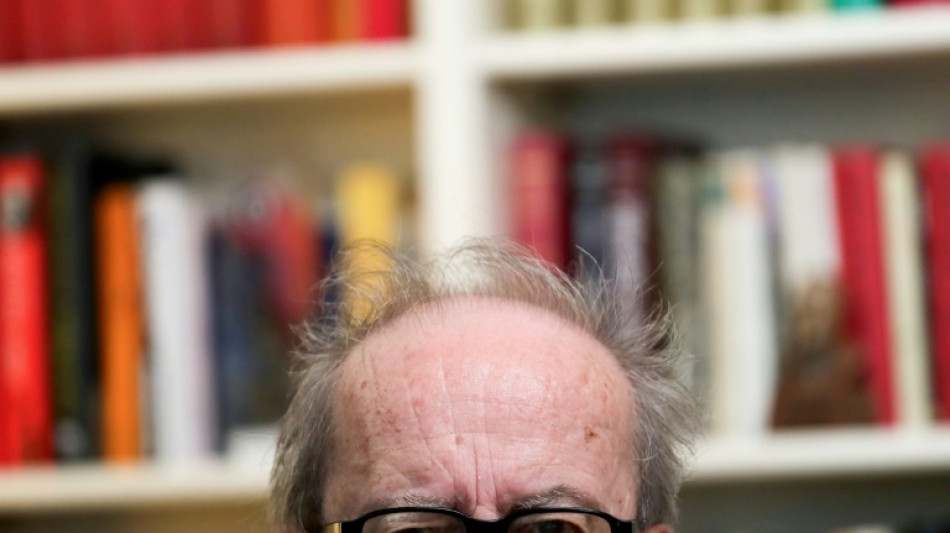
Writing triumphed over 'hell of communism', says Albania's Kadare / Photo: Adnan Beci - AFP

 UAE nominates official to lead UN

 NFL boss Goodell welcomes probe into Hurts medical care

 Musk threatens Democrats teeing up congressional probes

 In the Mexican town that makes emblematic Day of the Dead garlands
 Protests banned in parts of Paris as Macron swipes at Trump

 Judge orders Meta to pay $25 bn to New Mexico in Cambridge Analytica case
 Champagne puts cork in project to expand production area

 Canadian publisher says novelist Orelien used AI to write novel
 Trump faces fresh questions over ties to 'humanitarian' Putin

 Hansen back in Ireland squad for Nations Championship
 Kremlin sees little 'substance' in Ukraine peace ideas

 Top Arab-Israeli election candidate tells AFP Netanyahu win would be 'catastrophe'

 South African rugby player's death due to 'aortic dissection'
 France's Macron lands in Riyadh on surprise 'solidarity' visit

 Around the world, far right blames immigrants for French protests

 South Africa eases fuel pain as growth slows

 Woody Allen shoots new movie in Madrid
 Nvidia's Huang urges Europe to go all in on AI

 Five things to know as French bond yield tops 5%
 'Complete threat' Ngumoha excites Liverpool captain Van Dijk

 'The fishing's terrible': Deforestation devastates C.Africa river

 France's tourism sector worried about impact of riots

 Macron takes aim at Trump for using France riots for election gain
 North Korea says 'new firepower units' in place, loudspeakers to return

 Indonesia leader hits out at market downgrade warning
Acclaimed Albanian novelist Ismail Kadare has talked about being smothered by "the hell of communism" and how writing helped him survive one of the worst dictators in the old Eastern Bloc.
The veteran writer -- an eternal bridesmaid for a Nobel literature prize -- was awarded France's highest honour Monday.
Despite being branded a traitor by Albania's communist leaders when he defected to France in 1990, Kadare was accused by some of enjoying a privileged position under Enver Hoxha, who presided over Europe's most paranoid and isolated regime.
But the author of "Broken April" and "The General of the Dead Army" told AFP those years were "hell" -- a living nightmare from which he forged some of his greatest works.
"The hell of communism, like every other hell, was smothering in the worst sense of the term. But literature transformed that into a life force, a force which helped you survive and hold your head up and win out over dictatorship," said the 87-year-old.
Several writers and artists were imprisoned and even executed under Hoxha's murderous rule. Kadare -- who came from the same small town and was made a member of parliament -- escaped prison but was targeted by the secret police.
He was sent into internal exile in 1975 after publishing a satirical poem called "The Red Pasha", a clear reference to the dictator.
In her memoirs, Hoxha's widow Nexhmije claimed the tyrant -- who fancied himself as a man of letters -- protected Kadare from other hardline Stalinists who wanted the head of the "bourgeois" writer.
His defenders say Kadare's genius was using allegory and metaphor to depict the horrors of what was going on around him in almost impossible circumstances.
- 'Always been true' -
"Writing under a dictatorship is very difficult, almost impossible, because it is impossible to write as you want to write," he told AFP.
"Which is why I am so grateful for literature, because it gives me the chance to overcome the impossible.
"I have always been true to my writing," he insisted. "It was the absolute goal of my life and it helped me get over all the difficulties. When art survives it triumphs," he said.
Kadare, who was made a grand officer of France's Legion of Honour by President Emmanuel Macron, drew a comparison with the late dissident Czech writer Milan Kundera, who also had to deny allegations he collaborated with the communists who banned his work.
"As Kundera said, 'Art never triumphs with its head bowed.'"
Kadare previously said that his fame both protected him and made him suspect.
Files from Hoxha's feared secret police the Sigurimi showed that he and his family were continually followed and persecuted.
Indeed recently uncovered papers quote Hoxha as describing the writer as a cursed "raven of doom" who brought him bad luck.
- Haunted by Hoxha -
That has not stopped some critics dismissing him as the "official dissident" the regime tolerated.
Yet several of Kadare's works written under Hoxha took aim at authoritarianism, often through the oblique lens of the Ottoman empire, which occupied Albania for five centuries, or classical allusions.
"The Palace of Dreams", published four years before the dictator's death in 1985, was banned as a veiled attack on the Politburo but not before it had become a bestseller.
Kadare said writers "must serve freedom". "The truth is not in my acts but in my books, which are a real literary testament," he told AFP in 2019.
Hoxha's looming presence haunts several of the writer's works, mostly notoriously "The Successor" which delved into the murky death of the dictator's closest ally, Mehmet Shehu, who was later denounced as a "foreign agent".
"Literature is my great and only love," Kadare told AFP in his Tirana apartment. "It has given sense to my life, given me courage to resist, happiness and the hope to overcome everything."
And he said he has never lost his appetite for storytelling.
"I write all the time. I write down ideas, little stories... Every time something is published it is like being born again, and it has always been like that for me.
N.Walker--AT