World leaders seek to contain Israel-Hamas war, protect civilians / Photo: Sophie RAMIS, Nalini LEPETIT-CHELLA - AFP

 Judge orders Meta to pay $25 bn to New Mexico in Cambridge Analytica case
 Champagne puts cork in project to expand production area

 Canadian publisher says novelist Orelien used AI to write novel
 Trump faces fresh questions over ties to 'humanitarian' Putin
 Hansen back in Ireland squad for Nations Championship
 Kremlin sees little 'substance' in Ukraine peace ideas

 Top Arab-Israeli election candidate tells AFP Netanyahu win would be 'catastrophe'
 South African rugby player's death due to 'aortic dissection'
 France's Macron lands in Riyadh on surprise 'solidarity' visit

 Around the world, far right blames immigrants for French protests

 South Africa eases fuel pain as growth slows
 Woody Allen shoots new movie in Madrid

 Nvidia's Huang urges Europe to go all in on AI

 Five things to know as French bond yield tops 5%
 'Complete threat' Ngumoha excites Liverpool captain Van Dijk

 'The fishing's terrible': Deforestation devastates C.Africa river
 France's tourism sector worried about impact of riots
 Macron takes aim at Trump for using France riots for election gain
 North Korea says 'new firepower units' in place, loudspeakers to return

 Indonesia leader hits out at market downgrade warning

 Macron slams 'stupid' comments based on AI videos by leaders on France riots
 'Public health crisis': Indonesians seek fire relief from state
 British Museum sells second set of Bayeux exhibition tickets
 Australian lawmaker loses both legs after 'targeted' attack
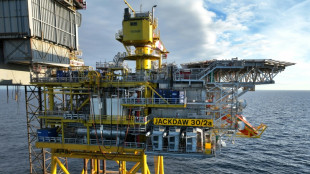 UK approves drilling in controversial Jackdaw gas field

As Israel prepares for a ground offensive into the Gaza Strip, the international community has mobilised to try to protect civilians and prevent the conflict spreading across the region.
But Israel's avowed determination to crush Hamas, the group behind the October 7 attack on Israel, are hampering mediation efforts. So too are clashes along Israel's northern border with Lebanon.
- A multitude of players -
Among the most active international players is the United States, whose Secretary of State Antony Blinken started a tour of six Arab countries on Friday, visiting Jordan, Qatar, Bahrain, the United Arab Emirates, Saudi Arabia and Egypt.
Washington, like its European allies, is concerned to avoid the opening of a second front with the Iran-backed Hezbollah militia in Lebanon. But they have been clear in their support for Israel's right to defend itself.
Egypt, Qatar and Turkey are also trying to contain the crisis. All have good relations with Israel and experts think they will have some influence over Hamas.
China and Russia have been more critical of Israel's response to the attack. But they might have some influence over Iran, Israel's sworn enemy, to prevent the conflict spreading.
Tehran has long supported Hezbollah and Hamas.
But there are numerous diplomatic fault-lines, as became clear at Friday's United Nations Security Council meeting, where Russia blamed the United States for the situation in Gaza.
European Council president Charles Michel has called a video-summit of European Union leaders for Tuesday to seek a joint position on the war.
Rym Momtaz, at the International Institute for Strategic Studies (IISS), says we should not expect much.
"Expectations are low for what they can concretely achieve," she wrote in an online analysis.
"In recent years, the eruption of Israeli-Palestinian conflicts has sidelined European diplomacy more than it has for the Americans, Egyptians, Qataris and Turks."
The EU's 27 leaders on Sunday acknowledged Israel's right to defend itself in the face of Hamas's attacks but also underlined the importance of protecting all civilians at all times, in compliance with international law.
- Preventing second front -
There are calls for Lebanon, which has already suffered from past wars with Israel, to stay out of the conflict.
"The situation is extremely dangerous," said a French diplomatic source, of the rise in clashes between Hezbollah and the Israeli army.
Paris, like Washington, has called for restraint from Hezbollah and Iran, with President Emmanuel Macron on Sunday warning Tehran "against any escalation or extension of the conflict".
UNIFIL, the UN peacekeeping force deployed in a buffer zone between northern Israel and southern Lebanon, on Sunday "reported intense exchanges of fire" along the Blue Line between Lebanese territory and Israel.
Iran's foreign minister, Hossein Amir-Abdollahian, warned on Sunday that no-one could guarantee control of the situation if Israel launched a ground offensive in the Gaza Strip.
"Yes, there is a risk that things will get out of control," said Hasni Abidi, director of the Geneva-based Center for Arab and Mediterranean Studies and Research, even if a flare-up along the Blue Line was not in Lebanon's interest, given the major domestic problems with which it is already grappling.
- Protecting Gaza's civilians -
From Pope Francis to international aid agencies and several European countries, there have been growing calls for the opening of humanitarian corridors in and out of Gaza.
Aid for civilians in Gaza is blocked in the Egyptian Sinai, currently the only border crossing with the Gaza Strip.
Egypt has been particularly involved in this issue, fearing a humanitarian crisis that would oblige it to take in hundreds of thousands of refugees from Gaza.
Cairo, historically a key intermediary between Israel and Hamas, faces growing pressure to allow foreigners trapped in Gaza to enter Egypt.
It has set conditions, including clearance to send aid into Gaza through the Rafah border crossing that it controls, according to well-placed sources.
Brazil, which holds the rotating presidency of the UN Security Council, has appealed to Israel to establish a humanitarian corridor so people in Gaza can flee to Egypt.
"Children must never be held hostage, anywhere in the world," Brazilian President Luiz Inacio Lula da Silva said, urging Hamas to free Israeli children taken hostage.
"Israel needs to stop its bombing so Palestinian children and their mothers can leave the Gaza strip via the Egyptian border," he said on X, formerly Twitter.
Israel cut off fuel, electricity and water to Gaza but has since said it is renewing water supplies to the southern part of the enclave.
- Release of hostages -
Several initiatives, notably by Turkey, Egypt and Qatar, are underway to secure the release of Hamas hostages trapped in the Gaza Strip, alongside hundreds of thousands of Palestinians.
An official Turkish said President Recep Tayyip Erdogan launched talks with Hamas after it threatened to kill them.
Ankara deems Israel's call for the civilians to immediately evacuate Gaza City is "unacceptable", the source added.
Qatar, which has negotiated past hostage releases, has also started discussions with Hamas. Russia's Middle East envoy Mikhail Bogdanov is expected in Qatar in the coming week.
"Qatar can pressure the members of the Hamas political bureau, but they are looked down upon by Gaza-based leaders because they live a luxurious lifestyle in Qatar," said Michael Horowitz, geopolitical analyst for consultancy Le Beck International.
"Egypt has always played a key role and I think may be in a better position to pressure both sides."
- Unlikely ceasefire -
Several resolutions are under consideration before the UN Security Council, including a Russian one calling for a "humanitarian ceasefire".
China's Middle East envoy will travel to the Middle East next week to promote a "ceasefire" as well as "peace talks".
But the chances of success are almost zero at present, according to Horowitz.
"It is far too early to talk about a ceasefire and I doubt Israel will listen to anyone who even mentions the need for a ceasefire," he said.
"The country is in the same state of shock and anger the US was after 9/11," he said.
Denis Bauchard of the French Institute of International Relations (IFRI) agreed. Before any mediation can happen, Israeli Prime Minister Benjamin Netanyahu will want, "for domestic political reasons, to appear as the strong man" who will win the war, he said.
E.Hall--AT