US genocide designation brings little comfort to Rohingya camps

 New four-lane bridge opens between China, North Korea

 Tech stocks lead rout after US inflation fuels rate hike bets

 'No time to recover': UNDP chief sounds alarm on growing poverty after Iran war shock

 Australia says won't let big tech have 'unfettered' access to kids

 Mobile clinics battle Mongolia's childhood dental 'disaster'
 Wallabies back Meredith as playmaker for second New Zealand Test

 Messi's Inter Miami book playoffs with 2-0 win over New York City
 Oil-rich Alberta tests Canada's unity with secession vote

 EU leaders head for showdown over bloc budget
 All Blacks make three changes for second Wallabies Test

 Spider Labs: 75.0% of Bot-Classified Ad Clicks Lacked Basic Browser Automation Signs

 PSG 'got lucky' to win Man City thriller, says Luis Enrique

 Real Madrid comeback stuns Roma as Mourinho enjoys happy reunion
 Shakhtar make winning start at new Champions League 'home'

 Hat-trick hero Barcola primed to shine for Liverpool: Iraola

 Villa put six past Fenerbahce in record rout
 US stocks fall after hot inflation report as leading AI shares tumble
 Government buildings torched in violent Albanian protests
 Wall Street grills Bank of America over money laundering fine

 Mekies extends contract as Red Bull team principal until 2031

 Indonesia rescues starved orangutan from fires: officials

 Real Madrid's Vinicius banned for Clasico after red card

 Restrictions expose Ukraine's Starlink dependency in Russia war: observers
 Espada out as Astros manager while Mattingly stays with Phillies

 Houthis say targeted Saudi oil giant Aramco, vow more attacks

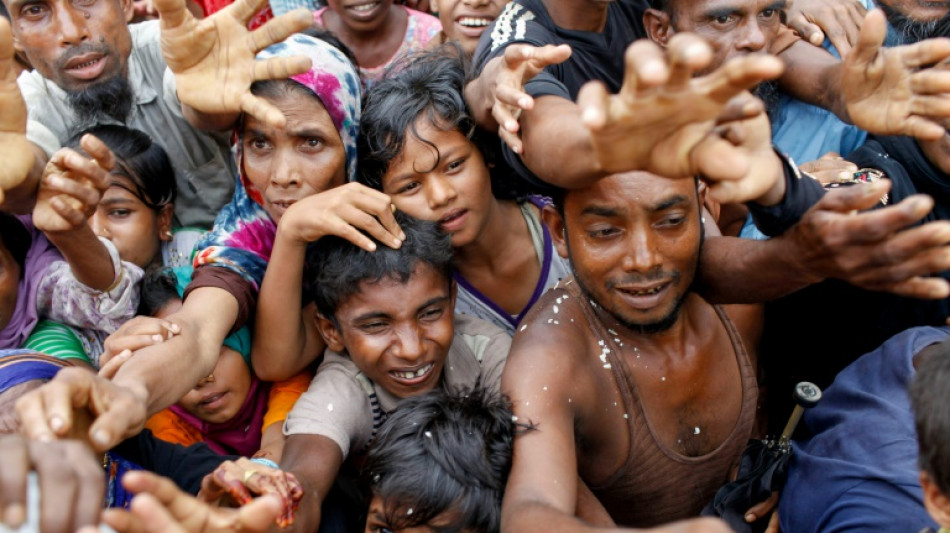
The US decision to brand a crackdown by Myanmar's military against the Rohingya minority as genocide is a victory for human rights campaigners but will do little to alleviate the suffering of those still languishing in camps, activists say.
Hundreds of thousands of the mostly Muslim Rohingya community fled the Buddhist-majority country for Bangladesh in 2017, bringing stories of rape, murder and arson, while another 600,000 remain in refugee camps in junta-ruled Myanmar.
On Sunday, Washington said the violence amounted to genocide and crimes against humanity, with media reporting the decision could be followed by further sanctions and limits on aid, among other penalties against the already-isolated junta.
Thin Thin Hlaing, a Rohingya rights activist welcomed the move.
"I feel like we were living through a blackout but now we see a light, because they recognise our suffering," she told AFP.
But she added: "My parents, my sister and my niece still have to live in camps in bad conditions and with no standard of human rights."
More outrage towards Myanmar's military -- already an international pariah -- will do little to change the wretched conditions many Rohingya live in, said David Mathieson, an analyst formerly based in the country.
"It's hard to see how it (the designation) will improve the lives of people who have suffered from crushing state repression and extreme violence," he said.
"The Myanmar military didn't care about the accusations when they started, and given they're now fighting almost everyone else in the country, I doubt this finding will affect them in any way."
Since ousting Aung San Suu Kyi's government last year, the junta has doubled down on widespread perceptions that the Rohingya are interlopers from Bangladesh and continues to deny them citizenship, rights and access to services.
Junta leader Min Aung Hlaing -- who was head of the armed forces during the 2017 crackdown -- has dismissed the word Rohingya as "an imaginary term".
Any sanctions that may follow Washington's designation are also unlikely to damage or dislodge the generals behind the crackdown, Mathieson added.
"Short of the US either actively blocking arms sales... or supplying anti-aircraft assistance to the resistance as they're doing in Ukraine, then Washington has little leverage or punitive options it can exert," he said.
- Suu Kyi -
The designation also makes uncomfortable reading for a shadow "National Unity Government" (NUG) dominated by lawmakers from Suu Kyi's ousted party, which is working to overturn the coup.
Her National League for Democracy was in power during the 2017 crackdown and her government's handling of the crisis deeply tarnished her reputation abroad.
Her office denied claims that fleeing refugees had suffered rape, extrajudicial killings and arson attacks on their homes by Myanmar troops.
When a genocide case opened at the Hague-based International Court of Justice (ICJ) in December 2019, the Nobel laureate travelled to the court to defend the generals, who a little over a year later would oust her government and plunge the country into turmoil.
Last year, the NUG invited Rohingya to "join hands" to end military rule, promising to repatriate those who fled to Bangladesh and grant citizenship to the minority.
But it holds no territory and has not been recognised by any foreign government, leaving hundreds of thousands of Rohingya at the mercy of authorities on either side of the Myanmar-Bangladesh border.
"Unfortunately, the determination itself by the United States won't help bring Rohingya home," Manny Maung, Myanmar researcher at Human Rights Watch told AFP.
"But I hope this is an indicator that the Rohingya will finally have a path towards seeking justice for what has been done to them."
The determination "should have been done way before," said one Rohingya at a camp for those displaced by the crisis near Sittwe, the capital of Myanmar's western Rakhine state.
"I believe the US decision will help" the Rohingya's case at the ICJ, he said, speaking on condition of anonymity.
Asked about the impact on day-to-day life in the camp of wooden huts at the end of a potholed road, he replied: "I don't know."
J.Gomez--AT