Indigenous troops guard Australia's vast north / Photo: DAVID GRAY - AFP

 Saudi airport closure disrupts life in kingdom's capital
 Ramaphosa tells South Africa to prepare for loss of US-Africa trade deal
 France presses resale platforms to remove 'stolen' goods after unrest
 Yamal v PSG: Ballon d'Or backdrop to Champions League showdown
 Araujo says too soon to talk about permanent Liverpool move
 US wants to be 'strong partner' for central Asia: Rubio
 'Special' to face friend Perez in Champions League, says Liverpool's Iraola
 Monitor says Indonesia fires have burned nearly two million hectares
 French PM says could declare state of emergency over unrest 'if needed'
 Albanian PM warns of 'red line' after days of unrest
 Putin, Xi and Trump could meet at APEC summit: Kremlin

 Microsoft exits data centre deal in blow to UK AI ambitions
 European stocks retreat as France violence spreads
 North Korea warns 'grave situation' prevailing along border
 Raya proud of Arsenal's 'incredible' reaction after third straight win

 Indonesia fires have burned nearly two million hectares: monitor
 Australian lawmaker 'critically' hurt in attack, officials say
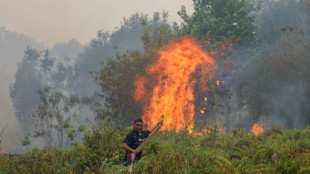 Indonesia fires burned over 1.9 mn hectares through September: monitor
 Asian tech stocks mixed after Wall St losses, eyes on earnings
 China's third-quarter growth narrowly beats forecasts
 Asian stocks start week on back foot, tracking tech-led Wall St losses
 China growth narrowly beats forecasts

 Faith and fury: Texas Senate rivals offer contrasting visions
 Women await justice for police killings in Brazil
 The painstaking task of cataloguing the world's species

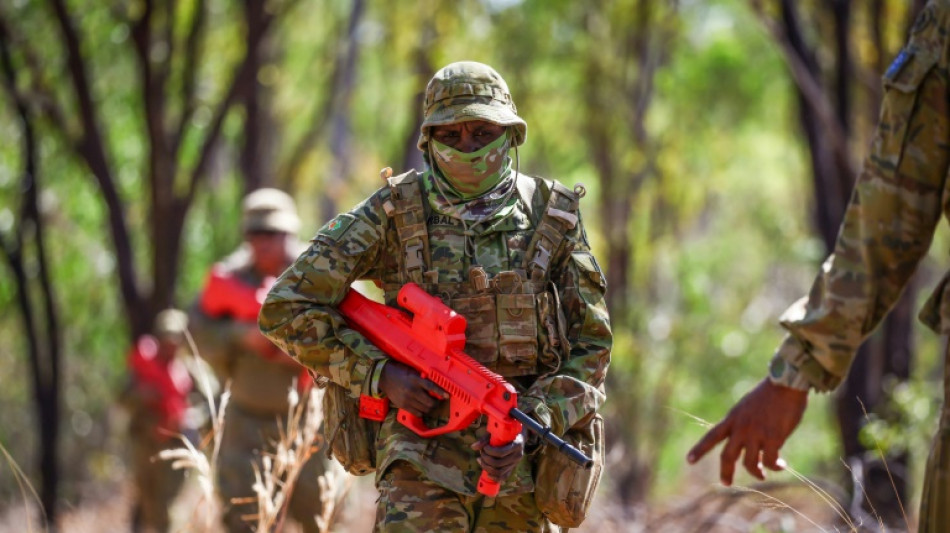
In the scorching heat of Australia's far north, the next generation of Indigenous army leaders crawl almost unseen through red dust, past towering termite mounds and eucalyptus trees.
Just over a century ago, their ancestors were banned from fighting for their country but these men and women are now training in Darwin to become patrol commanders.
The soldier at the rear uses the leaves of a small tree branch to brush the group's bootprints from the soil, erasing all traces of their presence.
The Indigenous soldiers are among 1,300 troops responsible for guarding just over half of Australia's landmass, an area larger than India.
They are from the North-West Mobile Force (Norforce) and 51st Far North Queensland Regiment.
Along with Western Australia's Pilbara Regiment, they make up the Regional Force Surveillance Group.
In the unlikely event that the north of Australia is invaded, they would conduct covert surveillance, feeding information to those coordinating a response.
But much of the group's peacetime work is border protection, looking for signs of smuggling, poaching, drug running and illegal fishing.
- Deadly wildlife -
Indigenous people have lived in Australia for at least 60,000 years.
Their knowledge of the land and local contacts mean they quickly notice anything amiss -- a discarded fishing net, animal remains, even money coming in.
"I know how to take care of myself when I'm in the bush," said Norforce Lance Corporal Carl Murkun, 34, from Gapuwiyak in north-east Arnhem Land.
"It's really natural to me."
The surveillance group can never hope to cover such a massive area alone, so they rely on contacts within remote communities who trust them with information.
A small group of soldiers can be sent to these communities to build networks or to check on assets such as fuel supplies, rural roads or landing strips.
Soldiers must be able to cope with extreme weather and deadly wildlife for up to three weeks.
They rely on skills passed down from ancestors -- hunting, tracking and the ability to read the environment and work with it.
Major Rob Watchorn, who commands the Indigenous Development Wing, said the First Nations soldiers' knowledge of the environment is valuable.
"What I depend on is the people with the intimate knowledge to be able to answer my questions and influence how I plan activities," Watchorn said.
- 'Bad track' -
Lance Corporal Murkun spent much of his childhood sleeping in the wilderness with his parents, dealing with snakes and crocodiles.
He decided to join the army after realising he was on a "bad track", struggling with alcohol and violence.
"Now I'm a clean man, a clean person and I don't like violence any more."
First Nations soldiers make up just over three percent of the Australian Defence Force -- about the same proportion as in the wider population -- but in these units, they represent up to 40 percent.
Cultural adviser Lieutenant Colonel Eileen Hall's job is to bridge the gap between military command and Indigenous communities.
With a First Nations mother and an Irish father, Hall describes herself as "blessed to walk within two worlds".
When the army recruits an Indigenous soldier, it also negotiates with their family and wider community, she said.
"We take the community on that journey."
First Nations Australians often have poorer education records and, if they live in an isolated community, the nearest high school may be too far away for them to attend.
They are statistically far more likely to end up in jail than other Australians.
Ordinary details like date of birth can also be hard to confirm, notably due to a government policy that forcibly removed Indigenous children from their families during much of the 20th century.
- 'Look after country' -
Commanding officers can often help overcome such hurdles, but there is no guarantee.
Many remote First Nations communities share mobile phones, and the nearest reception could be many miles away.
Since British colonisation more than 200 years ago, Indigenous Australians have struggled against discrimination, even when it comes to military service.
When Australia entered the First World War in 1914, it banned "Aborigines, half-castes and all coloured men" from service.
The rules were relaxed in 1917 as the need for reinforcements became desperate.
Despite not being allowed to vote or receive veterans' benefits, around 6,000 First Nations Australians served in World War II.
Murkun is like many other First Nations soldiers -- he follows his grandfather, who fought the Japanese in the Pacific.
Hall said First Nations people are also drawn to the military out of a sense of duty to the land.
"Part of that obligation is looking after and protecting because if I don't look after country, country won't look after me.
"And it doesn't just affect me, it affects my whole bloodline."
A.Ruiz--AT