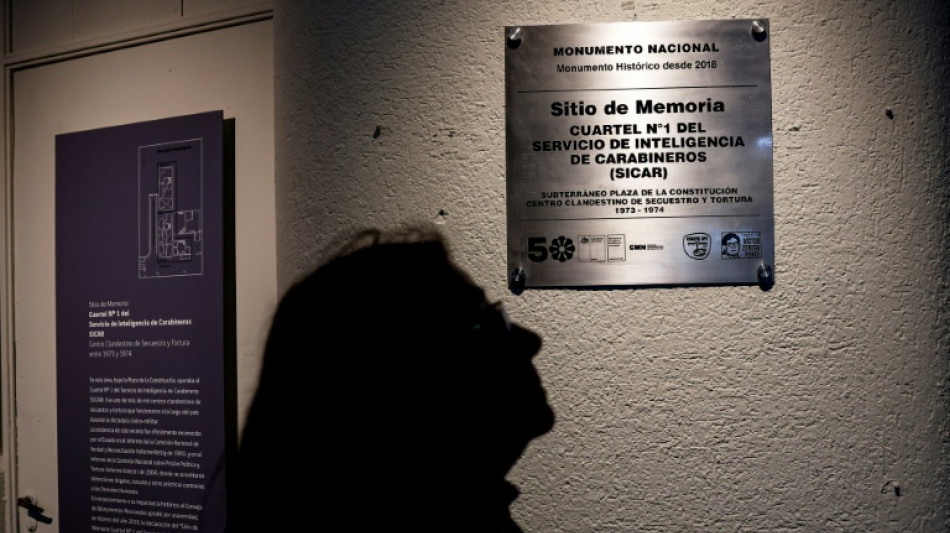
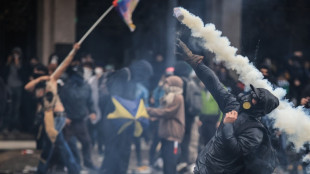
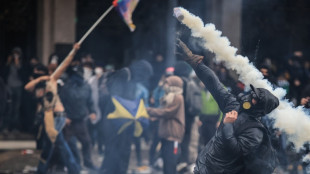
50 years later, wounds of Pinochet regime are still raw / Photo: Martin BERNETTI - AFP

 Trump's new press secretary says China lacked 'proper' toilets
 India closes down New Delhi park ahead of 'cockroach' movement rally

 'Let us build': World Bank chief outlines jobs-led development agenda
 Broncos top Super Bowl champion Seahawks in overtime

 Brilliant Brewers sweep Dodgers to reach World Series

 Brewers complete Dodgers sweep to reach World Series
 High-flying Freiburg try to shut out the noise as fairytale run continues

 Flamengo secure 0-0 draw in La Plata in Copa Libertadores semi
 The final lap? Two days on the campaign trail with Trump
 Asian stocks rise as tech bounces from rout, eyes on Warsh
 Saudi organisers say 2027 Asian Cup 'on schedule' after attacks

 Right-wing Brazil influencers on 'mission' to seal Bolsonaro win

 Using AI to help find Mexico's legions of missing children

 Fiji to deploy solar-powered Australian military drones at sea

 InterContinental Hotels Group PLC Announces Transaction in Own Shares - October 16

 Lawmakers Demand Menhaden Cuts Before Chesapeake Bay Science Is Complete, Ignoring Already Struggling Workers

 Wallabies coach has 'faith' as All Blacks juggernaut awaits

 Ailing UK director Mike Leigh wishes he could make '100 more films'

 Pixagram Announces Free Account Creation for 250 New Users Daily Through 2026
 Macron warns urgent to strike EU budget deal before French vote runup
 Zelensky rallies European allies as Trump ties slump

 Guardians edge Rays to seize MLB playoff series lead
 Trump scraps plan to livestream execution after fierce backlash

 Martinez apologises for outburst at Man Utd hierarchy

 Houthis launch deadly attack on presidential palace in Yemen's Aden

In the basement of the presidential palace in Chile's capital, Patricia Herrera was detained and tortured for months before being sent into exile. It was early in a military dictatorship that would kill or cause the disappearance of thousands of people.
Fifty years after the US-backed coup that snuffed out Chile's democracy, the wounds from all that suffering are still raw.
- Torment -
As she returned from class at the university, Herrera was detained by officers in plain clothes because she was "a woman and a socialist." She was 19.
Herrera was taken, blindfolded, to the basement of La Moneda, as the presidential palace is called. It was then also known as "El Hoyo," or the pit, as it was one of the first detention and torture centers set up by General Augusto Pinochet's new regime after the ouster of Socialist president Salvador Allende on September 11, 1973.
Allende committed suicide rather than be captured.
"From the very first night we got there, there was sexual humiliation. At first I thought it was just the guard who was overdoing it with me. I did not think it was an established thing that women had to suffer sexual, in addition to political, violence," said Herrera, now 68 and a historian.
Herrera was held for 14 months at the palace and in two other buildings in Santiago that were converted into torture centers by the Pinochet regime. She was then sent into an exile that would last 15 years, first in France and then in Cuba.
Two commissions created to study the dictatorship concluded that at least 38,254 people were tortured under the Pinochet regime, which lasted until 1990.
The basement in the presidential palace where Herrera was held was also known as Cuartel, or barracks, N°1 and is now used as office space. People taken there blindfolded could identify it because of its curved wall.
On August 30 of this year, the current president, Gabriel Boric, had a plaque installed in the basement space to mark the horrors endured by around 30 people who were held there.
"We want to put up a marker for everyone to see," Herrera said, "that here, in the political heart of the nation, there was a torture center."
- Disappearance -
Agents of the dictatorship killed 1,747 people, and detained and made another 1,469 disappear, according to an official government tally.
While 307 of the disappeared have since been identified, the other 1,162 remain missing. Fifty years later, their families still wonder where they are.
In 1974, when Pinochet's police detained a man named Luis Mahuida -- a 23-year-old university student active in leftist politics and the father of two young daughters -- they also brought an abrupt end to the childhood of his sister Marialina Gonzalez, who was then nine years old.
Their mother, Elsa Esquivel, spent all her time looking for her son; it was a full-time occupation. Marialina Gonzalez looked after her brother's daughters, who were three and 11 months old when he vanished. "I stopped playing with dolls. My nieces were dolls for me," said Gonzalez.
She never finished her education. She went to hundreds of places asking for her brother. Gonzalez even staged a hunger strike and recalls being arrested several times while taking part in protest marches in honor of missing people.
She regrets the childhood she never had. "I was not capable of saying: 'Stop, let me be. I want to go out dancing. I want to have friends.' I kept quiet," she said.
Now 59, she dedicates herself to caring for her elderly mother and expects to carry suffering with her into her own old age. "There is no closure just because my brother is still missing. There will be no closure."
- Exile -
The dictatorship triggered the biggest migratory movement in Chilean history. Just over 200,000 people went into exile, according to the non-governmental Chilean Human Rights Commission.
Employees of the Allende government, union leaders, workers, students and farmers left the country, taking their families with them. Sweden, Mexico, Argentina, France and Venezuela were the main recipient countries.
Most of the exiles were able to return home starting September 1, 1988, when the regime issued a decree allowing them back, a year and a half before the dictatorship ended.
A communist activist named Shaira Sepulveda was tortured in secret prisons called Villa Grimaldi and Cuatro Alamos. After her release she left in 1976 for France, along with her husband at that time. She left relatives and friends in Santiago.
"My family was here, my sister, my parents. But what really hurt was having to go to a country where you are a nobody," Sepulveda recalls.
She returned to Chile 17 years later with two children, but again her family was broken apart. The eldest child could not adapt to life in Chile and returned to Europe.
"I am an old woman, so my grandchildren there will barely know me," said Sepulveda, who is 74.
H.Thompson--AT