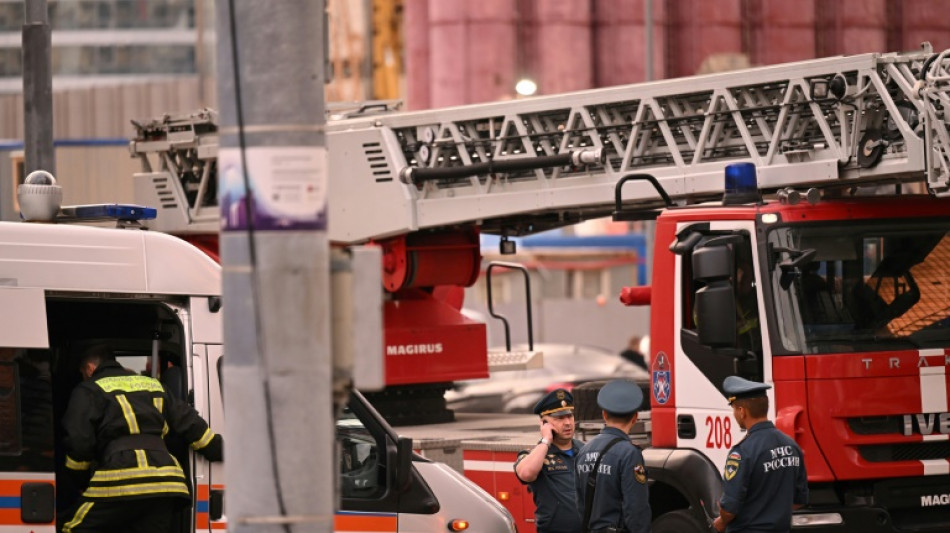
Moscow residents learn to live with drone strikes / Photo: NATALIA KOLESNIKOVA - AFP

 PSG outgun embattled Man City in six-goal Champions League thriller

 In Chicago, pope's hometown, Catholics express shock and support

 Musk suggests US govt behind any slowdown in Ukraine's Starshield system

 Chiclayo prays for recovery and return of the 'Peruvian pope'
 Barcola scores hat-trick as Liverpool hit LASK for six

 Healthy corals help bleached neighbors regain color: study

 Hope ton helps West Indies level T20 series at 2-2 in India

 Ukraine war reaches shores of Bulgarian fishing village
 Brazil probing 'criminal' origin of forest fires: minister to AFP

 Sally Rooney books cannot be sold in UK amid Palestine Action ban: publisher
 Italian ski stars Goggia and Brignone to miss season opener
 Bournemouth boss Rose urges Cherries to bounce back from Chelsea 'slap'
 Top seed Sabalenka falls at first hurdle in Wuhan

 FX Junction Brings Copy Trading to Everyone, While Their Money Never Leaves With Their Broker

 Brighton defender Struijk's red card overturned

 Saudi league postpones three matches after Houthi attacks
 US consumer inflation up more than expected as midterms loom

 Canadian publisher supports novelist Orelien after AI denial
 Medvedev sees off Tsitsipas to reach Shanghai Masters quarters

 Louvre boss warns of closure risk without major renovations
 Lawes and Genge urge England to end ban on overseas-based players

 Metrika Selected by OCC to Support Stablecoin Supervisory Framework Under the GENIUS Act
 Kenya hosting 2029 World Championships will help doping fight, says Coe
 UK prosecutor tells jury Russell Brand a 'sexual predator'
 Fulham manager Arbeloa fined £25,000 after Man Utd outburst

Strolling in Moscow on a summer's day as pop music blared from a cafe, Tigran is one of the capital's residents who say they have come to terms with a surge in Ukrainian drone attacks.
Day-to-day life in the city of some 12 million people has changed little since the Kremlin launched large-scale hostilities in Ukraine last February, upending the lives of millions of Ukrainians.
But a recent uptick in aerial assaults have hit the capital's financial district, ripped holes in commercial buildings and even struck the Kremlin, a reminder of hostilities playing out hundreds of kilometres away.
Still, some residents have accepted with a shrug the ripple effect of the conflict in Ukraine.
"Living in Moscow isn't scary," Tigran, a sunglass-wearing 40-year-old who declined to give his last name, told AFP. "I feel safe."
- 'Stay alert' -
The attacks point to a broader phenomenon of how crucial drones have become for both sides, being deployed on an unprecedented scale for reconnaissance and precision artillery targeting.
Ukrainian President Volodymyr Zelensky, whose country has weathered waves of assaults from Iran-made attack drones, warned late last month that "war" was coming Russia.
In the weeks since, Moscow has suffered at least eight aerial attacks that Russian authorities have blamed on Kyiv.
Residents voiced confidence in the military's ability to intercept them.
Konstantin, a 70-year-old retiree who also declined to give his last name, told AFP he felt "absolutely calm", citing his trust in the army.
"There are enough personnel and equipment," he said, referring to air defence systems around Moscow.
Authorities have reported those systems increasing ability to repel the wave of assaults, and have claimed the drones have caused relatively little damage.
Since the Kremlin strike in May, the Russian defence ministry has said most attacks have been foiled by electronic air defence systems.
"The most important thing is that they stay alert. The rest doesn't matter," Konstantin said, referring to Russian forces.
He however did complain that the electronic jamming techniques used to down Ukrainian drones were interfering with his car's navigation system.
"It's hard without a navigator in Moscow," he said.
- Sabotage? -
Apart from minor inconveniences, like difficulties getting around the city or repair work at drone crash sites, analysts also said the Ukrainian aerial attacks were having little impact.
"The scale of these events is not at all at a point where it would seriously worry the residents of a megacity like Moscow," said pro-Kremlin military expert Alexander Khramchikhin.
"These attacks have a microscopic effect on a city of at least 12 million people," he said.
He acknowledged that some businesses had relocated from the financial district, which had been hit several times, and that the attacks had disrupted work at Moscow's three airports.
"The biggest effect is bewilderment, and the question is, what do they want to achieve by this?" he added, referring to Ukrainian authorities.
Vassily Kashin, a political analyst and professor at the Higher School of Economics in Moscow, agreed that the attacks' impact was limited.
Compared to the damage Russian forces were bringing to Ukrainian cities, he said, Kyiv's aerial assaults on Kyiv were negligible.
"This probably helps to maintain their morale. That's all," he said.
"Drones in Moscow either do not affect people's attitude towards the war, or lead to calls for a tougher conduct," he added.
The strikes have nonetheless raised questions about Russian air defence systems and how vehicles launched from Ukraine can fly undetected for hundreds of kilometres.
Venera, the manager of an orthopaedics store in Moscow, had her own theory.
"I think that our Russian compatriots are going against Russia, they are launching these drones," she said.
W.Nelson--AT