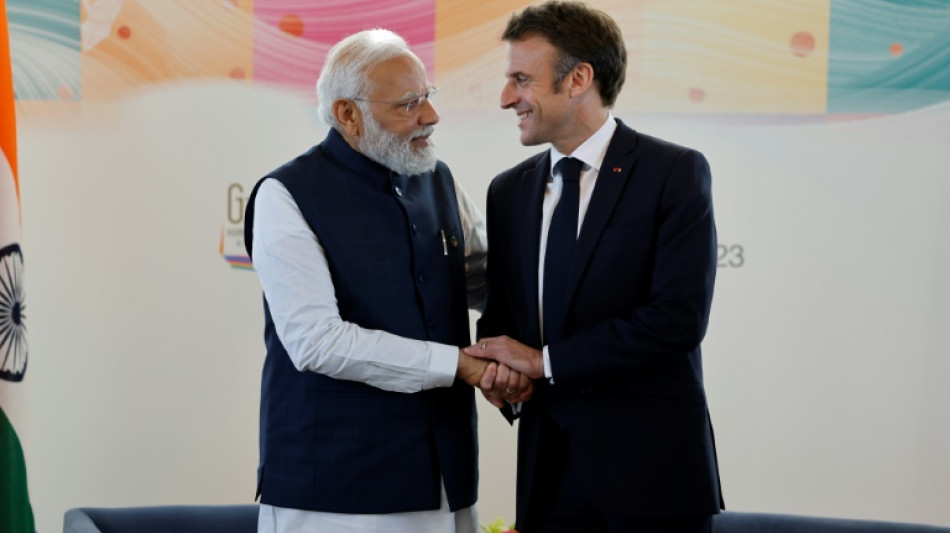
Bastille Day welcome for Modi as France courts India / Photo: Ludovic MARIN - POOL/AFP

 WhiteBIT Launches Bitcoin Lightning Network Support, Powered by Voltage

 Oil surges, stocks sink as US reportedly eyes fresh Iran strikes
 Anne Carson: modern takes on Greek classics
 Canada's Anne Carson wins Nobel literature prize
 Ethiopia drones hit Eritrean troops in Tigray
 Russian strike on buses kills 30 in frontline Ukrainian city
 Thailand begins extradition process against Chinese journalist

 Quarantine, unease and rumours: Russian city grapples with plague scare
 Taiwan says exports hit record in September on AI demand
 Marc Marquez vows to 'attack' Martin's lead at Indonesian MotoGP
 Diplomats, schools in Saudi take safety measures after blasts heard: sources to AFP

 In Beijing, EU trade envoy says deficit with China 'unsustainable'
 Sri Lanka's de Silva quits as Test captain
 Alcaraz feeling 'mentally fresh' ahead of Shanghai return
 Israel drastically reduces British diplomatic presence in Jerusalem
 Stocks fall further as oil surge fans fresh inflation worries

 North Korea demands South show 'utmost respect' to restore relations
 Saudi says three dead in airport attacks claimed by Houthis

 'Mad dream': New showcase for African film opens in London
 All Blacks coach Rennie says Wallabies exit 'part of the game'
 The growing protests against India's poll body - and PM Modi
 Stocks fall further as oil spike fans fresh inflation worries
 Bad COP, worse COP? EU tempers hopes for UN climate summit
 Rookie Henry named in Wallabies midfield to face All Blacks
 Housing crisis set to dominate Spain's snap election
Indian Prime Minister Narendra Modi is guest of honour Friday for Bastille Day celebrations in France, the latest Western power to court the world's largest democracy and its booming economy.
President Emmanuel Macron's red carpet welcome comes weeks after Modi was given the rare honour of a White House state dinner in Washington -- a city he was once banned from visiting.
That visit saw deals on arms sales, semiconductor investment and space cooperation, breezing past human rights concerns over India's Hindu nationalist government and accusations of rising religious intolerance towards the country's Muslim minority.
Further strategic and economic tie-ups are expected in Paris, which is seeking to broaden its engagement in Asia alongside other Western nations to check growing Chinese assertiveness in the region.
Modi's visit alongside Indian troops joining the annual Bastille Day military parade, marks "a new phase in the strategic partnership between France and India", Macron's Elysee Palace office said in June.
Both countries have "a shared vision of peace and security, especially in Europe and in the Indo-Pacific region", the statement added, using a term used by the US and its allies for the Asia-Pacific region.
Modi, who greeted the French leader with his customary bearhug during the latter's first state visit to India in 2018, said on Twitter last week that he was "looking forward to meeting with my friend President Macron".
"The India-France Strategic Partnership holds great significance for global good," he added.
India is already a customer for French arms, including Dassault's Rafale fighter jets, as it seeks to modernise its forces to match potential future threats from its northern neighbour.
The urgency of New Delhi's task has been heightened by simmering disputes with Beijing over the countries' immense Himalayan frontier, the site of a 2020 clash that killed 20 Indian and four Chinese troops, and sent relations between both capitals into free fall.
- Balancing game -
India once faced crushing poverty, but its middle classes have swelled in recent decades on the back of a rapidly growing economy, which last year overtook former colonial ruler Britain to become the fifth-largest globally.
In April, the country welcomed its first retail stores from Apple, eager to tap a burgeoning market for upscale consumer goods in what is now the world's most populous nation.
The US tech giant is also ramping up semiconductor and phone production in India to militate against the threat of politically driven supply chain disruptions in China.
India's rising economic clout has dovetailed with diplomatic assertiveness as its leaders relish the country's newfound prominence on the global stage.
This year, India is hosting the G20 summit for the first time and Modi has used the meeting to burnish his image at home as a steward of national power and prosperity.
Modi has struck a fine balance between historic ally Moscow and its new Western suitors, declining to criticise last year's invasion of Ukraine while India snaps up discounted Russian oil.
At the same time, his government has been enthusiastically welcomed into closer security cooperation with the West through the Quad alliance, a grouping that also includes the United States, Australia and Japan, and is seen as another countervailing force to China.
Modi attended a cricket match at a stadium bearing his name in March with visiting Australian counterpart Anthony Albanese, who likened the charismatic Indian leader to rock musician Bruce Springsteen at a rousing Sydney reception two months later.
"It is to do with containing China," said Manoj Joshi, a New Delhi-based author and geopolitical commentator.
"China is becoming a difficult market... and in terms of size and strength of its economy, India is a very good fit".
- Rights concerns -
But last month's enthusiastic welcome to Washington from US President Joe Biden saw minor ructions when several lawmakers boycotted Modi's joint address to Congress, citing his human rights record.
Rights groups say India's 200 million Muslims have faced increased discrimination and violence since India's ruling Bharatiya Janata Party (BJP) swept to power in 2014.
Modi himself was once subject to a US State Department travel ban over 2002 religious riots during his tenure as chief minister of western Gujarat state that killed around 1,000 people, mostly Muslims.
He has denied any responsibility for the violence and subsequent government probes have cleared him of culpability.
His government has also been accused of stifling independent media, with India falling 21 places to 161 out of 180 countries in the World Press Freedom Index since he took office.
Indian offices of the BBC were raided by the tax department in February, weeks after the British broadcaster was hit with a barrage of government criticism for airing a documentary questioning Modi's role in the Gujarat riots.
The ruling party denied the raids were politically motivated, while diplomats in London and Washington demurred from criticising them.
Ch.Campbell--AT