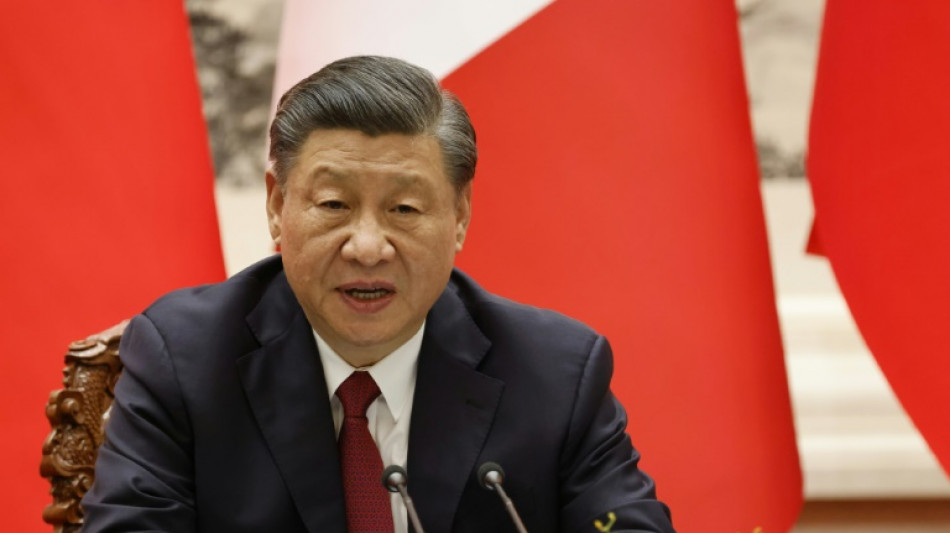
China's sweeping new anti-espionage law comes into effect / Photo: LUDOVIC MARIN - AFP/File

 HSBC 'consults' over UK unit job cuts amid AI adoption

 UK court quashes five ex-traders' Libor rate rigging convictions

 XM Receives “Global Customer Experience Leader Award 2026” at the TrustFinance Performance Awards

 Stocks slide as oil climbs on Mideast flareup

 Heavy casualties in Ukraine after Russian strikes

 French wine harvest set to hit historic low

 Kyiv 'cannot agree' to EU membership limiting food exports: minister

 Arteta targets more Arsenal glory after signing new deal until 2030

 Russell hit with Singapore grid penalty for taking new power unit

 Spotify expands audiobooks to more than 180 markets

 French-Japanese duo wins chemistry Nobel for solving molecular 'mystery'

 England's Nations League surge helps heal World Cup wounds

 Mayor of opposition stronghold Izmir defects to Erdogan party

 Mertens beats Gauff to set up Swiatek clash at China Open

 Benin full of pride at role in Messi's last dance

 France suspends stun grenade use at student protests ahead of PM speech

 Indonesian court hears 'negligence' complaint against state over fires, haze

 Rubio in Greece to urge against Western civilisation 'decline'

 Micron workers at Taiwan plant vote in favour of strike

 In 'The Social Reckoning,' Jeremy Allen White takes on Facebook's 'frightening' ambition

 Chip industry activists call for South Korea to recognise cancer cases

 Famine-scarred southern Madagascar braces for El Nino
 How the EU regulates lobbyists

 I.Coast refuge offers lifelong care for youngsters scorned as 'sorcerers'

 Indian central bank hikes rates for first time in more than 3 years

A revised law dramatically expanding China's definition of espionage came into force on Saturday, giving Beijing more power than ever to punish what it deems threats to national security.
The United States government, analysts, and lawyers say that the revisions to Beijing's anti-espionage law are vague and will give authorities more leeway in implementing already opaque national security legislation.
Originally released for public comment in December 2022, the revisions were formally approved by China's top legislative body in April.
Chinese law already meted out harsh punishment for those involved in alleged espionage, from life in prison to execution in extreme cases.
In May, a 78-year-old US citizen was sentenced to life in prison on spying charges.
Under the revised law, "relying on espionage organisations and their agents" as well as the unauthorised obtaining of "documents, data, materials, and items related to national security and interests" can constitute a spying offence.
Beijing insists it has the right to "safeguard its national security through legislation" and says it will "uphold the rule of law".
But experts have warned that the changes could sweep up those with even tenuous links to organisations accused of spying.
They come in the face of an already tense environment for foreign businesses in China, following raids on and questioning of staff at due diligence company Mintz Group and consulting giant Bain and Company this year.
The new law embodies a "whole-of-society approach to dealing with anything that is a risk to this broad definition of national security", Jeremy Daum, senior research fellow at Yale's Paul Tsai China Center, told AFP.
Daum said the law builds on a broader trend of tightening control since 2014, after President Xi Jinping took power.
But its vague definition of espionage and national security gives authorities a wider berth, he added, and will likely have a "chilling effect on Chinese citizens who have contact with foreigners and foreign organisations"
The new revisions have ruffled feathers among the business community, with companies fearing even tighter scrutiny.
The changes "have raised legitimate concerns about conducting certain routine business activities, which now risk being considered espionage", Craig Allen, President of the US-China Business Council, wrote in a recent blog.
"Confidence in China's market will suffer further if the law is applied frequently and without a clear, narrow and direct link to activities universally recognized as espionage," wrote Allen.
Diplomatic officials from several countries have also sounded alarm bells ahead of the legal changes, urging citizens in China to be vigilant.
The US State Department said the law will "greatly expand the scope of what (Beijing) considers espionage activities".
Deputy spokesman Vedant Patel said Washington would "continue to speak out for human rights and rule of law issues and promote accountability for (China's) repressive activities, which this of course would be one".
And the US National Counterintelligence and Security Center (NCSC) warned Friday that the law gives Beijing "expanded legal grounds for accessing and controlling data held by US firms in China".
J.Gomez--AT