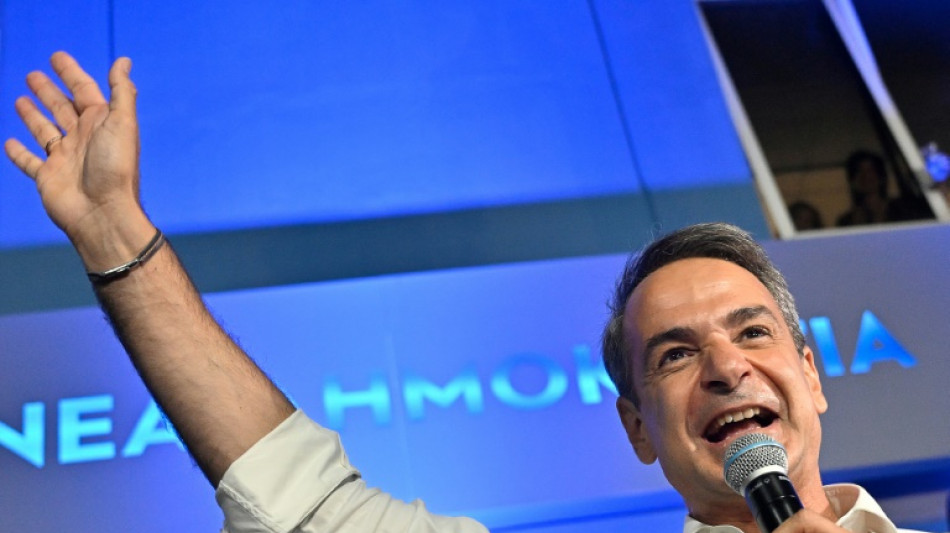
Mitsotakis back as Greek premier after election landslide / Photo: Louisa Gouliamaki - AFP

 Hotel Blacklist Launches New Accommodation Industry Risk Assessment Tool
 Bangladesh nuclear plant draws hope -- and worry
 US beat Canada 1-0 to wrap up four-win international break

 Turkey, Australia's joint COP31 leadership raises doubts
 For Turkish NGOs, COP31 offers rare space for action

 Sleep, appetite, gene-editing experts contend for Nobel chemistry prize
 Nobel Peace Prize haunted by the 'spectre' of Trump

 Africa launches own credit agency in bid for cheaper borrowing
 US, China, EU: three paths to regulating AI
 Australia's High Court rules against coal mine in landmark climate case
 Australia touts new funds for Pacific infrastructure at Fiji 'pre-COP'

 Eva Marie Saint, Oscar winner of Hollywood classics, dies at 102

 Australia probes app used in cheap smart glasses over privacy fears
 England needed to 'move on' from World Cup pain, says Tuchel

 O'Neill to stay at Celtic after period of "reflection"

 Kane marks 125th England cap with Wembley Nations League double
 Quebec's incoming separatist leader wants to block Crown from swearing-in

 Emmys gala will now stream its premier television awards
 Paramount completes Warner Bros takeover, creating Skydance
 Trump blames France unrest on Islam, migration

 Apple's Cook praises EU over efforts to protect children online
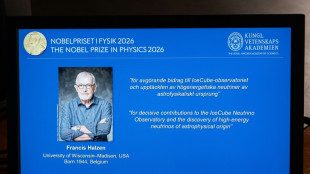 Nobel winner Halzen says years of October 'misery' finally over
 Quebec separatist win rattles Carney's unity push
 'Itching' for change: Shiffrin cuts back slaloms this season

 'Gen Z has risen up': Tens of thousands mass for tense France school protests
Kyriakos Mitsotakis embarked Monday on his second term as Greece's prime minister with a vow to accelerate institutional and economic reforms, after voters handed him a huge election victory for the second time in five weeks.
Crediting Mitsotakis and his New Democracy party for bringing economic stability to the erstwhile EU debt laggard, voters gave the conservatives their widest winning margin in almost 50 years on Sunday.
Hailing the "strong mandate", Mitsotakis said that "major reforms will proceed rapidly", adding that he had "ambitious" targets for his next four years in power that could "transform" Greece.
Among his pledges is pouring money into Greece's public health system -- which was stretched to its limits by the Covid-19 pandemic -- and improving railway safety after the deaths of 57 people in a February train collision that was Greece's worst rail disaster.
The 55-year-old former McKinsey consultant and Harvard graduate said Sunday that he "constantly strove to improve and learn from my mistakes".
Mitsotakis, who steered the EU nation from the pandemic back to two consecutive years of strong growth, had already scored a resounding win in an election in May.
But having fallen short by five seats in parliament of being able to form a single-party government, he refused to try to form a coalition, in effect forcing 9.8 million Greek voters back to the ballot boxes.
The gamble paid off, with his New Democracy party consolidating its win from the May 21 vote, while its nearest rival, the left-wing Syriza party of former premier Alexis Tsipras, saw a loss of tens of thousands of voters compared to just a month ago.
Tsipras, acknowledging a "serious political defeat", said he was leaving his political fate to the "judgment" of Syriza members.
For many Greeks, Tsipras is the prime minister who nearly crashed Greece out of the euro, and who reneged on a vow of abolishing austerity to sign the country on to more painful bailout terms.
To the dismay of centrists, the strong swing to the right was also accompanied by the return of the far right into parliament.
"Fascists will enter parliament... this constitutes a completely toxic environment," senior Syriza leader Costas Zachariadis told Skai TV.
- New cabinet -
Holding 158 seats in the 300-seat parliament, Mitsotakis will officially receive the mandate to form a government on Monday from Greece's head of state, President Katerina Sakellaropoulou.
The prime minister-elect is then expected to unveil his cabinet in the coming days, though names were already circulating even before the last votes were counted on Sunday.
Mitsotakis's trusted troubleshooter George Gerapetritis is being tipped as foreign minister in the new government.
A professor of constitutional law, Gerapetritis was enlisted in March to deal with the train tragedy, as well as a wiretapping scandal that implicated the prime minister's office last year.
The former foreign minister, Nikos Dendias, a political moderate, is expected to move to the defence ministry.
The new finance minister is touted to be Kostis Hatzidakis, a low-key veteran politician with past stints in the ministries of development, labour and transport.
- 'Visible' threat -
Mitsotakis, who first became prime minister in 2019, has vowed to make economic stability a feature of his new term.
He promised not to raise taxes while creating more jobs in public healthcare after a shortage of nurses and doctors was painfully exposed during the pandemic.
He had also championed a tough anti-immigration line, appealing to the conservative base in an electoral campaign in which the recent deadly sinking of an overcrowded trawler failed to garner a mention.
Instead, three small nationalist parties with anti-migration policies marched into parliament, garnering between them nearly 13 percent of the vote.
One of them, Spartiates (Spartans), is endorsed by the jailed former spokesman of the neo-Nazi party Golden Dawn.
Tsipras said the strongest showing of Greek hard-right parties in decades was a "visible" threat to democracy.
Voter fatigue was also evident in the second election in a month, with the turnout at under 53 percent compared to over 61 percent in May.
P.Smith--AT