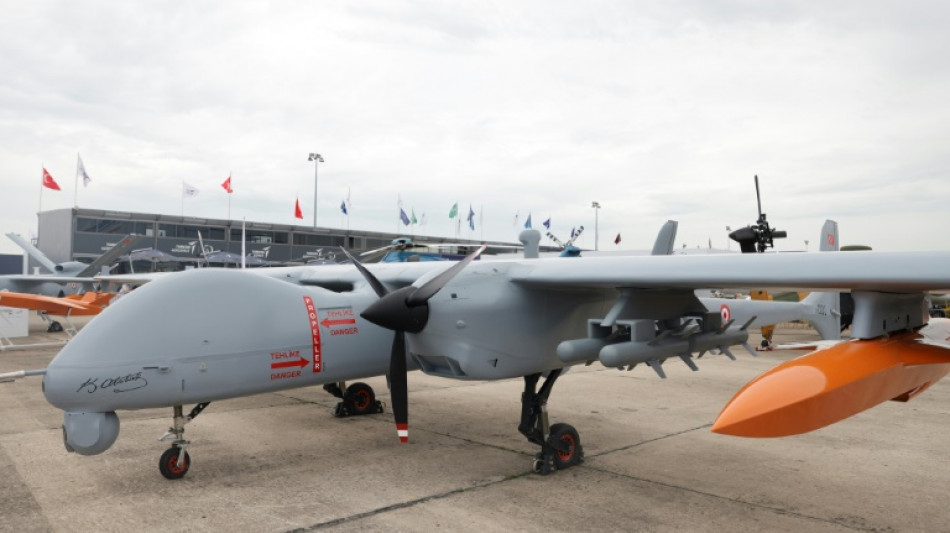
Turkish arms makers' export ambition on display at Paris Air Show / Photo: Geoffroy Van der Hasselt - AFP

 Emmys gala will now stream its premier television awards

 Paramount completes Warner Bros takeover, creating Skydance
 Trump blames France unrest on Islam, migration

 Apple's Cook praises EU over efforts to protect children online
 Nobel winner Halzen says years of October 'misery' finally over
 Quebec separatist win rattles Carney's unity push

 'Itching' for change: Shiffrin cuts back slaloms this season

 'Gen Z has risen up': Tens of thousands mass for tense France school protests
 Caribbean tourism hotspot loses men to Russian war machine

 Danish reservists practice war games to respond to 'aggression'

 Bhuvneshwar returns to India's T20 squad for New Zealand tour

 Asos says probing 'unauthorised activity' after phone alerts

 Stocks climb as oil prices retreat under $100 per barrel

 Neutrinos: space particles that change our view of universe

 'Destined' Djokovic wins China Open, extending unbeaten record

 Iceland is 'critical outpost' for security, says Rubio during visit
 Israeli settlers beat AFP photographer covering West Bank

 'Gen Z has risen up': Tens of thousands demand better education in France

 $10 Million and Counting: Hola Prime Hits Major Trader Payout Milestone
 UEFA investigate Ireland-Israel tunnel bustup after spitting claim

 Djokovic wins China Open and keeps unbeaten record after de Minaur retires
 Amsterdam's Rijksmuseum hosts 'homecoming' show for Willem de Kooning
 World Bank forecasts modest growth for Latin America, highlights climate risks
 'Afraid for my future': Tens of thousands demand better education in France

 Pakistan PM urges Imran Khan supporters to end protest march

Turkish defence manufacturers are out in force at this week's Paris Air Show, the first in four years during which conflicts including Russia's invasion of Ukraine have spotlighted the country's now-coveted weapons.
Most obvious is state-owned Turkish Aerospace (TAI), whose ample stand, fronted by a tarmac display of armed drones, helicopters and a recently-developed jet trainer, is just a few paces away from heavyweights like Airbus and Boeing at Le Bourget airport.
Dour-faced military delegations, including one group from Brazil, could be seen touring the aircraft while gawkers took pictures of the bomb- and missile-laden drones.
As an arms exporter, Turkey "benefits from an image as a 'third way': politically less restrictive than Western systems, but more neutral than buying Russian, Chinese or Iranian while guaranteeing satisfactory quality," Leo Peria-Peigne, a researcher at the French Institute of International Relations (IFRI) wrote in a recent paper.
Among the country's most sought-after products are armed drones, driven in part by the TB-2 Bayraktar produced by privately-owned firm Baykar, which does not have a stand of its own at the airshow.
The drone basked in the media spotlight last year for its role in the earliest stages of Ukraine's defence against the Russian invasion and has been bought by a dozen militaries according to the International Institute for Strategic Studies' Military Balance.
Like Baykar, TAI's unmanned aerial vehicles (UAV) have in recent years been sold around the world including to Kazakhstan, Kyrgyzstan, Malaysia, Algeria and Tunisia, according to data from arms trade watchdog SIPRI.
For drones, "most of the interest nowadays comes from Africa," where countries want them to "fight terrorism", TAI drones chief Omer Yildiz tells AFP.
Turkish UAVs had "proved to be very effective and efficient against terrorism," in Turkey's neighbour Syria, where Ankara's armed forces have engaged Kurdish fighters as well as the Islamic State group (IS), he adds.
Elsewhere in Africa, SIPRI data shows Niger and Chad have bought TAI's Hurkus-C turboprop trainer aircraft, which can also be used for ground attack missions.
The firm is at pains to show off less belligerent uses of its UAVs, pointing out their use to reestablish mobile phone coverage in some areas following February's devastating earthquake.
Their radars have also been used to spot Russian and Ukrainian mines threatening commercial shipping in the Black Sea since Moscow's invasion of its neighbour last year.
- 'Aggressive subsidies' -
TAI's Yildiz points to a scale model of the firm's latest iteration of its Anka drone, a jet-powered delta wing which bears a closer resemblance to an American stealth bomber than its gawky propeller-driven sister aircraft.
With its larger payload and other enhanced capabilities, the drone is "aiming to take the air-to-ground missions of the F-16" American fighter jet, he says.
Replacing Western technology with home-grown weaponry harks back to the origins of Turkey's domestic arms industry, which Ankara has pushed ever since the US' 1970s arms embargo over its invasion of northern Cyprus.
The sector's "increase in capability is ensured using a policy of very aggressive industrial subsidies, demanding high return on investment in the form of technology transfer, development of local production or partnerships with major Western industrial groups," IFRI's Peria-Peigne wrote.
"From the 2000s, there has been an emphasis on aeronautical capabilities" and the Turkish armed forces' growing appetite for drones, he added.
That has only been stoked by the US' refusal to sell NATO ally Turkey F-35 fighter jets, after Ankara bought anti-aircraft systems from the bloc's antagonist Russia.
At another Le Bourget stand, Rusen Komurcu, secretary-general of the Turkish Defence and Aerospace Industry Manufacturers' Association (SASAD), recites sectoral statistics by heart: 100,000 jobs and $10 billion in revenues, of which $4.4 billion in exports.
Asked why the country's products are doing so well, he says simply that in Turkey "you find good material at a good price".
- 'More and more for export' -
In a cosy room behind state-owned missile and rocket developer Roketsan's nearby stand bristling with mockups of guided explosives, marketing boss Mustafa Odabas agrees.
"As we are developing new systems to meet the Turkish armed forces' needs, our sales are growing," he tells AFP.
"We have the capability now" to supply "pinpoint accuracy missiles, cruise missiles, long-range missiles" that have drawn customers across the Middle East and especially the Gulf region, Odabas adds.
Sales of Baykar and TAI drones further afield have helped Roketsan win customers in Africa and even Europe, he says.
In the complex global web of defence production, Roketsan is the sole manufacturer of some parts used in Raytheon's Patriot anti-air missiles recently delivered to Ukraine, just as TAI makes components for NATO allies' aircraft such as the Airbus A400M transporter.
In future, "50 percent of our sales should be coming through exports. I believe it should be even more," Odabas said.
Industry association chief Komurcu expects that in the coming years, "more and more (Turkish arms) will be for exportation, maybe $10 billion is not far from our horizon."
That would put Turkey not far behind major exporter France, which sold 11.7 billion euros ($12.3 billion) of arms abroad in 2021 according to government figures.
S.Jackson--AT