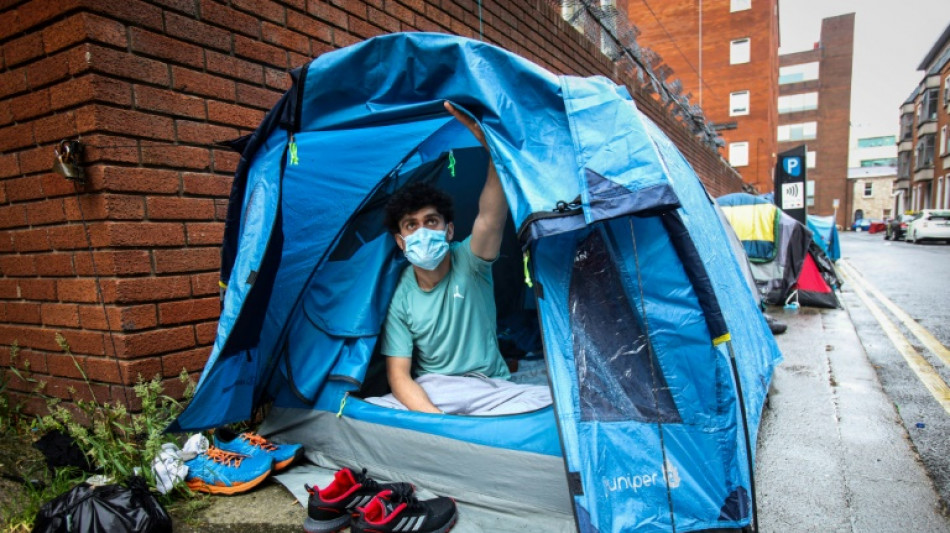
Far-right backlash as Ireland struggles to house asylum seekers / Photo: PAUL FAITH - AFP

 Spain's PM calls snap election after housing bill defeat

 STARCARES Equips Seven Foster Homes for Children and Young People in Tanzania

 Alleged Indian leader of neo-Nazi child abuse ring goes on trial in Paris
 Euro, French stocks slide on France debt concerns

 Alcaraz advances to Japan Open final

 US-German trio win medicine Nobel for work on optogenetics

 Hundreds of French high schools shut as protests persist

 Spain PM calls early election after housing crisis defeat

 Stocks rally as 'Goldilocks' jobs data ease rate fears
 Myanmar says 10,000 migrants returned from Malaysia this year

 Big guns back for Australia's Rugby League World Cup defence

 Braves rock Dodgers to level series, Brewers win thriller

 Most Asia stocks rally as 'Goldilocks' jobs data ease rate fears

 Sunken Silk Road city reveals Central Asia's lost history

 Three years on, Israeli rescuer cannot escape October 7

 Research into weight-loss drugs tipped for Nobel as award week opens

 US Supreme Court hears bid to shut the door on climate suits

 Chourio walk-off single lifts Brewers over Padres

 Helio Highlights Industry Recognition of Energy Demand as Starship Reaches Orbit, Advancing the Launch Economics Behind Space-Based Solar Power
 Shelfie-Tech Announces Private Placement

 Benzinga Reports Highlights SMX Performance, Technology
 As Muse Tops the App Store and Instinct Raises $1 Billion, Snaplii Offers a Separate Wallet for AI Agent Spending, With Cashback
 Copper Intelligence to Attend the National Investment Banking Association's 153rd Investment Conference in Fort Lauderdale

 Apex Extends Trinity Zone 200 m with 3.55% REO over 116.0 m and 2.35% over 171.5 m in Western Step-out Drilling at Rift

 Argo to Present at National Investment Banking Association's (NIBA) 153rd Investment Conference in Fort Lauderdale

Unzipping a tent in a damp alleyway behind Ireland's International Protection Office, Salman Akahel reveals a sleeping bag, a pillow and a thin, white blanket to protect him from the hard concrete.
"This is my home," the 23-year-old asylum seeker from Kunduz in northern Afghanistan told AFP.
On what was his sixth day in Ireland, he was living in one of 50 tents clustered around the Dublin agency processing international protection claims.
The camp, which first appeared in the centre of Dublin in March, is unprecedented in size -- a very public indication of the homelessness crisis among asylum seekers that has gripped Ireland.
It has also coincided with a far-right backlash against new arrivals seeking sanctuary.
Akahel's journey from Afghanistan and across Europe took over two years, he said -- and he has already faced prejudice and shouted threats in the few days he has spent in the Irish capital.
"All the time, there's problems," he said.
Since late January when government accommodation was overwhelmed, 1,393 asylum seekers have been left homeless -- some for up to 10 weeks -- according to figures released by the Irish Refugee Council (IRC) on Monday.
Among them were three pregnant women and four unaccompanied children, the charity said.
- Abuse and assaults -
"The experience of living on the streets has been very difficult," IRC chief executive Nick Henderson said.
"We've worked with people who've been assaulted, people who've had health conditions that have been made worse and exacerbated by living rough."
Sahed Mawlod, 22, from Erbil in northern Iraq, told AFP he had been left with health problems by living on the streets.
He was looking to see a doctor after sleeping in parks, on the street and in a tent for two months in "very, very cold" weather.
Irish premier Leo Varadkar said this month his government was "doing everything we can" as he announced 10,000 more beds for asylum seekers and refugees and talked up deportations for illegal arrivals.
"We've experienced a refugee crisis in Ireland the likes of which we've never experienced before and never imagined," the Taoiseach, or prime minister, said.
More than 70,000 Ukrainians sought protection in 2022 under a separate scheme in Ireland following Russia's invasion.
In the same year, the country of five million people received a record 13,651 asylum claims from the rest of the world, according to government figures.
Accommodation applications for international protection have not been helped by Ireland's chronic housing crisis.
The government has estimated there is a deficit of 250,000 homes to meet the housing needs for the country's general population.
Widespread dissatisfaction over housing has fed into the backlash against asylum seekers and refugees. Far-right figures have promoted their anti-immigration argument at rallies and on social media with claims that "Ireland is full".
Beginning in November last year, protesters launched a series of demonstrations in inner-city north Dublin's East Wall area, blocking traffic near the port over plans to house refugees in disused offices.
- Protests -
In rural areas across the country, smaller protests have been staged over housing plans for asylum seekers and refugees.
Over February and March in the town of Mullingar in central Ireland, hundreds of protesters demonstrated against the use of a former military barracks to house asylum seekers.
In the western town of Inch in May, protesters used tractors to blockade emergency accommodation in a hotel, forcing some asylum seekers to flee.
The camp at the International Protection Office in Dublin became the focus of anti-immigration protests in May and a smaller camp on a nearby street was attacked and tents burned.
One resident whose flat overlooks the camp by the government agency told AFP she lived in fear of violent protests.
"We don't want somebody to come here and light up a tent. We worry about clashes," she said. "There are so many people here and there are different activist groups."
The 30-year-old civil servant, who asked not to be identified, added that the patience of residents who had initially welcomed the asylum seekers was also wearing thin.
"We are probably moving from understanding to frustration at this point," she said.
"It would be better if (the government) could find better accommodation... instead of just leaving them on the street," she added.
T.Perez--AT