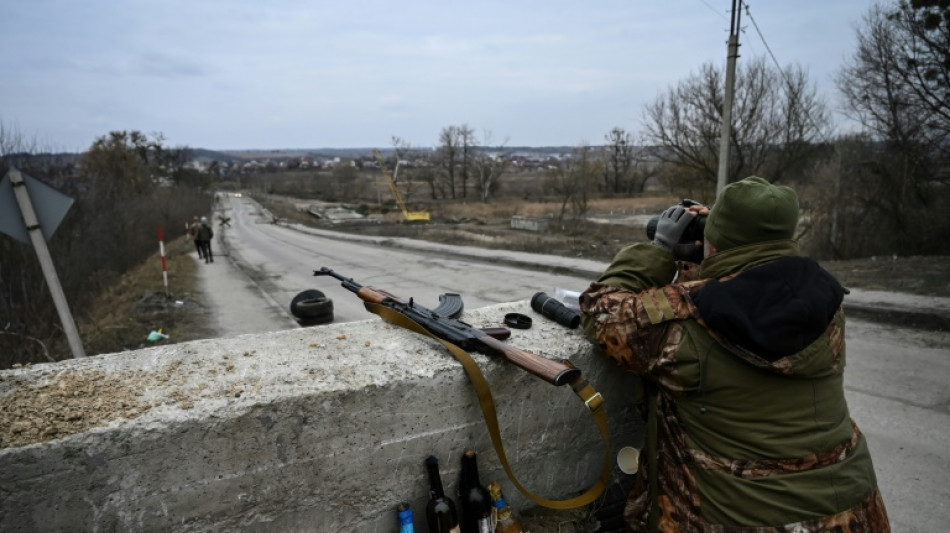
'We will blow it up': Last bridge to Kyiv stalls Russian advance

 Lufthansa wins contest for TAP Air Portugal stake
 AI worms, 'major' incident fears spur safety calls at industry summit
 Fuel shortage triggers queues on Indonesia's Bali island

 Evolution Metals & Technologies Corp. Reaffirms $400 Million to $460 Million FY2027 Revenue Guidance, Unveils Eight Sintered Magnet Grades Covering an Estimated 75% of Global NdFeB Revenue, and Moves to Answer U.S. Army Call for Rare Earth Magnets

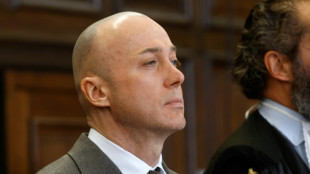 Trial defence says Russia used Nord Stream pipelines as 'weapon'

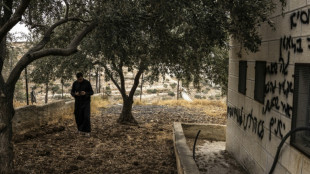 Israeli settlers set fire to mosque in occupied West Bank

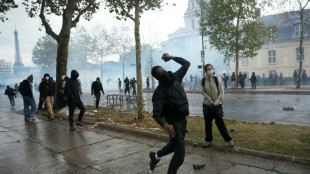 Macron says French student protesters 'exploited' by political forces: spokeswoman
 Stocks diverge ahead of key US inflation data
 Japan summons Russian ambassador to protest journalist's arrest

 Workers to strike at world's largest copper mine in Chile

 Ukraine accuses US of helping Russia as missiles hit Kyiv
 Drone hits data centre of Russia's largest bank

 Bivial AG Brings Its Complete Dashboard to Mobile
 Mont Blanc nearly two metres taller than in 2023: French surveyors

 Pope recovering after lung cancer operation that rattles Church
 Indonesia haze spikes Singapore pollution, shuts East Timor schools

 Higher borrowing costs an 'alarm signal' for France: finance minister

 Zelensky accuses Putin of disrespecting Trump after latest attacks

 Japan PM says housework makes her busier than male predecessors

 Top Indian 'cockroach' leaders sent to jail after protest

 Ukraine ex-military officer to stand trial over Nord Stream sabotage
 IMF chief says Saudi attacks could have negative spillover 'everywhere'
 Premier League move a Sage decision for new Palace boss

 South Korean FA condemns 'personal attacks' as rift rumours grow

 Japan urges 'impartial treatment' of journalist arrested in Russia

The explosives tied under the belly of the last bridge standing between advancing Russian soldiers and Kyiv sadden Ukrainian volunteer forces sergeant "Casper".
His fellow commanders have blown up all the other bridges on the western flank of the Ukrainian capital in a desperate bid to slow the Russian tanks.
The one still spanning a stream in the town of Bilogorodka leads to leafy villages that were once filled with summer cottages and are now a war zone.
The historic city of Kyiv would be effectively cut off from much of its western hinterland should Casper receive the order to blow the bridge up.
"We will try to do everything possible to keep it standing," the former paratrooper told AFP on Sunday.
But the fighting is getting closer and the mood among the Ukrainians manning the barricades is turning morose.
Russian warplanes have joined the ground forces and are bombing the surrounding villages and towns.
The flood of people fleeing for safety seems never-ending.
And the rare hours of silence between the battles make the Ukrainian soldiers worry that the Russians are just reloading for an even more ferocious push.
Casper looks up at the Ukrainian surveillance drone buzzing over the frontline and admits that the hour may soon come when he is forced to sever Kyiv's last link to its western lands.
"If we get the order from on high, or if we see the Russians advancing, we will blow it up," he said.
"But we'll make sure to sink as many enemy tanks as we can while we do it."
- Shrinking city -
The Ukrainian capital's boundaries are shrinking and its streets are growing more dangerous and deserted by the day.
Another Russian push on the east bank of Kyiv's Dnipro River has seen some forces approach to within about 50 kilometres (30 miles).
But the west offers the Russians a more direct route to the heart of Kyiv and its prized government district.
Some of the city's residents -- almost uniformly defiant but increasingly grim-faced -- are preparing for guerrilla warfare.
Auto repair shop owner Oleksandr Fedchenko is one.
The 38-year-old used to host Ukraine's most popular weekly TV show about cars in his spare time.
But he has converted his sprawling garage into an underground weapons manufacturing centre aimed at giving some muscle to Ukraine's vastly outgunned volunteer units.
"When the war started, everything changed," Fedchenko said.
"We discovered that our regular mechanics knew how to manufacture weapons. Others knew how to make Molotov cocktails. We are doing absolutely everything we can."
- Underground weapons -
All the workers at Fedchenko's repair shop have swapped their grease-stained overalls for the olive uniforms of Ukraine's volunteer units.
A mechanic-turned-volunteer fighter who adopted the nom de guerre "Cross" was soldering a large-calibre machine gun Ukrainian troops had earlier grabbed from a captured Russian tank.
The 28-year-old was trying to slice down the massive gun and convert it into a handheld weapon that an untrained volunteer might be able to use on the streets.
"This thing might not shoot very straight, but at least it's something," Cross said and gave his balaclava a reassuring tug.
"Not many people know we do this and it might not be very legal," he said.
"But when there is a war, what is legal no longer matters -- only our national defence does."
- No man's land -
Fedchenko's voice broke and his eyes glistened when recalling life before Russia attacked Ukraine on February 24.
"I felt helpless. Stick a Kalashnikov in my arms, and I wouldn't last 10 minutes. But I needed to do something," he said.
His makeshift weapons manufacturing plant is woefully exposed to a Russian missile strike.
The huge garage sits on a road marking Kyiv's westernmost point. Numerous similar industrial buildings along the same route now stand in ruins.
"Each one of us knows that we can be attacked at any moment," Fedchenko said.
"Each one of us knows that this can be our last day. And still we come."
The tears were also streaming down the cheeks of pensioner Ganna Galnychenko.
The 64-year-old walked out alone from the fields marking the no man's land between the bridge overseen by Casper and Russian-held villages.
"I don't know where my children are," she said in a quivering voice. "I can't reach them by phone."
A.Ruiz--AT