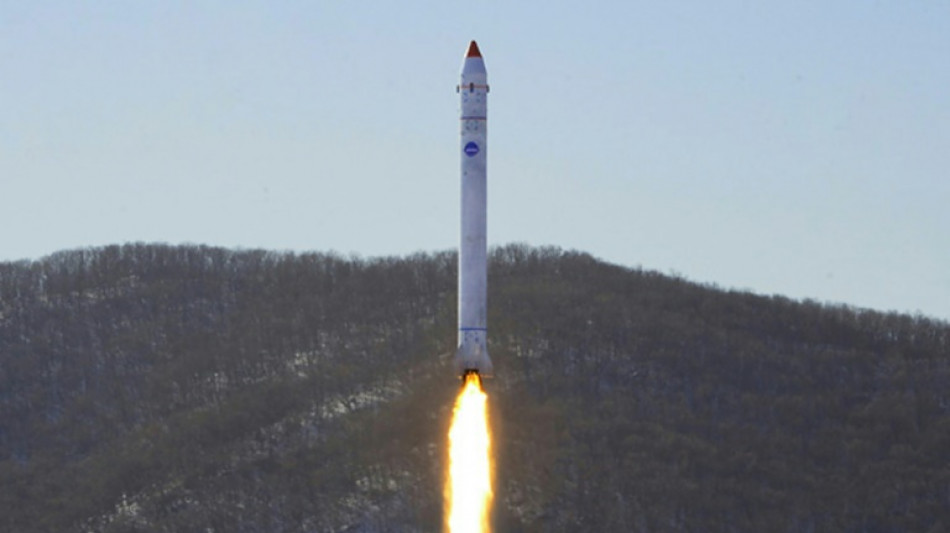
North Korea's military satellite launch: five things to know / Photo: STR - KCNA VIA KNS/AFP/File

 ALEX BODI ȘI AMBASADORUL REPUBLICII SUDANUL DE SUD, GUM DOMINIC MATIOK, DISCUTĂ LA BERLIN DESPRE POSIBILITATEA ÎNFIINȚĂRII UNUI CONSULAT ONORIFIC LA BUCUREȘTI

 Dodgers step up World Series three-peat bid with 5-3 win over Braves

 Spain break down Czechs as England outclass Croatia in Nations League

 Yamal on target as Spain hold off Czech Republic

 Latvian exit polls suggest pro-European choice

 Lula, Bolsonaro wrap up campaigns ahead of knife-edge election

 Tuchel hails 'complete' England after Croatia demolition

 Fury to invite Trump to lead ring walk before Joshua showdown

 Fashion industry in 'precarious moment', says Vivienne Westwood supremo

 Seventh heaven for England in Nations League rout of Croatia

 Storms, flooding cause chaos on Greek holiday island of Crete

 #IAmJaneDoe: online support campaign in US university rape case

 Brazil shine on Selecao's first visit to India

 Zverev sets up Djokovic quarter-final at China Open, Rybakina out

 Happier at home, Bordeaux hammer Lyon in Top 14

 Lula, Bolsonaro in final push for votes ahead of knife-edge election

 Boisterous fashion week barnstorms 'sleepy' Nigerian capital

 UAE investigators say flydubai co-pilot was planning 'terrorist act'

 Rahul smacks century in India v Windies ODI

 Daryz seeks to join exclusive club of dual Arc winners

 Russia warns diplomats to leave Kyiv over new strikes threat
 Olympic champ Zheng rebukes rowdy home crowd at China Open

 World No.1 Sinner pulls out of Shanghai Masters to delay return

 Red Bull's Verstappen grabs pole position for Bahrain GP

 India beat Pakistan in blockbuster as golfer Kim wins 'crazy' gold

North Korea said Tuesday that it would launch a military reconnaissance satellite by June 11, prompting concern from Seoul, Tokyo and Washington, which claim the move would violate UN sanctions.
Kim Jong Un has made developing such a satellite a top military priority for his regime, and has personally inspected it, approving its future launch.
AFP takes a look at what we know:
Is it banned?
Kim Jong Un's regime is barred from using any ballistic missile technology by a raft of UN sanctions, including one which specifically demands North Korea "not conduct any further nuclear test or any launch using ballistic missile technology".
Pyongyang regularly flouts these restrictions -- which it describes as an infringement on its sovereignty -- and has test-fired multiple intercontinental ballistic missiles already this year.
It never gives advance warning of missile tests, but -- in line with its idea of itself as a law-abiding global power, experts say -- has previously notified international authorities of planned satellite launches.
It told Japan on Monday it would launch one between May 31 and June 11.
The issue is that the technology used for both satellite launches and ICBMs is "essentially the same," said Choi Gi-il, professor of military studies at Sangji University.
Missiles & satellites are the same?
Both satellite launches and ICBMs use rockets and "require highly advanced expertise" in similar ways, experts say.
Ballistic missiles have internal guidance systems, allowing them to exit and then re-enter the atmosphere to hit specific targets on Earth.
With a satellite launch, the rocket simply carries it to an intended height in space then separates, leaving the satellite in orbit and falling back to Earth in a shower of debris.
"For ICBMs, mastering re-entry expertise is a must to ensure a warhead isn't burnt out before hitting a target," Han Kwon-hee of the Missile Strategy Forum told AFP.
"But for satellite rockets such re-entry technology isn't necessary, as its goal is to launch a satellite above the stratosphere."
The risk of debris from the rocket is why the North informed Tokyo of its pending satellite launch, Han said.
Have they done it before?
North Korea does not have a functioning satellite in space, experts say.
Since 1998, Pyongyang has launched five satellites, three of which failed immediately and two of which appeared to have been put into orbit -- but signals from them have never been independently detected, indicating they may have malfunctioned.
The most recent satellite launch was in 2016. The following year, Pyongyang successfully test-fired its first ICBM.
"Satellites launched by North Korea in the past were effectively ICBM tests disguised as normal satellites," An Chan-il, a defector-turned-researcher who runs the World Institute for North Korea Studies, told AFP.
"The upcoming launch is being advertised by Pyongyang as a state-of-the-art satellite," he said, adding it showed the North was eager to enter "the so-called 'military space era' before Seoul does".
So it's a space race?
South Korea is yet to develop a satellite "specifically and solely for military purposes", Seoul's defence ministry told AFP, adding it plans to launch one later this year on a SpaceX rocket.
Seoul did this month successfully launch its homegrown Nuri rocket, placing working satellites into orbit for the first time.
In response, "Kim Jong Un has likely increased pressure on his scientists and engineers to launch a North Korean spy satellite," Leif-Eric Easley, a professor at Ewha University in Seoul, told AFP.
It is doubtful North Korea "has the remote sensing technologies for a proper reconnaissance satellite. However, even a rudimentary eye in the sky could have military uses and would offer domestic political value for the Kim regime".
Will it work?
"North Korea is known to have failed a number of times," Choi of Sangji University said about ICBM re-entry into the atmosphere.
However, "it is rumoured there was a transfer of know-how from Russia and China to the North, though it is not officially confirmed," he said.
Even a failed satellite launch -- like in 2016 -- shows North Korea's "capability and intentions to develop longer-range ballistic missiles", the Washington-based Center for Strategic and International Studies said at the time.
This time, Pyongyang wants to get a closer look at Seoul's defence posture, Han of the Missile Strategy Forum told AFP.
"It is an attempt by Pyongyang to show it has the capability to keep Seoul's nuclear deterrent in check with a spy satellite. They are sending this message: 'We can see you through and strike anytime.'"
O.Gutierrez--AT