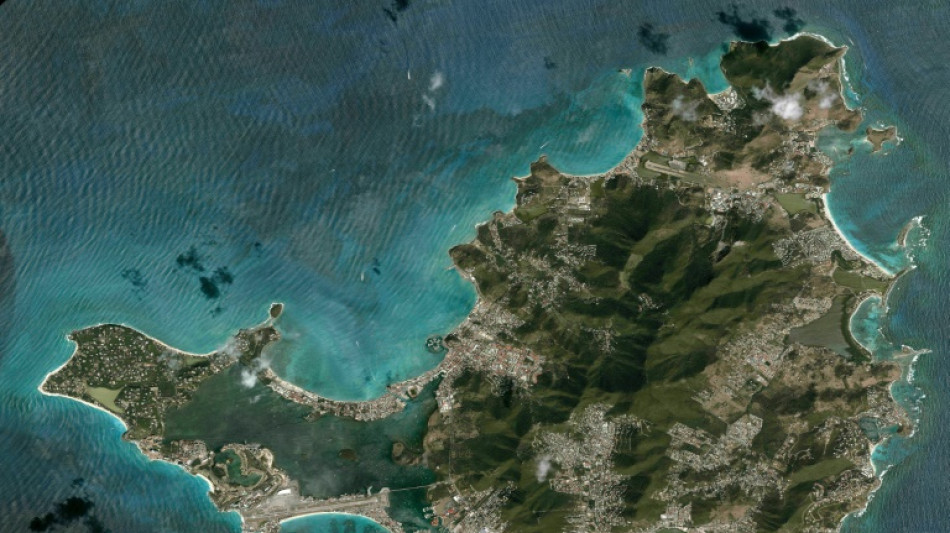
France, Netherlands settle tensions over 'footrace frontier' / Photo: - - CNES/AFP

 #IAmJaneDoe: online support campaign in US university rape case

 Brazil shine on Selecao's first visit to India

 Zverev sets up Djokovic quarter-final at China Open, Rybakina out
 Happier at home, Bordeaux hammer Lyon in Top 14
 Lula, Bolsonaro in final push for votes ahead of knife-edge election

 Boisterous fashion week barnstorms 'sleepy' Nigerian capital

 UAE investigators say flydubai co-pilot was planning 'terrorist act'

 Rahul smacks century in India v Windies ODI

 Daryz seeks to join exclusive club of dual Arc winners
 Russia warns diplomats to leave Kyiv over new strikes threat

 Olympic champ Zheng rebukes rowdy home crowd at China Open

 World No.1 Sinner pulls out of Shanghai Masters to delay return

 Red Bull's Verstappen grabs pole position for Bahrain GP

 India beat Pakistan in blockbuster as golfer Kim wins 'crazy' gold

 India beat arch-rivals Pakistan to win Asian Games cricket gold

 Ethiopia's Tigray rebels abandon regional capital as govt advances: journalist

 Tom Kim powers to Games gold and exemption from military service

 Split loyalties for Indian football fans at Brazil friendly

 India-Pakistan blockbuster brings cricket fever to Japan baseball field

 Wong waiting on Rafa after winning Asian Games tennis gold
 With Russia next door and rising costs, Latvia goes to the polls

 Penalty hero rues empty seats as Games hosts Japan win football gold

 North Korea fires ballistic missile after Seoul's apology demand

 US regulator finds Boeing 737 MAX software bug 'not a safety concern'

 Ohtani 'managing' injuries as Dodgers launch MLB post-season

Around 400 years ago, two groups of runners -- one Dutch, one French -- are said to have set off from the same point on the Caribbean island of Saint Martin to trace the border between their nations. On Friday, this footrace frontier is set to be formally updated.
Starting from a bay on the east coast and running in opposite directions, the runners in 1648 eventually met on the west coast of the island, with a straight line between the two points forming the international border ever since.
According to the legend, the Gallic runners were faster, handing France by far the larger share of the roughly 90-square-kilometre (35-square-mile) tropical paradise, which they called Saint Martin.
The Netherlands took the southern part, which they named Sint Maarten, with the athletic feat and the peaceful coexistence of the two colonial powers leading to the territory being dubbed the "friendly island".
The so-called Concordia Hill treaty of 1648 established the boundary and has formed the basis of relations on Saint Martin/Sint Maarten ever since, although no written record for the footrace exists.
"Although there are two territories which are governed differently by two separate nations, this is neither drastic nor obvious," notes the French tourist office on its website.
Low-level friction over administration, tax, or policing have caused problems, however, and new tensions emerged in 2017 after Hurricane Irma ripped through the local palm trees, luxury villas and plantations.
Reconstruction around Oyster Pond on the east coast -- the point of departure for the 1648 runners -- stalled because both countries disputed the exact location of the frontier.
The Dutch claimed all the waters of the bay, while the French pointed to modern international law which posits that the border should run through the mid-point of the natural harbour.
- 'Long-awaited regeneration' -
Rather than settling it with a sprint, French Interior Minister Gerald Darmanin is set to meet Sint Maarten Prime Minister Silveria Jacobs to pen a new agreement on Friday after months of sometimes difficult talks.
France, as with the running, has prevailed in the border argument.
The boundary will be "in the middle of the pond, giving equal water to both sides," Jacobs said in a statement ahead of Friday's signing ceremony.
The agreement "will help define the border in a precise and clear way," Saint Martin president Louis Mussington said, while also "preserving the free movement established in the Concordia agreement".
Resolving the conflict "will open the way for long-awaited economic and urban regeneration" of the Oyster Pond area, which suffers from higher-than-average poverty, he added.
The island is not the only territory in the Caribbean to be divided, with Haiti and the Dominican Republic sharing the same landmass.
Saint Martin/Sint Maarten, which has a history of producing salt, tobacco and sugar cane, was host to indigenous Arawak and Carib populations before the arrival of Spanish, then French and Dutch settlers in the mid-17th century.
G.P.Martin--AT