
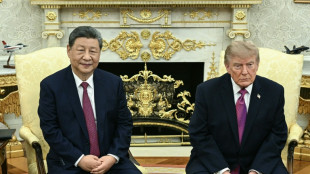
China steps up response to US chip moves but economic reality limits how far / Photo: Hector RETAMAL - AFP

 Lula, Bolsonaro in final push for votes ahead of knife-edge election

 Boisterous fashion week barnstorms 'sleepy' Nigerian capital

 UAE investigators say flydubai co-pilot was planning 'terrorist act'

 Rahul smacks century in India v Windies ODI

 Daryz seeks to join exclusive club of dual Arc winners

 Russia warns diplomats to leave Kyiv over new strikes threat

 Olympic champ Zheng rebukes rowdy home crowd at China Open

 World No.1 Sinner pulls out of Shanghai Masters to delay return

 Red Bull's Verstappen grabs pole position for Bahrain GP

 India beat Pakistan in blockbuster as golfer Kim wins 'crazy' gold

 India beat arch-rivals Pakistan to win Asian Games cricket gold

 Ethiopia's Tigray rebels abandon regional capital as govt advances: journalist

 Tom Kim powers to Games gold and exemption from military service

 Split loyalties for Indian football fans at Brazil friendly

 India-Pakistan blockbuster brings cricket fever to Japan baseball field

 Wong waiting on Rafa after winning Asian Games tennis gold

 With Russia next door and rising costs, Latvia goes to the polls

 Penalty hero rues empty seats as Games hosts Japan win football gold

 North Korea fires ballistic missile after Seoul's apology demand

 US regulator finds Boeing 737 MAX software bug 'not a safety concern'

 Ohtani 'managing' injuries as Dodgers launch MLB post-season
 New "What Is a Gold IRA?" Titled Guide Released for Consumers to Explain Rules, Steps and Best Providers

 Botched US execution leaves murderer unconscious on ventilator: lawyers
 Cornell rape case exposes sexual violence at US colleges

 France held by Italy in Zidane's homecoming after Olise stunner

Beijing's restrictions on American chipmaker Micron in retaliation to sweeping US chip curbs marks a major step up in its response to Washington's pressure and could open the door for further measures in the geopolitical standoff, analysts say.
But they warned President Xi Jinping's ability to raise the stakes will be limited as he battles to re-energise the world's number two economy while it struggles to recover from years of zero-Covid-imposed inertia.
China on Sunday banned the use of Micron's chips in critical infrastructure projects, which Beijing said posed "major network security risks" that could affect "national security".
Washington expressed "serious concerns" over the ruling that came just as leaders of the world's seven richest nations (G7) signed a statement urging Beijing to end "economic coercion".
The move marked a significant shift in China's response to US measures that have targeted the country's technology sector, with Gary Ng, a senior economist at Natixis who specialises in the global chip trade, calling it "a landmark case".
He emphasised it was China's first cybersecurity probe into a foreign company since tighter rules were announced in 2021, and a rare instance when the scope of such reviews was expanded to include national security concerns.
"I wouldn't be surprised if regulators used these reviews as a tool for retaliation in future" when faced with other geopolitical issues, he said.
Emily Weinstein, a research fellow at Georgetown University specialising in the US-China tech rivalry, added that the definition of what fell under "critical information infrastructure" was very broad -- ranging from online government services and defence to healthcare and water conservation.
"Technically that could mean that anything qualifies," she said.
"China has consistently found national security or other reasons to create protectionist barriers" including mandatory technology transfer agreements, which require companies to store all data locally and requirements for foreign entities to have joint ventures with local partners in several sectors.
- 'Fuel to this fire' -
China began an investigation into Micron in late March, five months after the US unveiled sweeping curbs aimed at cutting off Beijing's access to high-end chips, chipmaking equipment and software used to design semiconductors.
"This is clearly part of a tit-for-tat retaliation for what Beijing perceives as Washington's support of Micron and the US semiconductor industry," said Paul Triolo, a China tech expert at consultancy Albright Stonebridge.
Micron was singled out to make a political statement, Triolo said, adding that previous cybersecurity reviews of domestic firms, such as ride-hailing app Didi, focused on data instead of broadening the scope to include national security.
Washington has banned Chinese chipmakers including Micron rival Yangtze Memory Technologies.
The announcement came as the G7 nations said they would move to "de-risk, not decouple" from China, while Washington pressures allies to unite in restricting chip equipment exports to China.
"The strong statement from G7 may have added fuel to this fire," Ng said.
However, Xi's desire to combat what he sees as US hegemony will need to be balanced against the impact such measures would have on the economy.
According to analysts, Micron -- one of the US's largest memory chipmakers -- was an easy target because its semiconductors could be replaced by products from South Korea's SK Hynix and Samsung.
But restrictions against other US firms such as Intel and Qualcomm would be much harder to deal with because their technologies are used in consumer goods, including smartphones, that are made in the country and shipped abroad.
- Betting on South Korea -
"The approach of limiting US firms like Micron intends to send a signal that Beijing is willing to bear some pain as it contests with the US," Ja Ian Chong, an associate professor of political science at the National University of Singapore, said.
"But Beijing is quite careful to limit costs to itself," he said, according to Bloomberg News.
The ban will come down particularly hard on companies offering cloud services or data centres because they use hardware that requires high-end memory chips, according to Toby Zhu, an analyst at market research firm Canalys.
He told AFP that Micron's consumer goods products are "completely replaceable" by South Korean and domestic memory chip suppliers.
And Triolo said Beijing was "betting on switching to South Korean suppliers".
However, the White House last month urged South Korean chipmakers not to export to China to fill any gap left by a ban on US semiconductor imports.
The Netherlands and Japan have already announced their own restrictions on chip exports, following requests from Washington.
Ng added: "China has been quite cautious not to retaliate too much... because Beijing can't ramp up domestic capacity quickly to match any shortfall."
E.Rodriguez--AT