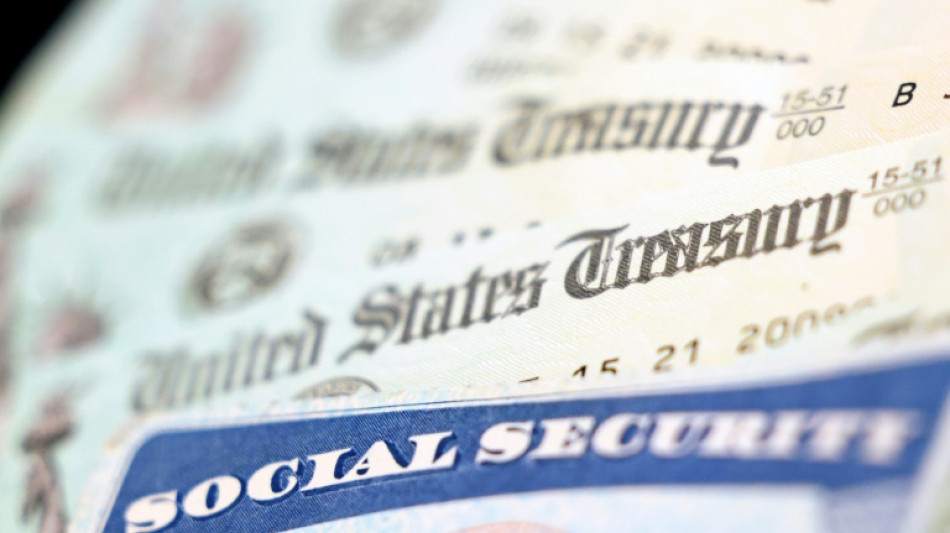
Social Security, healthcare, veterans likely casualties of US debt default / Photo: Kevin Dietsch - GETTY IMAGES NORTH AMERICA/AFP

 Zverev thrashes Shang to set up Djokovic quarter-final at China Open

 Turkey football ref chief jailed pending trial for graft

 North Korea says test of intermediate-range strategic missile included use of AI

 Rampant Sayers leads Hong Kong to third men's rugby gold in a row

 Ethiopia's Tigray rebels abandon regional capital as govt advances

 Bulgaria's Tsar Samuel returns 'home' after 1,000 years

 'Glad it's over': Kim powers to Games gold and military exemption

 After 11 World Cups, football finally comes home for one Indian fan

 Marc Marquez wins sprint at Japan MotoGP, Martin grabs pole

 Alcaraz fends off Arnaldi to reach Japan Open quarters

 Antonelli tops times in final practice at Bahrain GP

 Gauff digs deep to beat Osorio in China Open second round

 Fresh protests to hit Spain after housing measures defeated

 'He's here with me': Japan cycle queen dedicates gold to late brother

 Japan Olympic chief says 'lot more' athletes at Games than expected

 Asian carmakers besting US rivals at home, China poised to strike

 Widgets & Web Offers All-Inclusive Investor Relations Websites for Public Companies, IPOs and SPACs

 New "What Is a Gold IRA?" Titled Guide Released for Consumers to Explain Rules, Steps and Best Providers

 Botched US execution leaves murderer unconscious on ventilator: lawyers

 Cornell rape case exposes sexual violence at US colleges

 France held by Italy in Zidane's homecoming after Olise stunner

 Ethiopian pro-government militia claims Tigray airport as regional tensions spike

 Ohtani shaking off injuries as Dodgers launch MLB post-season

 Sea levels to rise in California as coastal wave surges up west coast
 New rallies urged in France as protests disrupt over 730 schools

The White House and Congressional Republicans are still locked in crunch talks to try and avert the first debt default in US history, which Treasury officials have warned could come as soon as June 1.
The US borrows more than it brings in through taxes, and so Congress periodically has to authorize an increase to the US debt limit, known as the debt ceiling, which currently sits at more than $31 trillion.
While the probability that policymakers fail to lift or suspend the debt ceiling remains low, the risks of the United States stumbling into a situation where it cannot meet all its financial obligations -- known as the "X-date", rises with every day that passes.
If the US Treasury hits the debt ceiling and -- as many analysts predict -- it prioritizes debt repayments, it will be forced to pause spending on federal programs that provide crucial financial support to tens of millions of Americans.
"We would simply not have enough cash to meet all of our obligations," US Treasury Secretary Janet Yellen said earlier this month.
Here's how things are likely to play out in such a scenario:
- Payments defered? -
The Washington Post reported Tuesday that the Treasury Department has begun asking federal agencies to look into the feasibility of deferring scheduled payments if the US blows through the debt ceiling.
A Treasury spokesperson declined to comment on the reports.
Deferring payments, even for a few days, could have severe consequences for Social Security, Medicare and Medicaid programs which help tens of millions of people with pension and healthcare costs.
The budgets for these programs accounted for more than 45 percent of the $6.27 trillion government budget last year.
The impact on this chunk of federal spending would likely be immediate if the US runs out of money to meet its obligations in time.
On June 1, for instance, the Treasury is due to make a payment of $47 billion to Medicare providers, with $25 billion in Social Security payments due the following day. Further such payments are scheduled over the next few days.
Past and present military personnel would also likely be hit if the US misses the X-date, as a large share of their pay and benefits are paid on the first of the month.
The nonpartisan Congressional Budget Office estimated recently that around $25 billion in payments to military personnel, civil servants and others are due on June 1.
- Unpalatable options -
Pausing or delaying payments may help the US government survive a few days on the other side of the X-date, but it will only work for so long.
If the tug-of-war between Republicans and Democrats continues, the federal government may need to consider an even less palatable scenario: choosing which bills to pay and which to skip.
Such an eventuality could have severe knock-on effects for the most vulnerable Americans, including pensions going unpaid, healthcare providers refusing to take care of patients with Medicare or Medicaid, and insurance premiums rising.
Another option available to the government would be to start selling government assets to ensure it can continue paying pensions and healthcare costs.
According to Treasury data, the Social Security Administration had more than $2.8 trillion in assets at the end of April, making it the largest holder of Treasury bonds in the world.
But such a solution would be fraught with political risk for Joe Biden, according to Robert Hockett, a law professor at Cornell University.
In such a scenario, Republicans could attack Biden over his failure to control spending, he said.
With many of the Treasury's options after the X-date unpalatable to politicians on both sides of the aisle, both parties are backing the talks between Biden and McCarthy, and hoping negotiators can secure a deal before then.
R.Garcia--AT