India's G20 tourism meet begins in Kashmir under tight security

 'Glad it's over': Kim powers to Games gold and military exemption
 After 11 World Cups, football finally comes home for one Indian fan
 Marc Marquez wins sprint at Japan MotoGP, Martin grabs pole
 Alcaraz fends off Arnaldi to reach Japan Open quarters
 Antonelli tops times in final practice at Bahrain GP
 Gauff digs deep to beat Osorio in China Open second round
 Fresh protests to hit Spain after housing measures defeated
 'He's here with me': Japan cycle queen dedicates gold to late brother
 Japan Olympic chief says 'lot more' athletes at Games than expected
 Asian carmakers besting US rivals at home, China poised to strike
 Widgets & Web Offers All-Inclusive Investor Relations Websites for Public Companies, IPOs and SPACs

 Adams named new US captain to 2030 World Cup

 China a better influence in Latin America than US: poll
 Judge pauses construction of border project in Texas national park

 Belgium's De Bruyne fires double to sink Turkey, France held by Italy
 US jobs data boosts stocks as oil prices dip

 US Supreme Court to hear high-stakes climate case
 Trump expected to name intel chief Clayton as AI czar: reports
 Argentina unveils passports-for-investment scheme

 Brazil election debate chaos sparks censorship row
 England's Carse charged by cricket body over nightclub incident

 Amazon vows $1 bn for data center towns, decries 'myths'
 Oil prices drop on G7 fuel release, US jobs data boosts stocks

 G7 agrees deal to ease global energy supply concerns

 Spain's government dealt blow as lawmakers reject housing bills
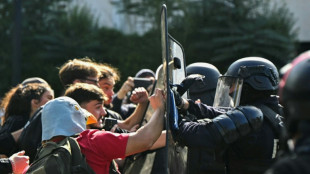
A G20 tourism meeting began on Monday under tight security in Indian-administered Kashmir, as New Delhi seeks to project an image of normalcy in a region wracked for decades by violence.
Both China and Pakistan have condemned holding the event in the disputed Muslim-majority territory, which is split between New Delhi and Islamabad, both of whom claim it in full.
Over the decades an insurgency seeking independence or a merger with Pakistan has seen tens of thousands of civilians, soldiers and rebels killed.
But India wants to show that what officials call "normalcy and peace" are returning to the region after New Dehli revoked its limited autonomy and took direct control in 2019, imposing an extended lockdown.
Since then, the rebels have largely been crushed -- although young men continue to take up arms -- and the annual death toll, once in the thousands, has been on a downward trend, with 253 fatalities last year.
Now India is promoting tourism in the region, with its spectacular mountain scenery and signs at the airport declaring it "paradise on earth".
More than a million Indian citizens visited last year, to the delight of local tourism businesses.
But dissent has been criminalised, media freedoms curbed and public protests limited, in what critics say is a drastic curtailment of civil liberties by New Delhi.
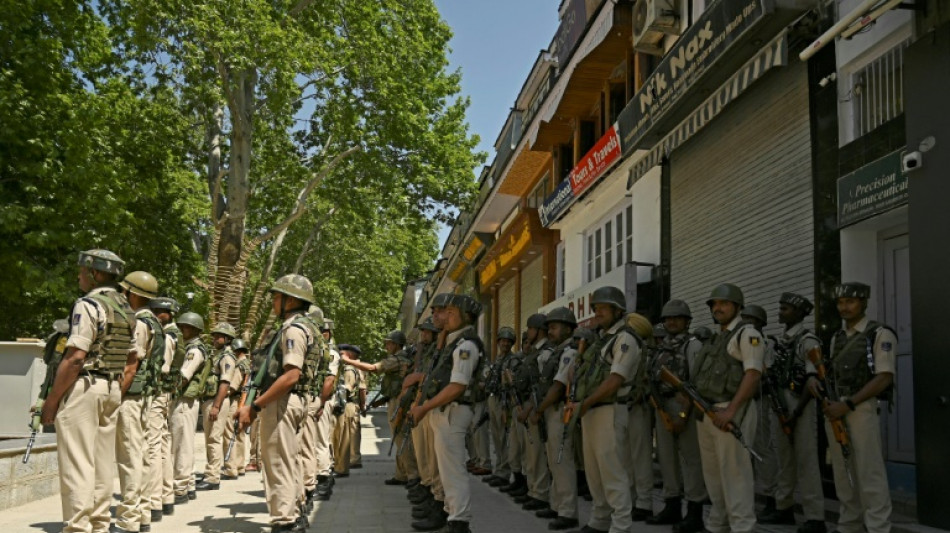
Police said last week that security had been beefed up "to avoid any chance of terrorist attack during the G20" meeting, and on Monday soldiers and armoured vehicles were deployed at multiple locations in Srinagar.
But many checkpoints -- wrapped in metal mesh and barbed wire -- had been dismantled overnight, and some paramilitary police stood hidden behind G20 advertising panels in what appeared to be an effort to minimise the security forces' visibility.
The People's Anti-Fascist Front, a new rebel group that emerged in Kashmir after 2019, issued a statement condemning the event and threatening to "deploy suicide bombers".
"Today, tomorrow or day after. It will come," it said.
- 'Terrorist-infested places' -
The three-day gathering will take place at a sprawling, well-guarded venue on the shores of Dal Lake in Srinagar.
Two Indian government ministers are attending, but several Western nations are sending only locally based diplomatic staff.
G20 member China, which has its own territorial disputes with India, has refused to attend, and no delegations are expected from Turkey or Saudi Arabia.
Meanwhile, questions have been raised over the choice of location.
"Does the Modi government think that tourism can be promoted in closed conference halls next to a scenic lake being patrolled by marine commandos, with surveillance drones overhead?" columnist Bharat Bhushan wrote in the Deccan Herald newspaper.
"Such staged events make it clear that the situation in J&K (Jammu and Kashmir) is far from normal."
To visit Kashmir, foreign journalists require special permission, which is not normally forthcoming, though it has been granted for the event.
The permits are valid only for coverage of the G20 meeting itself and limited to the city of Srinagar. Holders are required not to "propagate anti-India narratives", nor visit "terrorist-infested places without prior permission".
India holds the G20 presidency for 2023, and has planned more than 100 meetings across the country.
It is locked in a military standoff with China along their mostly undemarcated border in the Ladakh region.
Beijing also claims the Indian state of Arunachal Pradesh in full as part of Tibet, and it considers Kashmir a disputed territory.
"China firmly opposes holding any form of G20 meeting in disputed territory and will not attend such meetings," foreign ministry spokesman Wang Wenbin told reporters last week, after Beijing also stayed away from events in both Ladakh and Arunachal Pradesh.
Non-G20 member Pakistan controls a smaller part of Kashmir, and accused India of "arrogance" and violating international law by holding the tourism meeting in the territory, triggering a sharp retort from New Delhi.
India accuses Pakistan of training and supporting militants in Kashmir, which Islamabad denies.
Last week, the UN Special Rapporteur on Minority Issues, Fernand de Varennes, said New Delhi was seeking to use the G20 meeting to "portray an international seal of approval" on a situation that "should be decried and condemned". India rejected the comments.
Residents have chafed under the stepped-up security measures.
Hundreds have been detained in police stations and thousands, including shopkeepers, have received calls from officials warning against any "signs of protest or trouble", a senior official told AFP on condition of anonymity.
P.Smith--AT