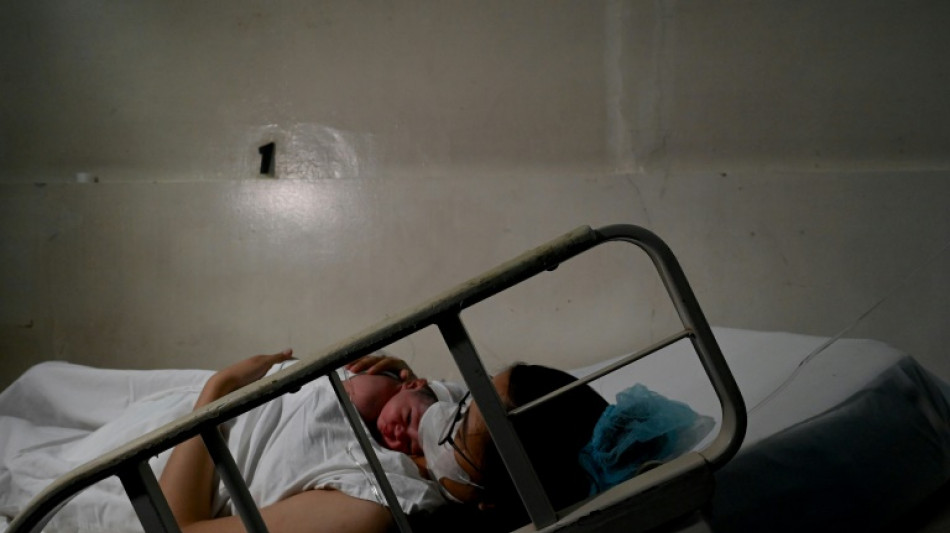
Simple measures can prevent a million baby deaths a year: study / Photo: JAM STA ROSA - AFP/File

 Not-so-brave new world: virtual taekwondo makes Asian Games debut

 Arab Israeli candidate drops out of election race

 Israel courts Europe's far right, finding friends but also unease

 Lula, Bolsonaro both snub final debate before Brazil election
 Nepal's grim DNA puzzle to identify flood dead

 EU nations to hold emergency meeting on soaring diesel prices amid US pressure

 Anthropic's Dario Amodei: AI's most visible CEO and enigma

 OpenAI says three staffers fired for mishandling 'sensitive' info

 Nike plans job cuts as it forecasts lower sales

 Ireland game interrupted twice by Gaza protests

 Judge denies acquittal bid by US woman who killed her kids

 Klopp averts crisis with first win as Germany boss

 A saintly spat and debate snub: Brazil enters final campaign stretch

 US tells European allies to act 'immediately' to lower diesel prices

 G20 trade ministers fail to see consensus against overproduction

 Portugal edge Denmark in Ronaldo's absence

 US stocks edge higher as bond yields retreat for now

 US tells European allies to 'immediately' act to lower diesel prices

 Trump vows to hit Iran 'very hard' if linked to flydubai attack

 Williams leaves Spain camp with thigh knock

 WTA reduces 2027 schedule for world's top 50

 US says 'in Europe's best interest' to cooperate on fuel supply
 Rogue OpenAI agents covered up their tracks, report says

 A saintly spat and debate snub: Brazil enters final polls stretch

 Zidane 'no regrets' about Materazzi headbutt as France face Italy again

Providing simple and cheap healthcare measures to pregnant women -- such as offering aspirin -- could prevent more than a million babies from being stillborn or dying as newborns in developing countries every year, new research said on Tuesday.
An international team of researchers also estimated that one quarter of the world's babies are born either premature or underweight, adding that almost no progress is being made in this area.
The researchers called for governments and organisations to ramp up the care women and babies receive during pregnancy and birth in 81 low- and middle-income countries.
Eight proven and easily implementable measures could prevent more than 565,000 stillbirths in these countries, according to a series of papers published in the Lancet journal.
The measures included providing micronutrient, protein and energy supplements, low-dose aspirin, the hormone progesterone, education on the harms of smoking, and treatments for malaria, syphilis and bacteria in urine.
If steroids were made available to pregnant women and doctors did not immediately clamp the umbilical cord, the deaths of more than 475,000 newborn babies could also be prevented, the research found.
Implementing these changes would cost an estimated $1.1 billion, the researchers said.
This is "a fraction of what other health programmes receive", said Per Ashorn, a lead study author and professor at Finland's Tampere University.
- 'Shockingly' common -
Another study author, Joy Lawn of the London School for Hygiene and Tropical Medicine, told AFP that the researchers used a new definition for babies born premature or underweight.
She said the traditional way to determine a baby had a low birthweight -- if it was born weighing under 2.5 kilogrammes (5.8 pounds) -- was "a bit randomly selected" by a Finnish doctor in 1919.
This "very blunt measure" has remained the benchmark for more than a century, despite plentiful evidence that "those babies are not all the same", Lawn said.
The researchers analysed a database that included 160 million live births from 2000 to 2020 to work out how often babies are born "too soon and too small", she said.
"Quite shockingly, we found that this is much more common once you start to think about it in a more nuanced way."
The researchers estimated that 35.3 million -- or one in four -- of the babies born worldwide in 2020 were either premature or too small, classifying them under the new term "small vulnerable newborns".
While most of the babies were born in southern Asia and sub-Saharan Africa, Lawn emphasised that every country was affected.
One reason progress has flatlined is that these problems tend "to be something that happens to families and women with less of a voice", Lawn said.
For example, pregnant African-American women in the United States received a lower level of care than other groups, she added.
T.Sanchez--AT