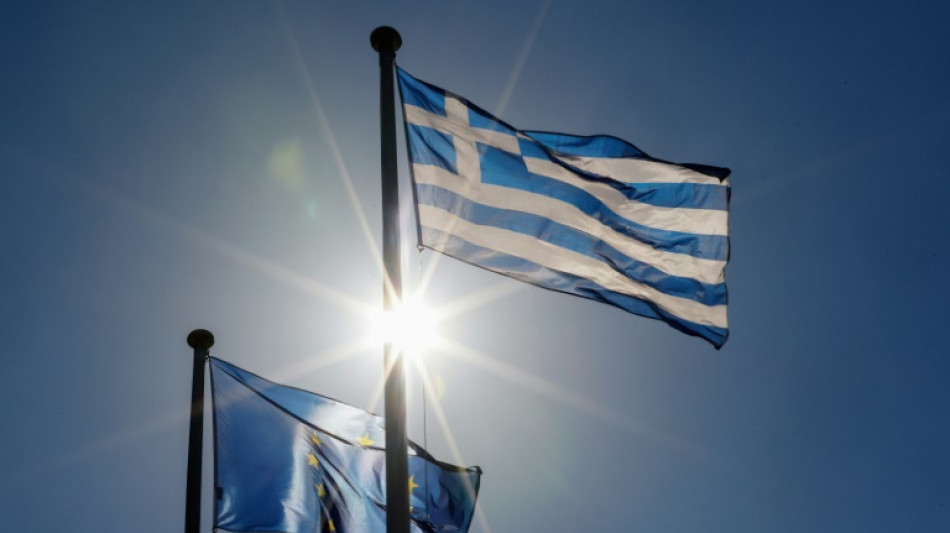
Main points of Greece's May 21 ballot / Photo: David GANNON - AFP

 Asian stocks drop as oil spike fans rate hike bets, eyes on US jobs
 Viral anti-vax posts weaponise Philippine inoculation fears
 Saudi coalition accuses Houthis of drone attack on Medina
 Effective Altruism: the philosophy behind Silicon Valley's AI fears
 Chinese judoka accused of biting as home hope wins Asian Games gold

 Four-member crew docks at International Space Station

 Portugal win without Ronaldo as Klopp's Germany get first victory

 Wemby: 'Very sad' to see players endorse betting firms

 Manchester City Women scrape draw with Real Madrid

 India, Australia and Pakistan in same World Cup group

 Daryz's hopes of repeat Arc win boosted by draw
 Steelers ship disgruntled defender Porter to Cowboys

 Klopp gets first win as Germany boss

 Bolivia's attorney general arrested on drugs, money laundering charges
 Raiders host Chiefs in battle of unbeaten division rivals
 Lowest Fee Bitcoin ATMs Announces Launch of More Than 400 ATMs Nationwide

 G20 against 'weaponization' of food trade: French minister

 Female US inmate in critical condition after botched execution

 Spotlight on UK-UAE ties amid Manchester City scandal
 Ethiopia and Eritrea break diplomatic ties over conflict

 Downing Street says Manchester City not 'above the rules'

 Hadjar wants to 'fight for the title' from next season

 Bolivia's attorney general arrested for alleged drug trafficking, money laundering
 German sugar tax sparks new government row
 Musk returns to US government for Pentagon war study

Greece holds its most unpredictable election in over a decade on May 21.
It is expected to be a close contest between the conservative New Democracy of outgoing Prime Minister Kyriakos Mitsotakis and the left-wing Syriza of former premier Alexis Tsipras.
This is what is at stake in the ballot in the eastern Mediterranean country of 10.5 million, which is almost certain to be followed by a second election in around a month's time:
- Heading right, or left? -
In power since July 2019, New Democracy has not once fallen behind Syriza in the polls and continues to lead by 2.5 to seven points according to different surveys.
The ruling party is even seeing a small rebound since February, when the country went into collective shock and massive protests were held over the deaths of 57 people in a train collision that was Greece's worst-ever rail disaster.
In the polls, New Democracy and Syriza supporters constitute nearly 50 percent of respondents. But the determining factor is the undecided voters, who are measured at over 10 percent.
A total of 36 parties are eligible to participate in the election. Parties need a minimum three percent of the vote to enter the 300-seat parliament.
Four other parties already in parliament alongside New Democracy and Syriza are a safe bet to return -- the Pasok-Kinal socialists led by former Euro MP Nikos Androulakis, the KKE communists, the Greek Solution nationalists and MeRA25, headed by left-wing, anti-austerity former finance minister Yanis Varoufakis.
- Coalition dilemma -
The election will take place under an electoral law passed by the Tsipras administration (2015-2019). Its objective is to ensure that as many parties as possible are represented in parliament, with an eye in encouraging coalition governments.
But in a country with a very polarised political discourse and little experience with coalitions, an agreement between the parties remains a difficult equation, making a second vote all but certain.
- Second vote gambit -
Kyriakos Mitsotakis wants to avoid having to form a government with other parties. In his campaign speeches, he has clearly stated his preference for a second ballot, which will be held under a different electoral law passed by his own government.
This law gives a bonus of up to 30 seats to the victor, depending on the final results.
The scion of a political dynasty whose father was also prime minister, Mitsotakis has said that in a second ballot, the objective of a "stable and strong right-wing government will be achievable".
Alexis Tsipras, twice elected prime minister in back-to-back elections in 2015, wants to "put an end to" political families which dominate political life, cultivating "favouritism" and "corruption". He has not ruled out a coalition with the Pasok-Kinal socialists.
- Recovery and inflation -
After a ruinous decade of economic crisis between 2010 and 2018, Greece has experienced significant growth in recent years.
Output jumped by 5.9 percent last year, mainly fuelled by tourism, merchant shipping and construction.
Mitsotakis' outgoing government forecasts 2.3-percent growth in 2023.
But the country's debt, at 171.3 percent of GDP in 2022, is a longstanding concern.
Unemployment also remains high at 12.4 percent, especially among the young, nearly a quarter of whom are out of work.
An inflationary wave driven by the energy crisis and a rise in prices and housing costs is a key concern for voters. Inflation in 2002 stood at 9.6 percent.
- Rights vs security -
Greece is one of the main entry points for migrants seeking to reach the European Union along a route via neighbouring Turkey. Under Mitsotakis it has adopted a hard line, sealing its borders with help from EU border agency Frontex.
The outgoing government has been accused of illegal migrant pushbacks, which it consistently denies.
Domestically, police repression intensified during the coronavirus pandemic, with its strict confinement rules.
A wiretapping scandal in which politicians and journalists were last year revealed to have been under surveillance was a serious blow to public perceptions regarding the rule of law. It was also seen as a serious violation of press freedom.
O.Ortiz--AT