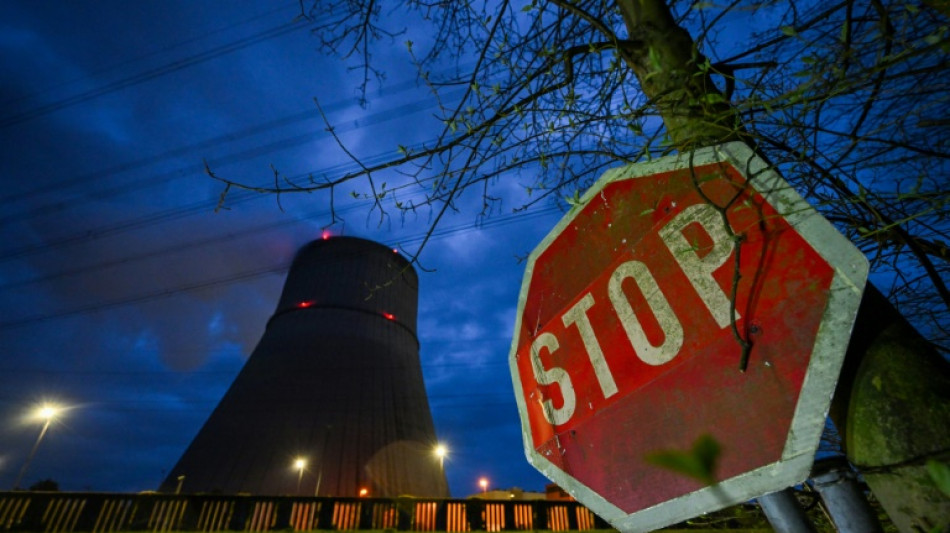
Germany ends nuclear era as last reactors power down / Photo: Ina FASSBENDER - AFP

 In Manchester, people say City scandal is 'shame for football'
 Stocks lacklustre as inflation data weighs on sentiment
 Israel-bound plane rerouted, pilots wounded in reported fight
 Truth commission on Sweden's Sami people seeks redress

 Energy costs spark inflation surges in France, Italy

 South Korea break China hearts to reach Asian Games football final
 Eala storms into Asian Games semi-finals to thrill adoring fans

 Turkey freezes ex-minister's assets as fund crisis grows
 What we know about the North Korean POW dispute

 Most equities rise after oil price plunge, US data in focus
 Polar oceans transformed as warming melts ice habitats: research

 Lost shark becomes viral star in South Korea
 Dangote to launch $16bn refinery in Kenya
 North Korean leader 'extremely obese': Seoul spy agency
 Yankees and pope-backed White Sox start MLB playoffs with wins
 Malaysia's ex-PM Mahathir in hospital for observation
 'No limits': Marathon world record holder Sawe chasing history
 Countdown begins to biggest-ever Rugby World Cup
 Bangladesh women lose ground after quota reform
 Vietnam admits 'differing opinions' on Hanoi development
 Stocks temper gains as oil pares heavy losses, US data in focus
 New Zealand denies breaching climate commitments to EU
 Albert becomes youngest US scorer in 4-2 win over Chile
 Pirate island's plunging population shows Greece's demographic decline
 With elections ahead, Latvia's Russian-speakers reject Moscow's help
Germany will switch off its last three nuclear reactors on Saturday, exiting atomic power even as it seeks to wean itself off fossil fuels and manage an energy crisis caused by the war in Ukraine.
While many Western countries are upping their investments in atomic energy to reduce their emissions, Germany is bringing an early end to its nuclear age.
Europe's largest economy has been looking to leave behind nuclear power since 2002, but the phase-out was accelerated by former chancellor Angela Merkel in 2011 after the Fukushima nuclear disaster in Japan.
The exit decision was popular in a country with a powerful anti-nuclear movement, stoked by lingering fears of Cold War conflict and atomic disasters such as Chernobyl in Ukraine.
"The risks of nuclear power are ultimately unmanageable," said Environment Minister Steffi Lemke, who this week made a pilgrimage to the ill-fated Japanese plant ahead of a G7 meeting in the country.
But the challenge caused by Russia's invasion of Ukraine, which put an end to cheap gas imports, and the need to quickly cut emissions has upped calls in Germany to delay the withdrawal from nuclear power.
- 'A mistake' -
Initially planned for the end of 2022, Germany's nuclear exit has already had to be pushed back once.
As Russian gas supplies dwindled last year, officials in Berlin were left scrambling to find a way to keep the lights on, with a short extension agreed until mid-April.
Germany, the largest emitter in the European Union, also powered up some of its mothballed coal-fuelled plants to cover the potential gap left by gas.
The perilous context has increased calls domestically to delay the nuclear exit.
Germany had to "expand the supply of energy and not restrict it any further" in light of potential shortages and high prices, the president of the German chambers of commerce Peter Adrian told the Rheinische Post daily.
The conservative leader of Bavaria Markus Soeder meanwhile told the Focus Online website that he wanted the plants to stay online and three more to be kept "in reserve".
Outside observers have been similarly irked by Germany's insistence on exiting nuclear while ramping up its coal usage, with climate activist Greta Thunberg in October slamming the move as "a mistake".
- 'Sooner or later' -
At the Isar 2 complex in Bavaria, technicians will progressively shut down the reactor from 10:00 pm (2000 GMT) on Saturday, severing it from the grid for good.
By the end of the day, operators at the other two facilities, in northern Emsland and southwestern Neckarwestheim, will have taken their facilities offline as well.
The three final plants provided just six percent of Germany's energy last year, compared with 30.8 percent from all nuclear plants in 1997.
"Sooner or later" the reactors will start being dismantled, Economy Minister Robert Habeck told the Funke group ahead of the scheduled decommissioning, brushing aside the idea of an extension.
The government has the energy situation "under control", Habeck assured, having filled gas stores and built new infrastructure for the import of liquefied natural gas to bridge the gap left by Russian supplies.
Instead, the minister from the Green party, which was founded on opposition to nuclear power, is focused on getting Germany to produce 80 percent of its energy from renewables by 2030.
To this end, Chancellor Olaf Scholz has called for the installation of "four to five wind turbines a day" over the next few years -- a tall order given that just 551 were installed last year.
But the current rate of progress on renewables could well be too slow for Germany to meet its climate protection goals.
Despite planning to exit nuclear, Germany has not "pushed ahead enough with the expansion of renewables in the last 10 years", Simon Mueller from the Agora Energiewende think tank told AFP.
To build enough onshore wind capacity, according to Mueller, Germany now has to "pull out all the stops".
A.O.Scott--AT