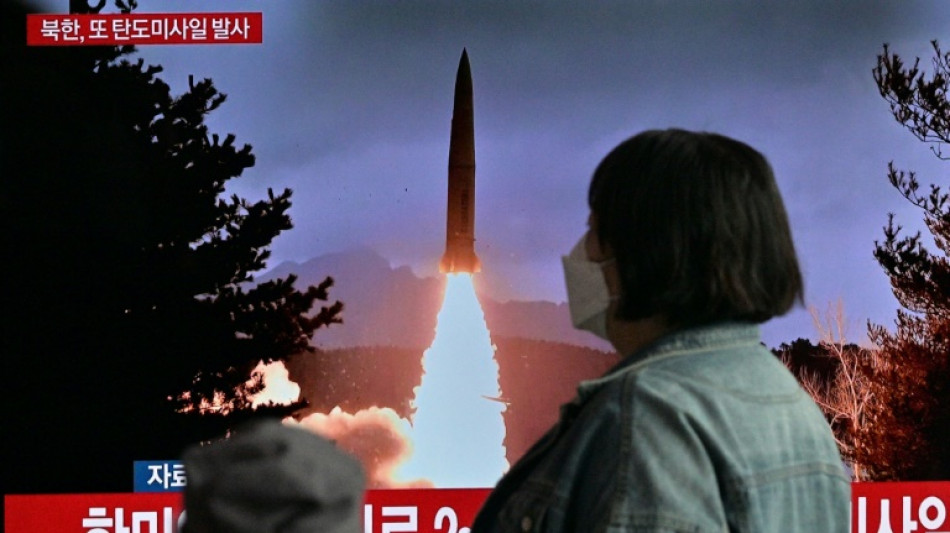
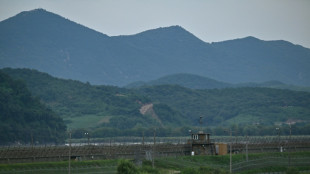
North Korea fires short-range ballistic missile / Photo: Anthony WALLACE - AFP

 Colombian police capture wife, daughter of Ecuador drug lord

 More Asian Games woes as bus takes Pakistan team to wrong venue
 Radio frequencies vital to Earth observation must be protected: UN
 Comedian on trial for insulting Erdogan in standup show

 Women's Fashion Week kicks off in Paris

 Pope arrives in French border city to speak on united Europe
 The wildfires choking Indonesia, sparking regional haze
 PU Prime Deepens Argentina Presence Through FX Expo Buenos Aires 2026

 Nothing to seal here: NZ police help stranded pup home
 White House releases list of products US, China could tax less
 'Pseudo-journalism': Partisan 'news' sites target US midterms

 'Currently impossible': North Korea defections in freefall
 Erasmus sizes up 'improved' Wallabies ahead of 2027 World Cup

 Scandal-weary Brazilians to vote as Lula faces Bolsonaro son

 SpaceX aims to put Starship in orbit for the first time
 Pope to speak on united Europe from French border town

 Fulcrum Metals PLC Announces Interim Results for the six months to 30 June 2026

 Hemogenyx Pharmaceuticals PLC Announces Half-year Financial Report

 Eagle Plains' Partner Xcite Uranium Intersects Anomalous Radioactivity at Lorado and Commences Drill Program at the Gulch Uranium Project, Saskatchewan

 DataMeds AI and Tollo Health Announce Launch of 'Health Lives Here' Mobile Application

 Scheffler makes sportsmanship stand over tee screamer

 Anthropic CEO Amodei to dine with Trump at White House

 Dupont scores twice to send Toulouse to Top 14 summit

 Greece stun Klopp's Germany as Ireland show sorrow for Gaza

 Ramos fires holders Portugal to Nations League win in Norway

North Korea fired a short-range ballistic missile on Sunday, Seoul's military said, the fourth show of force in a week as South Korea and the United States stage major military drills.
Seoul and Washington have ramped up defence cooperation in the face of growing military and nuclear threats from the North, which has conducted a series of increasingly provocative banned weapons tests in recent months.
South Korea and the United States are currently in the middle of 11 days of joint drills known as Freedom Shield, their largest in five years.
North Korea views all such exercises as rehearsals for invasion and has repeatedly warned it would take "overwhelming" action in response.
"Our military detected one short-range ballistic missile fired from around the Tongchang-ri area in North Pyongan province at 11:05 am (0205 GMT) towards the East Sea," South Korea's Joint Chiefs of Staff (JCS) said, referring to the body of water also known as the Sea of Japan.
The missile flew 800 kilometres (497 miles) and was under analysis by US and South Korean intelligence, the JCS said in a statement, calling the launch "a serious provocation" that violated UN sanctions.
"Our military will maintain a solid readiness posture based on its ability to overwhelmingly respond to any provocation by North Korea, while carrying out intensive and thorough combined exercises and drills," it added.
The US military's Indo-Pacific Command also condemned the launch, saying it highlighted "the destabilising impact" of North Korea's banned weapons programmes.
Tokyo confirmed the launch, with its deputy defence minister Toshiro Ino telling reporters that it had "lodged a vehement protest to and strongly condemned (North Korea) through our embassy in Beijing".
The missile may have flown on an irregular trajectory, and appeared to have fallen outside Japan's exclusive economic zone, Kyodo News reported, citing unnamed government sources.
- '800,000 volunteers' -
The latest launch comes a day after North Korean state media reported that more than 800,000 young North Koreans had volunteered to join the army to fight "US imperialists".
The young volunteers were determined to "mercilessly wipe out the war maniacs" and joined the army to "defend the country", the Korean Central News Agency (KCNA) said.
On Thursday, Pyongyang test-fired its largest and most powerful intercontinental ballistic missile, the Hwasong-17 -- its second ICBM test this year.
State media described the ICBM launch as a response to the ongoing, "frantic" US-South Korea drills.
Analysts previously said North Korea would likely use the drills as an excuse to carry out more missile launches and perhaps even a nuclear test.
On Saturday, KCNA said the joint drills by the allies were "inching close to the unpardonable red-line".
The ICBM launch followed two short-range ballistic missiles on Tuesday, and two strategic cruise missiles fired from a submarine last Sunday.
The recent flurry of aggression by Pyongyang has pushed Seoul and Tokyo to mend fences over historical disputes and try to boost security cooperation.
Just hours after the ICBM was fired Thursday, South Korean President Yoon Suk Yeol arrived in Japan for the first full-scale leaders' summit between the countries in 12 years.
Following their summit, Japanese Prime Minister Fumio Kishida said both countries wanted stronger deterrence capacities, and that suspended security and ministerial talks would now resume. Yoon said the nations would also revive a military intelligence agreement that Seoul paused when relations nosedived.
Last year, North Korea declared itself an "irreversible" nuclear power, and leader Kim Jong Un recently called for an "exponential" increase in weapons production, including tactical nukes.
Kim earlier this month also ordered the North Korean military to intensify drills to prepare for a "real war".
P.Hernandez--AT