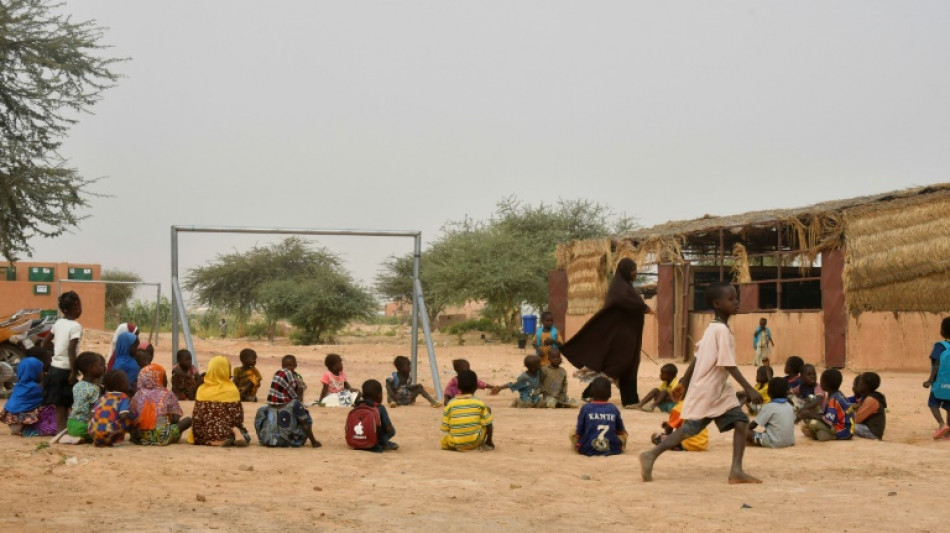
Ten million children in Sahel face 'extreme jeopardy': UN / Photo: BOUREIMA HAMA - AFP/File

 Messi and Alcaraz love it, now padel takes step closer to Olympics

 Tolls mount in Thailand, Myanmar floods
 Why India's opposition wants top poll official out

 PU Prime Strengthens UAE Momentum with Strong Showing at Forex Expo Dubai 2026

 Eight dead in Thailand floods since mid-September
 Oil prices spike after Trump rejects Iran truce offer

 Taylor Swift sets new record at MTV VMAs
 Seoul seeks apology after Ukraine reveals transfer of North Korean POWs

 Messi on target again but Miami downed by Columbus

 In Washington's political cauldron, a fight over foie gras

 Flavio Bolsonaro: political heir in his father's shadow

 Ravens grab last-second win in Rio as Commanders stop Seahawks

 Caledonia Mining Corporation Plc: Notification of Relevant Change to Significant Shareholder
 InterContinental Hotels Group PLC Announces Transaction in Own Shares - September 28

 Scheffler makes sportsmanship stand over tee screamer

 Anthropic CEO Amodei to dine with Trump at White House

 Dupont scores twice to send Toulouse to Top 14 summit

 Greece stun Klopp's Germany as Ireland show sorrow for Gaza

 Ramos fires holders Portugal to Nations League win in Norway

 Greece hand Klopp first defeat as Germany manager

 Pope promises French sex abuse victims to prevent further harm

 UK village on edge over threats to air base in terror alert

 Two giant pandas, emblems of China soft diplomacy, arrive in US

 Aleksandar Vucic: from Milosevic minister to long-serving Serbian statesman

 Trump expects new Iran talks despite rejecting deal offer

Ten million children in west Africa's central Sahel region are now in "extreme jeopardy" and desperately need humanitarian help due to worsening violence, the United Nations warned Friday.
The number of children in dire need of aid in Burkina Faso, Mali and Niger is twice as many as in 2020, the children's agency UNICEF said.
Meanwhile a further four million children are at risk in neighbouring countries as battles between armed groups and security forces spill across the borders.
"Children are increasingly caught up in the armed conflict, as victims of intensifying military clashes, or targeted by non-state armed groups," Marie-Pierre Poirier, UNICEF's regional director for west and central Africa, said.
"The year 2022 was particularly violent for children in the central Sahel. All parties to the conflict need to urgently stop attacks both on children, and their schools, health centres, and homes."
The region has been caught in a spiral of jihadist violence for years, with Mali struggling with an 11-year-old insurgency that has claimed thousands of lives and forced hundreds of thousands from their homes.
Meanwhile Burkina Faso, one of the world's most volatile and impoverished countries, witnessed two military coups in 2022.
UNICEF said the armed conflict engulfing the region had become increasingly brutal, with some groups that operate across vast swathes of territory blockading towns and sabotaging water networks.
- Schools burned, looted -
In Burkina Faso, three times as many children were verified as killed during the first nine months of 2022 as in the same period in 2021, according to UN data.
Most died from gunshot wounds during attacks on their villages or as a result of improvised explosive devices or explosive remnants of war.
Armed groups which oppose state education "systematically burn and loot schools, and threaten, abduct or kill teachers", said UNICEF.
More than 8,300 schools have shut down across the three countries: more than one in five in Burkina Faso, while nearly a third of schools in Niger's Tillaberi region are no longer functional.
James Jones, UNICEF spokesman for the region, detailed "the extreme jeopardy facing the lives and futures of children in the central Sahel".
"Things have been accelerating downhill at an alarming pace," he told reporters in Geneva.
"Slowly and surely it has been spreading, and children -- millions of them -- are increasingly in the middle of it."
He said there were several factors behind the worsening trends, including higher food prices, chronic underfunding of humanitarian and development work, a lack of national commitment to child services, and climate change, with temperatures rising in the Sahel 1.5 times faster than the global average.
UNICEF called on all parties to the conflict to fulfil their "moral and legal obligations" towards children under international law, including ending attacks on youngsters and schools.
- Spreading southwards -
UNICEF said the violence was spreading from the central Sahel into the northern regions of Benin, Ivory Coast, Ghana and Togo, which are remote communities where children have very limited access to protection and services.
"Insecurity is growing in these coastal countries, linked to similar activities by non-state armed groups," said Jones.
In 2022, UNICEF received only a third of the $391 million sought for the central Sahel appeal.
In 2023, it has appealed for $473.8 million for the humanitarian response plan in the central Sahel and neighbouring coastal countries.
The crisis needs long-term investment to foster "social cohesion, sustainable development, and a better future for children," Poirier said.
W.Stewart--AT