From his farm to Alaska, Jimmy Carter leaves environmental legacy / Photo: Brendan Smialowski - AFP

 Iran proposes Hormuz plan, Trump reportedly refuses
 El Nino rewrites the menu in the world's top restaurants
 Pope to hold giant mass on Champs-Elysees

 TikTok to pay Alabama $100 mn under pre-trial settlement

 Internationals take 7-3 Presidents Cup lead after foursomes sweep
 Brazil team returns to Colombian site of doomed jet crash

 Mbappe injured as Zidane wins on France debut, Italy lose on Mancini return

 Senegal draw in Vieira debut, Nigeria survive scare as Cape Verde crash

 U2 performs surprise 50th anniversary gigs in Dublin

 Pope calls worshippers 'saints of France' after AI warning

 US court sides with Pentagon in Anthropic AI ban

 Wall Street stocks rise, greeting optimism over possible US-Iran deal

 NFL players chief raises concerns over pitch for Maracana game

 Daytime Russian attacks kill seven in Kyiv

 Spotting AI writing: how reliable are the detectors?

 French youth await pope after AI 'paradise of machines' warning

 Man City found guilty of Premier League charges, set to appeal: reports

 Embolo follows Xhaka out of Swiss squad over fake Covid documents
 Trump, Xi inspect founding documents of US democracy to close summit

 'Bottle Claus': Kipchoge's 'hero' helping runners chase Berlin marathon glory

 Olympic medallist Samba-Mayela handed provisional doping ban

 First US trial against TikTok to open Monday

 Palmer misses 'too many' England games, says Tuchel

 UN refugees chief warns conditions in W.Sahara 'deteriorating'

 Antonelli 'mad' about crash in Azerbaijan qualifying
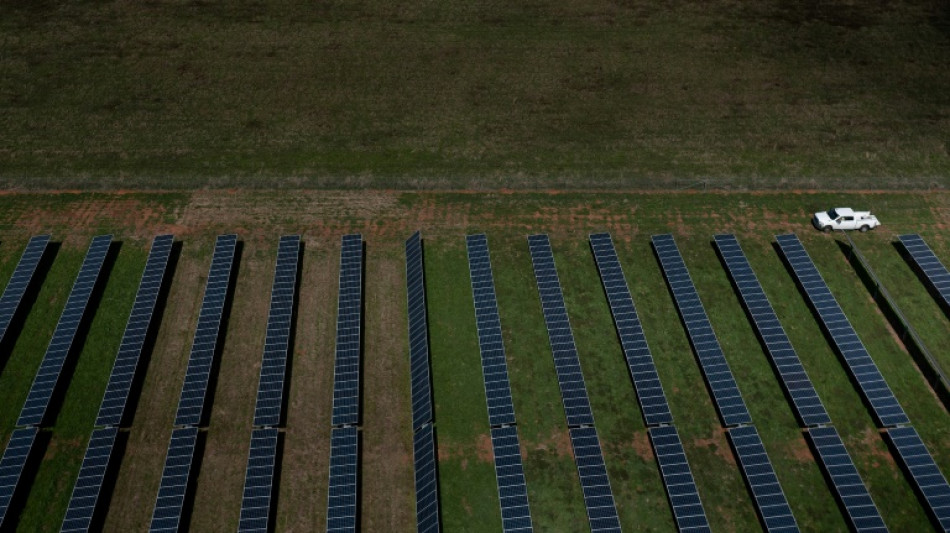
Several thousand solar panels bake under an unseasonably warm February sun in Plains, Georgia, one of the many projects that bolster the environmental record of local icon and former US president Jimmy Carter.
They are located on a plot of land belonging to Carter that now produces green energy rather than the region's cash crops such as peanuts, cotton and corn.
"He wanted to inspire people, he wanted to show other land owners that they could create solar on their property, he wanted to provide clean local energy to people," longtime Carter family friend Jill Stuckey told AFP from the dirt path leading to the industrial panels.
Back in 2017, Carter and his wife, Rosalynn, cut the ribbon on the first solar farm in Plains -- part of a long legacy of conservation and energy efforts.
The former president, 98, is now under hospice care at his modest home in the small hamlet where he was born and raised -- and returned to in his post-presidency.
As one of the US leaders with the strongest environmental record -- a status he earned long before climate change topped the global agenda -- Carter is credited with bringing a substantial number of green initiatives to fruition.
During his 1977-1981 White House term, he designated millions of acres in the Alaskan wilderness as federally protected lands. He signed into law the Superfund program for cleaning up hazardous waste sites and spills.
And he brought into existence the Department of Energy, in part to develop new energy technology.
In 1973, oil prices skyrocketed as a result of an OPEC oil embargo against the United States, with inflation and stagflation marking the years ahead.
Prices spiked again in 1979 following the Iranian Revolution and Americans were famously left queuing in long gas lines. The oil crisis frustrated consumers, sank Carter's approval ratings and no doubt scuttled his bid for a second term.
Acutely aware of the role foreign turmoil was playing in the US markets, Carter from the beginning encouraged Americans to take personal responsibility for their consumption.
During his first TV "fireside chat" as president in February 1977, a sweater-clad Carter famously encouraged Americans to turn the heat down to conserve energy.
Later, he had several dozen solar panels installed on the White House roof -- a move far ahead of its time -- although his successor Ronald Reagan removed them.
- 'To this day' -
"Something I remember about him was when we had the oil crisis," Lisa Fox, who came to Plains after she heard the news of Carter's hospice care, told AFP from a shop in the tiny downtown.
"And he wore his sweater on TV and asked everybody to turn their thermostats down, and that's something I remember, and I try to do it myself to save energy to this day."
Today, the solar offtake from the Carter farm, which connects to Georgia Power's grid, is enough to power 40 to 50 percent of Plains on a partly sunny day, Stuckey said.
Stuckey, who wears multiple hats, including a particularly wide-brimmed one in the style of a park ranger as superintendent of the Jimmy Carter National Historical Park, said Carter's interest in the environment is just another part of his well-known humanitarian efforts.
"He's always thinking about others, and this is just a great example," she said, adding that Carter's interest in the environment began in his earliest days.
- 'Game changing' -
It was perhaps the windmill on his parents' farm in the 1930s that first set the environmental gears in motion in his mind.
At the one-story farmhouse where he grew up, leaves on a magnolia tree out front quietly rustle to the tune of birdsong.
The site, now part of the National Park Service, is "where Mr Jimmy started thinking about using green energy," volunteer Dorner Carmichael said.
When the family finally had running water to the house and barn thanks to the windmill, "that was just game changing," said Carmichael, standing near a pecan orchard that belonged to Carter's mother.
When Carter was young, he would go fishing and canoeing in the nearby forest.
"Jimmy Carter was a person of the land. He knew every nook and cranny in Sumter County, Georgia," said Rice University presidential historian Douglas Brinkley.
As president, he was rivaled only by Franklin and Theodore Roosevelt as the greatest preservationist, Brinkley added.
Carter was by nature "someone who didn't believe in wasting natural resources" and who had a "deep affinity for the natural world."
O.Gutierrez--AT