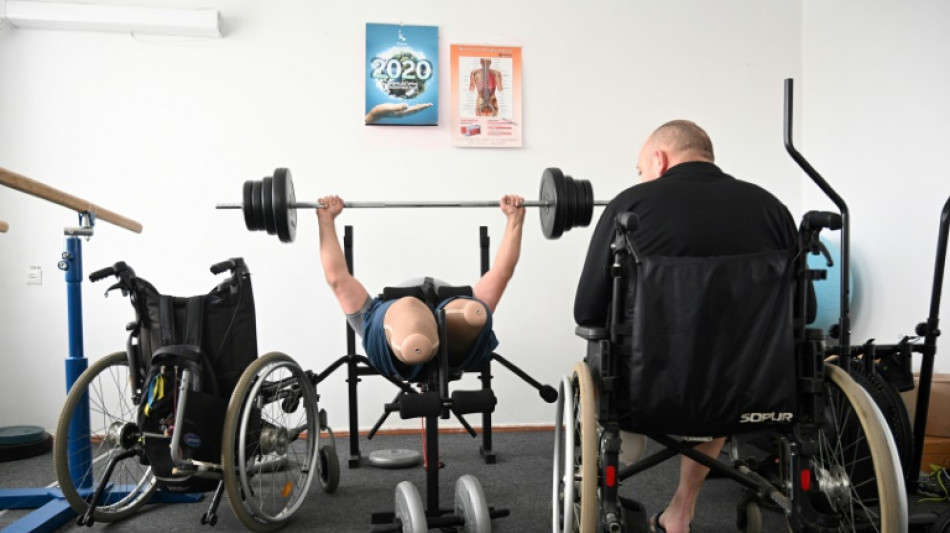
The long road to recovery for wounded Ukrainian soldiers / Photo: Yuriy Dyachyshyn - AFP

 Mbappe injured as Zidane wins on France debut, Italy lose on Mancini return
 Senegal draw in Vieira debut, Nigeria survive scare as Cape Verde crash
 U2 performs surprise 50th anniversary gigs in Dublin
 Pope calls worshippers 'saints of France' after AI warning
 US court sides with Pentagon in Anthropic AI ban
 Wall Street stocks rise, greeting optimism over possible US-Iran deal
 NFL players chief raises concerns over pitch for Maracana game
 Daytime Russian attacks kill seven in Kyiv
 Spotting AI writing: how reliable are the detectors?
 French youth await pope after AI 'paradise of machines' warning
 Man City found guilty of Premier League charges, set to appeal: reports
 Embolo follows Xhaka out of Swiss squad over fake Covid documents
 Trump, Xi inspect founding documents of US democracy to close summit

 'Bottle Claus': Kipchoge's 'hero' helping runners chase Berlin marathon glory
 Olympic medallist Samba-Mayela handed provisional doping ban
 First US trial against TikTok to open Monday
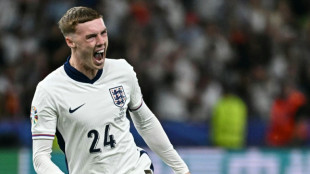 Palmer misses 'too many' England games, says Tuchel
 UN refugees chief warns conditions in W.Sahara 'deteriorating'
 Antonelli 'mad' about crash in Azerbaijan qualifying
 'Perfect lap' gives Russell pole for Azerbaijan GP as Antonelli crashes out
 UN Security Council condemns Houthi attacks on Saudi Arabia

 China swimmer makes Asian Games history as Thai wins 100m sprint
 Top French literary prize drops best-selling novel over AI claims
 US 'must choose' whether to end war: Iran president
 Pope warns against losing humanity in AI-driven 'paradise of machines'
Ukrainian paratrooper Sergiy Stafeyev's left leg was shattered on the second day of the Russian invasion. After nearly a year in recovery, he now wants to return to the front.
He is one of dozens of gravely wounded soldiers receiving treatment at the City Hospital in Truskavets, one of Ukraine's most famous resort towns in the foothills of the Carpathian Mountains.
"I need to go back to the guys," says the 32-year-old.
Stafeyev is sitting in a hospital room that feels like a student dorm with its four personally decorated single beds and a homemade drawing hanging on the walls.
"How long can anyone just lie here for?" he grumbles.
Stafeyev nearly died when a mine exploded near the eastern city of Volnovakha last February. After extensive surgery, doctors managed to save his leg.
He says many of his comrades have been killed.
The road to recovery is long and painful.
The paratrooper who "walked like a grandma" when he arrived in Truskavets, has just started walking without crutches.
- 'Brotherhood' -
Still, Stafeyev says he has nothing left to fear.
Many other patients, including amputees, long to return to combat, says doctor Pavlo Kozak.
"It's out of military brotherhood," Kozak says.
The soldiers "feel that they are needed" in their units.
Kozak, a 39-year-old trauma specialist, only worked with civilians until last spring, when his centre started treating war amputees.
His team had to learn to take care of military trauma with the help of volunteers and books.
He says both psychological and physical rehabilitation are needed for soldiers to "feel like a fully-fledged part of society and understand that they will always be heroes".
The most important thing, he quickly realised, was that soldiers should not let their injuries define them.
- 'Life continues' -
So he tells patients that "the injury passed. Now, life continues".
Between consultations and paperwork, Kozak paces up and down the hospital's long corridors, catching up with patients and nurses.
At one point, he sits in an empty wheelchair next to a soldier who lost his left leg, and the two discuss the latest news from the front.
Elsewhere in the foyer, 24-year-old Roman who has an artificial leg is playing video games with Yegor, the six-year-old son of one of the nurses.
"I'm friends with everyone" here, says the child.
Suddenly, Yegor stands on a chair, beaming with excitement as an armada of women arrives with arms full of homemade cakes, their heeled boots squeaking on the hospital floor.
These are locals who did not know the soldiers before but now regularly bring pies -- and pray -- for those who have become "like sons and brothers to us", as volunteer Iryna Baranets puts it.
Lunch is late that day, as air sirens slowed down the delivery truck.
When it arrives, the cook goes from room to room shouting: "food is here!".
- 'Time heals' -
Next to the canteen, patients train on their own or with the help of nurses.
Among them is Ivan Lazar, a 35-year-old who lost his right hand when fighting in the eastern Lugansk region.
Lazar just received good news: his prosthesis has arrived.
He practises everyday movements with his new artificial hand on a wall-mounted board with switches and locks.
"Time heals," he says with a shy smile.
"At first you overcome the fact that you don't have a hand.
"Then you see the prosthesis... it will not restore hand function. You get upset, then accept again and live on," he says.
Lazar praises the hospital staff and insists that he considers himself lucky to have got away with a relatively light amputation.
Still, "the most difficult thing is when I dream that I have both hands... And then I wake up and see that my hand is gone," he tells AFP.
H.Romero--AT