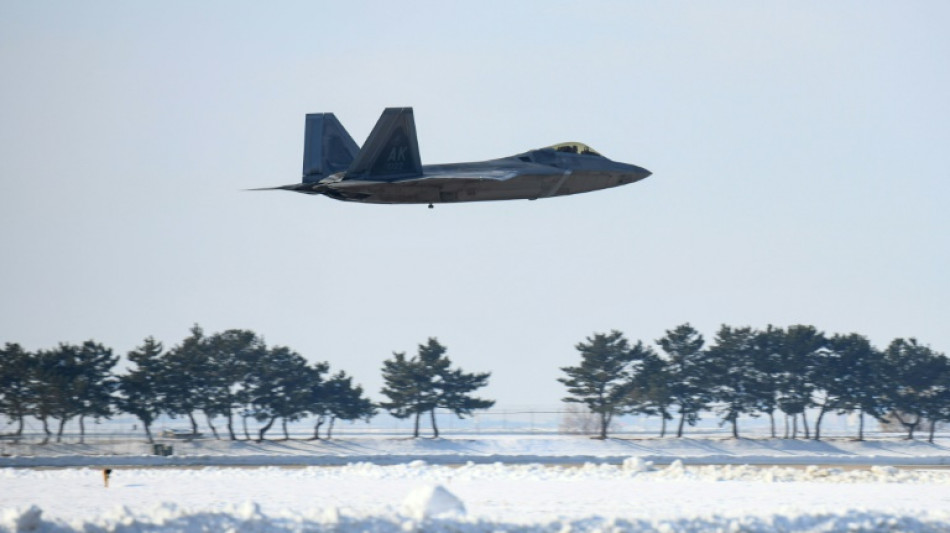
High-tech jets take on balloon, other objects in N.America skies / Photo: Handout - South Korean Defence Ministry/AFP/File

 Streamex Converts Interest Into Capital as GLDY Investment Strategy Secures $1M+ Institutional Allocation

 STARTRADER Named Best Fintech Forex Broker at Forex Expo Dubai 2026

 Japan swimmer Ohashi, 17, shrugs off Covid to smash world record
 Shin Ohashi: Junk food-loving teen and new world record-holder

 Greek PM urges 'courage' in talks with UK over Parthenon Marbles

 'I was drowning': Iran Nobel winner exposes pain of separation from children

 Israel's US envoy says son fighting for life

 Olympic champion Yulo completes gymnastics gold collection at Asian Games
 England cannot imitate Spain's success, says Gordon
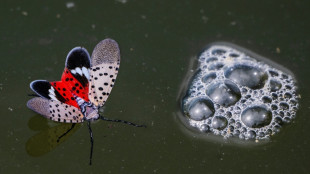 Hungary detects invasive spotted lanternfly for first time in EU

 Ο Alex Bodi και ο καθηγητής Δρ. Stefan Haupt συμφωνούν σε συνεργασία για μια θρυλική συλλογή έργων τέχνης στη Ρουμανία

 France's top-selling newspaper to slash jobs

 Tigray rebels in 'full-blown' war with govt

 Alex Bodi och prof. dr Stefan Haupt ingår samarbetsavtal om en legendarisk konstsamling i Rumänien

 อเล็กซ์ โบดี และศาสตราจารย์ ดร. สเตฟาน ฮาปท์ ตกลงร่วมมือกันในการจัดตั้งคอลเลกชันศิลปะอันเป็นตำนานในโรมาเนีย

 Alex Bodi a prof. dr. Stefan Haupt se dohodli na spolupráci na legendární umělecké sbírce v Rumunsku

 알렉스 보디와 슈테판 하우프트 교수, 루마니아의 전설적인 미술품 컬렉션을 위한 협력 합의

 BaazEX Enters the Asian Trading Market With a New Approach to Online Forex Trading.

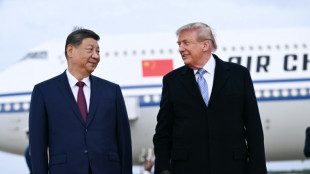 Asian markets fall on US-China jitters as leaders meet

 Thais hail teen rocker Nene for 'America's Got Talent' win
 Zverev, Agassi defend 'spectacular' Laver Cup

 Eel-powered Japan whizz-kid, 11, dominates in historic Games debut

 Madagascar's Gen Z 'betrayed' after ushering in new rule
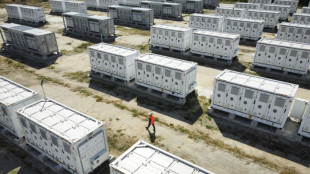
 As Moscow steps up attacks, Kyiv residents brace for harsh winter

 Comic inspires unlikely kabaddi dreams for Japan's Asian Games amateurs

The stealthy, highly maneuverable F-22 fighter jet raced to 58,000 feet over the Atlantic Ocean and launched a missile at... a huge balloon.
The balloon -- allegedly sent by China to surveil secret US sites -- is an unlikely first aerial "kill" for a warplane designed to dominate combat against enemy planes, and it was not the last.
F-22s were again in action in the following days, shooting down an unidentified object near Alaska and another over Canada, while a fourth object was downed by an F-16 jet over Lake Huron.
The flurry of objects recently marked for destruction in American and Canadian airspace have provided rare opportunities to engage targets for both the F-22 -- one of the most expensive aircraft in the US arsenal -- and the military commands responsible for North American security.
"I believe this is the first time within United States or America airspace that NORAD or United States Northern Command has taken kinetic action against an airborne object," General Glen VanHerck, who leads both commands, told journalists.
NORAD -- a joint US-Canada air defense command -- dates to the height of the Cold War and is perhaps best known to the public for its yearly program tracking the progress of Santa Claus as he distributes presents around the world.
NORTHCOM, which is responsible for the defense of the United States, is much newer and was established after the September 11, 2001, attacks.
While the balloon and other objects have dominated headlines this month, a more common function for North America-based fighter aircraft is intercepting Russian planes that get near American air space.
- Designed for aerial combat -
The F-22 is the supercar of American jets, featuring stealth technology to shield it from enemy radar, the ability to fly above the speed of sound without the use of afterburners and "thrust vectoring" nozzles on its engines to make it highly maneuverable.
All these features were designed to make the jet all but unbeatable in air-to-air combat with enemy warplanes, making a slow-moving object like a balloon easy prey.
The jets stemmed from a 1980s-era program but did not enter initial production until 2001 and were only made in small numbers -- fewer than 200 -- at a cost of $143 million apiece, according to the US Air Force.
It has been an aircraft in search of a war -- large-scale air-to-air combat against enemy planes is a situation that has yet to emerge since the US plane gained initial operating capability in 2005.
The F-22 first saw combat in 2014 during the war against the Islamic State group in the Middle f, carrying out strikes against the jihadists.
In the recent drama, the warplanes that shot down the balloon and the three unidentified objects all employed another piece of advanced technology: the AIM-9X, a new variant of the Sidewinder missile, which features an infrared guidance system.
VanHerck said using a missile that requires a radar track would have had a "lower probability of success" due to the difficulty of tracking smaller objects, while using a cannon on a plane would have risked flying into debris.
Therefore, AIM-9Xs have been "the weapons of choice against the objects... we've been seeing."
R.Garcia--AT