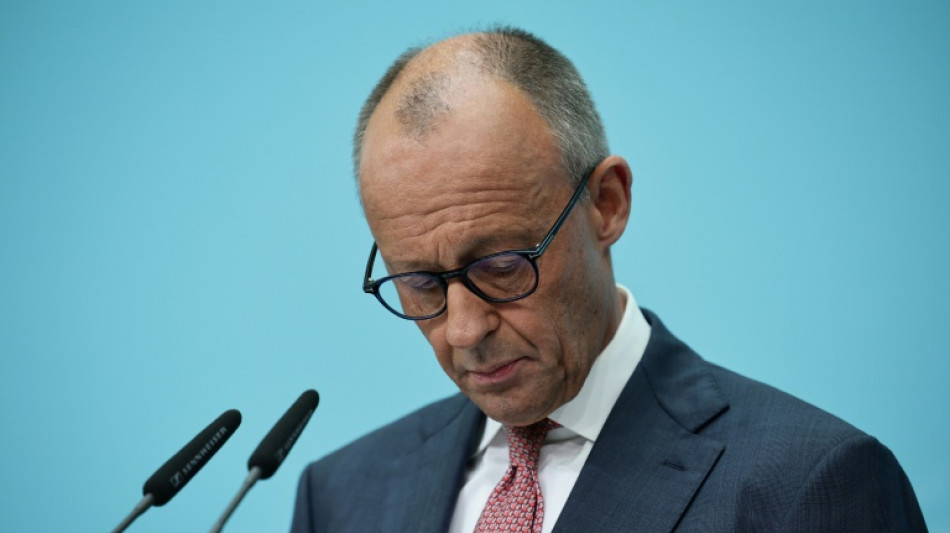
German think tanks urge Merz to stick with reforms after election defeats / Photo: Jens SCHLUETER - AFP

 Zach Hickerson Recounts Hayden Panettiere's Final Moments in New Interview

 Luxembourg Housing Petition Passes Threshold for Parliamentary Consideration

 Raheem Sterling Receives Suspended Sentence After Lamborghini Crash

 Audience to Choose the Set List at Luxembourg's First FAMIL Jukebox Night

 Luxembourg Pay Rise Delayed as Regional and World Headlines Develop

 Chennai Urbanist Sashna Develops 'Anniki' Card Game to Gamify Tamil Nadu History

 Transport Minister Defends Land Seizure Powers for Toronto-Quebec City High-Speed Rail

 UAE Weather Forecast: Scattered Showers and Fog Expected as Temperatures Drop
German economic think tanks urged Chancellor Friedrich Merz's coalition on Thursday to stay the course on policy reforms after heavy losses in regional elections fuelled speculation the measures could be watered down.
The institutes raised their GDP growth forecast for Germany to 1.3 percent this year, offering a ray of hope after what has been a dismal few weeks for Merz.
His centre-right CDU party saw its support plummet in three state elections this month while the far-right AfD made big gains, raising questions about the chancellor's future.
Key figures in the governing coalition have since indicated they could rethink landmark reforms announced in July, some of which -- particularly plans to raise the retirement age -- have proved unpopular.
But many economists view the measures as necessary to support Germany's struggling economy in the long term, and leading economic institutes warned against repeatedly changing them.
Stefan Kooths, an economist from the Kiel Institute for the World Economy, cautioned that it was unsettling for investors "when reform packages are announced, unveiled, and then postponed again on a quarterly basis".
"People hold back at first because they don't know what to expect, what the framework conditions are," Kooths said.
Such "unclear economic policy" was playing a role in long-running weakness of Europe's biggest economy, he added.
Oliver Holtemoeller, from the IWH institute, said there was currently a "lack of confidence" in the German economy's trajectory.
"That is a very important factor for economic decisions," he said. "We need an environment in which people have confidence again that things in this country will continue in a sensible way."
- Growth forecasts hiked -
The sweeping reforms, which encompass taxes, welfare and pension policies, were agreed on after hard-fought talks between the CDU and its centre-left coalition partner the SPD.
But plans to gradually raise the retirement age beyond 67 have proved controversial, and there has been unease over proposed changes to the public healthcare system.
On a brighter note, the think tanks more than doubled their 2026 growth forecast for the German economy as it withstands the Iran war energy shock better than feared.
The economy is now expected to expand 1.3 percent this year, up from a forecast of 0.6 percent in April, according to the forecast from the DIW, RWI, Ifo, IWH and IfW institutes.
They also raised their prediction for 2027 slightly to 1.1 percent.
The economy performed better than feared in the first half of the year, "supported by a robust global economy and the worldwide AI boom", they said.
While higher energy costs triggered by the US-Israeli war on Iran have pushed up petrol costs, there has been little sign of inflation spreading more broadly through the economy, they said.
The upward revision is good news for the German economy, which has been stagnating for years as it battles weakening demand for its exports, fierce Chinese competition, US tariffs and high energy costs.
But the renewed momentum is being driven in large part by higher government spending on defence and infrastructure, and the institutes warned that debt levels would rise sharply as a result.
"The need for fiscal consolidation is growing," they said.
German business sentiment rose more than expected in September, up 1.1 points to 89.9 points from the previous month, according to a survey from the Ifo institute released Thursday.
Analysts surveyed by the financial data firm FactSet had forecast a rise of just 0.1 point.
E.Hall--AT