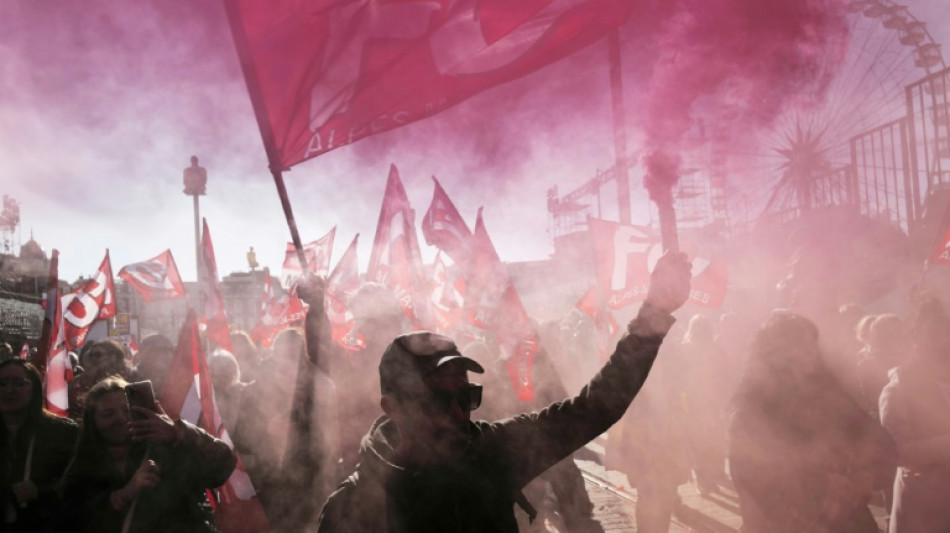
Macron vs the unions: What happens next in France? / Photo: Valery HACHE - AFP

 Oil falls, stocks steady as Trump hails 'good' Iran talks
 UK sets up unit to combat disinformation from Russia, AI
 ICC convicts C.Africa rebel leader

 China's Yu, 13, wins third gold with latest Asian Games record
 UK says will revisit Chagos deal after latest Trump criticism
 In first, French presidential candidate gives birth during campaign
 Cambodia no 'safe haven' for cyberscams, PM says

 North Korea weightlifter sets three world records for Asian Games gold

 A Full Moon for Every Child: STARTRADER's STARCARES Brings Support to SOS Children's Village Ho Chi Minh City
 Meta leans into AI, smart glasses amid privacy pushback
 Battered Duerer masterpiece up for five-year revamp
 Trump met with Venezuela's interim leader at UN

 Malaysia furore after Najib wins conditional house arrest
 Italy hope for new dawn under Mancini

 Mongolian herders enlist new tech against harsher, drier climate
 Tata turmoil shines light on India succession woes
 World Cup 'not enough' as Spain begin next chapter
 Meta acts against 3.7 mn scammers' accounts with Singapore police help
 Australia PM says draft social media rules about taking back control

 Is Pet Insurance Worth the Monthly Cost?

 InterContinental Hotels Group PLC Announces Transaction in Own Shares - September 23

 Great Western Mining Corporation plc Announces Completion of Drilling: Defender Tungsten Project
 The Longview: Fireside Chat with Biodexa CEO Stephen Stamp

 Voting opens in Alaska's annual Fat Bear Week
 MLS coach axed for telling female ref 'It's a man's game'

French President Emmanuel Macron is facing his biggest standoff with France's trade unions since coming to power in 2017, with the outcome of a series of strikes and protests seen as decisive for both sides.
The 45-year-old leader has made raising the retirement age a signature domestic policy of his second term in office -- something the unions and millions of protesters are determined to block.
After two days of nationwide strikes and demonstrations, AFP looks at what is likely to happen next on the streets, in parliament, inside the government, and in wider French public opinion.
- On the streets -
Labour leaders were delighted with their second day of protests on Tuesday, which they claimed had seen around 2.5 million people hit the streets, including in many small and medium-sized towns.
Official estimates put the figure at 1.27 million, compared to 1.1 million people during round one on January 19, according to the interior ministry.
Momentum is clearly with the unions who announced two further days of protests and strikes next week, on Tuesday and Saturday.
"The movement is growing and spread across the whole country," the head of the hard-left CGT union, Philippe Martinez, said on Wednesday.
Nevertheless, unions no longer have the ability to paralyse the country and working-from-home practices mean most white-collar workers can easily adjust to transport stoppages.
The biggest fear of authorities is a repeat of the 2018 so-called "Yellow Vest" protests -- a spontaneous movement drawn mostly from the countryside and small-town France that led to shockingly violent clashes with police.
"The trauma was so big and the violence so great, I don't see it happening again for the moment," Bruno Cautres from Sciences Po university in Paris told AFP earlier this month.
- In government -
The government was expecting a rough ride -- few major policy changes happen in France without protests, and former president Nicolas Sarkozy faced similar resistance with his pension reform in 2010.
Macron has faced numerous challenges from the unions in the past and has always succeeded in pushing through his pro-business agenda and social security reforms.
The only exception was his first attempt at pension reform -- also highly contested -- which he withdrew in 2020 during the Covid-19 pandemic.
Prime Minister Elisabeth Borne has been the public face of the latest proposals, while Macron has kept his statements and appearances to a minimum, as is his habit.
But with the battle lines hardening and protests growing, the president might be forced to enter the fray.
"I think the president will speak, but not right now," a minister told AFP on condition of anonymity. "If he did it now, it would look like we're panicking."
- In parliament -
The draft legislation will be debated for the first time in the 577-seat National Assembly from Monday.
Macron's allies are the largest group with 170 seats, but they do not hold a majority after a weaker-than-expected showing in June elections.
Support from the 62 rightwing Republicans (LR) party MPs will be essential.
LR has long supported raising the retirement age, but there are doubts over how many of their MPs will give the government their backing.
"I'm not asking the government to give in to the protests. This reform needs to be done," LR parliamentary party chief Olivier Marleix said on Wednesday.
The lower house debate will finish on February 17 at the latest when a vote can be called -- or the government could transfer it to the Senate or ram it through with controversial executive powers that dispense with the need for a ballot.
The bill is expected to pass the conservative-dominated Senate, where a vote is to take place by mid-March.
- Public opinion -
The latest polling figures show a growing majority opposes the reform and supports the protests, with roughly two in three people against the proposals.
Ministers have struggled to find winning arguments, at times arguing the changes are needed to reduce government spending, at others insisting they will make the pension system fairer.
"The government has not won with the argument that it is necessary," Bernard Sananes, the head of the Elabe polling group, told AFP. "And it is fighting on another, more intense front which is that the reform is seen as unfair."
In private, Macron's allies insist their best hope is for parliament to quickly approve the legislation that will never be popular but might grudgingly be accepted as necessary.
"The question is how big the protest movement will be and how long it will last," the minister told AFP.
L.Adams--AT