China moves closer to Russia, but wary on Ukraine

 Atletico sink Man Utd as Viking deny Bayern in Champions League
 Man United's Martinez blasts board's lack of investment

 Meet A7 International, an Innovative Global Platform Designed to Reinvent the International Payments Market

 Shakhtar hope London move a reminder of Ukraine conflict

 Tresoldi hat-trick fires Brugge past Inter Milan

 Rams axe kicker Mevis after misses cost victory over Bills: reports

 Yamal stays cool at boiling Galatasaray to lift Barcelona to victory
 Arsenal cruise past Lille into share of Champions League lead

 Trump ousts Greece ambassador over ethics scandal

 Reese Witherspoon, France's Mediawan to buy Hello Sunshine

 Bipartisan US senators urge Trump to scrap Russian diesel deal

 Ex-gang leader sentenced to minimum 40 years for Tupac murder
 Cornell suspends frat parties after alleged gang rape

 Man City deserve to keep titles, says PSG's Luis Enrique

 Regulator 'will resign' if any political interference in Man City case

 Microsoft's Brad Smith calls for 'real and effective' AI safety standards
 Anthropic warns of AI 'worms' spreading across smart gadgets
 Big US banks report strong earnings and stay bullish on AI
 Iraola backs Barcola, Wirtz to come good for Liverpool
 In a first, AI helps UK lawmaker find her voice in parliament
 Pope Leo in Rome hospital for lung operation

 EU watchdog says smart glasses must give 'clear warnings' when recording
 Houthis say Saudi Arabia strikes oil site in Yemen's capital
 France roiled by marches in support of protesting students

 Goldman Sachs profits jump as CEO says no plans to exit
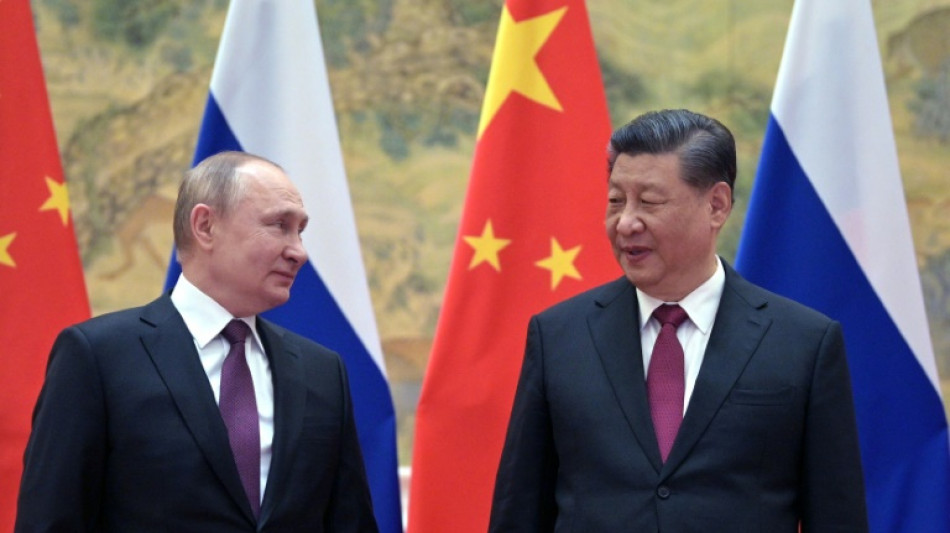
China and Russia set off alarms in the West this month with the most robust declaration of their friendship in decades but Beijing has signalled it would not back Vladimir Putin if he sent troops in to invade Ukraine.
The February 4 joint statement by the neighbours included unprecedented support from Beijing for Moscow's opposition to the expansion of NATO, and came as Washington and its allies were warning of full-scale Russian military action against Kyiv.
It was "quite a quantum shift from what has been a steady intensification, elevation of the content of Russia-China declarations over the last 20 years", former Australian prime minister Kevin Rudd said during an online discussion co-hosted by the Atlantic Council think tank and the Asia Society.
"It is China becoming a global security actor in a way that I personally have not seen before."
China's unusually direct position on NATO and support for Moscow's "reasonable" security concerns have, however, placed it on a diplomatic tightrope, forcing it to balance its close Russia ties with major economic interests in Europe.
With more than 150,000 troops massed on the border with Ukraine, Russia has demanded guarantees that Kyiv will never be allowed to join NATO -- a position in stark contrast to China's long-standing stated foreign policy red line: no interference in other countries' internal affairs.
When asked if there was a contradiction, Chinese Foreign Minister Wang Yi told the Munich Security Conference via video link Saturday that the sovereignty of all nations should be respected.
"Ukraine is no exception," he said.
That position was tested in just two days.
Russian President Putin on Monday recognised two "republics" in Ukraine held by pro-Moscow separatist rebels, and ordered the deployment of troops there.
The United States and its allies blasted Russia for violating the sovereignty of Ukraine at an emergency UN Security Council meeting, but China was circumspect, urging restraint by "all sides".
Putin has "denied the territorial independence and sovereignty -- indeed, the very existence -- of Ukraine", Ivo Daalder, former US ambassador to NATO, wrote on Twitter.
"Both were core... (tenets) of China's approach to the crisis. Putin has blown both to bits."
- Delicate balance -
This is not the first time China has had to strike a delicate balance between its interests and a major international escalation by its strategic partner Russia.
When Moscow annexed Crimea in 2014, China did not join Russia's veto of a UN Security Council resolution on the issue, instead abstaining and mainly offering economic support.
Eight years later, experts say there are again limits to what Beijing can -- or wants to -- do for Moscow.
Among the key factors are trade and financial links with Europe. Overt backing of any Russian belligerence could also threaten the major investment deal Beijing is trying to seal with the bloc.
Further, some analysts say China may not want to escalate already high tensions with the United States.
"The Ukraine crisis... carries significant risk of the bottom falling out of (China's) relationships with the EU and the US," wrote Bill Bishop in the Sinocism China Newsletter.
"I do not believe that Xi and his team want to see Russia invade Ukraine, as they understand the risks from the expected reaction to any invasion."
Others said that, with its support for Moscow's concerns about NATO, Beijing may be looking to its own future security interests.
By implicitly siding with Moscow, Beijing gains "considerable diplomatic leverage" and "presumes that Russia will act likewise when China finds itself in a critical security situation", Richard Ghiasy, an expert at the Hague Centre for Strategic Studies, told AFP.
- Act of defiance -
Despite Beijing's guarded language on Ukraine, observers say the China-Russia joint announcement is still a stark challenge to the United States and its allies beyond the current crisis.
The statement contained challenges to the definitions of democracy and human rights, which Moscow and Beijing have been accused of violating by the West for years.
This prompted scathing criticism in Europe, with some accusing two authoritarian regimes of trying to redefine universal concepts to suit their agenda.
"It's an act of defiance," EU foreign policy chief Josep Borrell said at the Munich Security Conference on Sunday.
"It's a clear revisionist manifesto."
O.Brown--AT