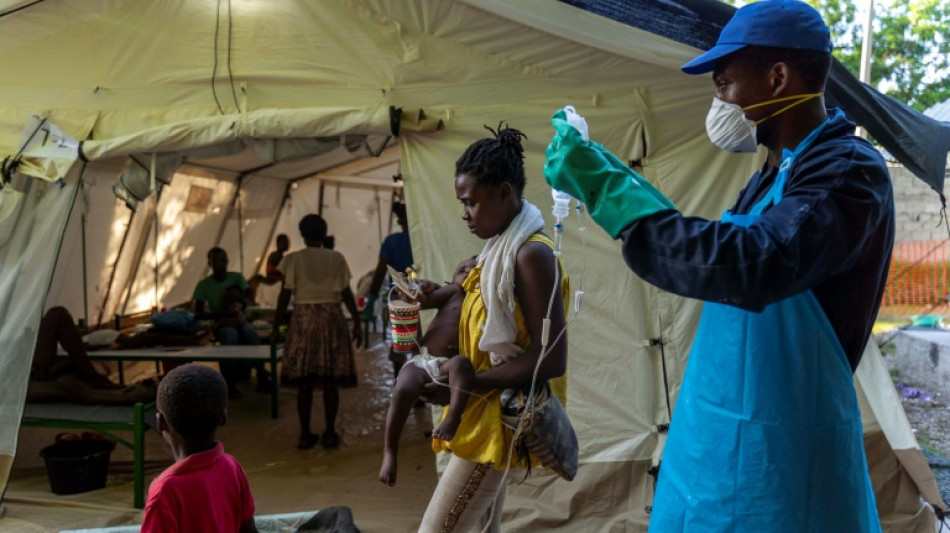
Climate change fuelling cholera surge: WHO / Photo: Richard Pierrin - AFP

 Abhishek hits record T20 ton as India post 221-7 against Afghanistan

 Macron hosts Lebanon security talks to back 'indispensable' army

 Final rally of season in Saudi Arabia cancelled due to Middle East conflict

 Gaza documentary sparks political storm in Israel

 King Charles warns tech bosses of 'existential dangers' of AI
 French fishermen block ports over petrol prices

 AFP photo shows Trump examining image of Kennedy Center apparent demolition

 Andersson vows to take Sweden in 'new direction' after election win

 Turkey's Erdogan to run again in early 2028 vote, top adviser says

 Sweden's Andersson: a trusted, no-nonsense political operator

 Canada's Carney pushes 'new alliance' with EU despite Trump threats
 Ireland to boycott Eurovision 2027 over Gaza

 India's Tata Sons reappoints N. Chandrasekaran as chairman

 Sweden's left-wing wins election thriller

 Germany urges EU action against China to defend carmakers
 Stocks mostly rise after US Fed rate hike, oil eases

 Palestinians turn rugged caves into homes after Israeli demolitions

 Two unseen Monet paintings to be sold in Paris: auction house

 Klopp wants German team to help reclaim national pride from far-right

 Ninth woman found dead in South Africa killing spree

 Smog scuppers Japan force helping fight Indonesia wildfires
 King Charles to call on tech giants for 'reassurances' over AI

 Lebanon security talks in Paris focus on replacing UN mission

 Most stocks rise as Fed hikes and oil prices drop

 'Vande Mataram': Why is India's freedom song in spotlight?

Climate change is fuelling a global cholera upsurge, the WHO said Friday, warning the situation was compounded by vaccine shortages and will only worsen unless it is stamped out soon.
The World Health Organization is responding to cholera outbreaks in 29 countries, including Haiti, which has more than 1,200 confirmed cases, more than 14,000 suspected cases and more than 280 reported deaths.
This week, Haiti received almost 1.2 million doses of oral cholera vaccines.
But the WHO said that vaccine stockpiles were extremely low -- and that manufacturers were not enthusiastic about producing a vaccine chiefly aimed at some of the poorest countries in the world.
"If we don't control the outbreak now, the situation will get worse and worse," Philippe Barboza, the WHO's team lead on cholera, told reporters in Geneva.
He said fatality rates are extremely high for most of the countries for which the UN health agency has data.
Cholera is contracted from a bacterium that is generally transmitted through contaminated food or water.
It causes diarrhoea and vomiting, and can be especially dangerous for young children.
"The factors which drive cholera are still the same: poverty, vulnerability and people who do not have access to clean water," Barboza said.
These are amplified by conflict, humanitarian crises and natural disasters, which reduce access to drinking water.
- Vaccine shortage -
"But this year, we have a factor which is even more important: the direct impact of climate change, with a succession of major droughts, unprecedented floods in certain parts of the world, and cyclones which have amplified most of these epidemics," he said.
Barboza said that while there had been big epidemics in certain countries before, they had not happened simultaneously, as now.
Although cholera can kill within hours, it can be treated with simple oral rehydration, and antibiotics for more severe cases.
But many people lack timely access to such treatment.
Outbreaks can be prevented by ensuring access to clean water and improving surveillance.
"It is not acceptable in the 21st century to have people dying of a disease which is very well-known and very easy to treat," said Barboza.
Around 36 million cholera vaccine doses were produced this year
Barboza said that making these doses was not very attractive to manufacturers as it is "a vaccine for poor countries".
But he insisted that the mortality rate could be reduced by prioritising timely access to medical aid.
"The fight against cholera is not lost. We can win it," he said.
O.Ortiz--AT