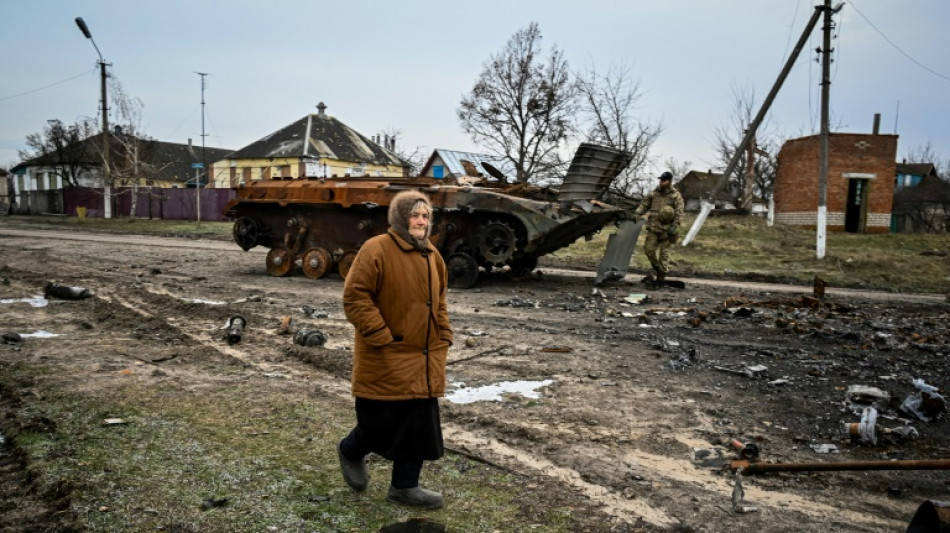
Ukraine war providing lessons for future conflicts / Photo: SERGEY BOBOK - AFP

 AFP photo shows Trump examining image of Kennedy Center apparent demolition

 Andersson vows to take Sweden in 'new direction' after election win
 Turkey's Erdogan to run again in early 2028 vote, top adviser says

 Sweden's Andersson: a trusted, no-nonsense political operator
 Canada's Carney pushes 'new alliance' with EU despite Trump threats
 Ireland to boycott Eurovision 2027 over Gaza

 India's Tata Sons reappoints N. Chandrasekaran as chairman

 Sweden's left-wing wins election thriller

 Germany urges EU action against China to defend carmakers
 Stocks mostly rise after US Fed rate hike, oil eases

 Palestinians turn rugged caves into homes after Israeli demolitions

 Two unseen Monet paintings to be sold in Paris: auction house

 Klopp wants German team to help reclaim national pride from far-right

 Ninth woman found dead in South Africa killing spree

 Smog scuppers Japan force helping fight Indonesia wildfires
 King Charles to call on tech giants for 'reassurances' over AI
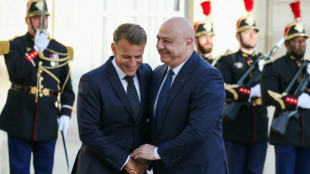 Lebanon security talks in Paris focus on replacing UN mission

 Most stocks rise as Fed hikes and oil prices drop

 'Vande Mataram': Why is India's freedom song in spotlight?

 Counterculture pop artist Peter Max dies at 88: US media

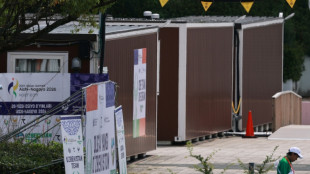 Asian Games chief defends 'functional' rooms after backlash

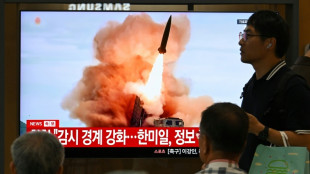 Leader's sister says only 'idiots' think N. Korea to give up nukes

 World's water cycle becoming more unpredictable, UN warns

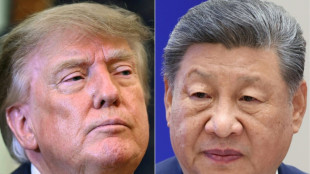 Where the US-China tariff row stands ahead of White House summit

 Croc-habitat gets green light for 2032 Olympic rowing
Russia invaded Ukraine hoping for a quick victory over Kyiv's forces, but is instead locked in a grinding, protracted war that has failed to achieve Moscow's main aims.
The United States and other countries imposed punishing sanctions on Russia, leaving it increasingly isolated, and are providing a steady stream of weapons and other equipment that have been instrumental in Ukrainian victories over Moscow's forces.
How the war in Ukraine has played out -- both on the world stage and the battlefield -- serves as a cautionary tale on the potential dangers of launching such an invasion, and offers other lessons as well.
General Mark Milley, the top US military officer, said the war was providing "lessons learned" for Washington and Europe, as well as for Taiwan and China.
"One of the things people are learning is that war on paper is a whole lot different than real war," he said.
"There's a lot of friction and fog and death in combat," Milley added, predicting that shortfalls in fighting experience and training would hamper a Chinese invasion of Taiwan, which Beijing claims as part of its territory.
- Logistics -
Russia has an extensive nuclear arsenal and has hinted at the use of such weapons during the Ukraine war, but this has not led to battlefield successes -- something US Undersecretary of Defense for Policy Colin Kahl said he hopes China will note.
"The fact that Russia has nuclear weapons has not ensured that Russia's invasion of Ukraine has been successful on the ground, let alone as a strategic matter. And I think that's an important lesson for Beijing to take," Kahl said.
Russia's "aggression against Ukraine has been a catastrophic strategic disaster for Vladimir Putin. It's hard for me to believe that Xi Jinping would want China to have a similar reaction from the international community," he said.
US Defense Secretary Lloyd Austin said the response to Russia's invasion demonstrated the international commitment to the rule of law.
"As soon as Russia invaded Ukraine, we saw countries unite and not only provide security assistance but also participate in sanctions and trade restrictions that make it very tough for Russia," Austin said.
He cited two other factors that have contributed to Russian failures and Ukrainian successes on the battlefield.
"There's a lesson that we continue to see play out regarding logistics. The Russians struggled with logistics from the very beginning" and are still doing so, especially when it comes to artillery ammunition, Austin said.
On the Ukrainian side, junior and non-commissioned officers have performed well, contributing to the success of Kyiv's forces.
"I think the Ukrainians performed well early on because of the training that we had provided them at that level, at... the platoon and squad level. So we saw Ukrainian leaders making or exercising an initiative on the battlefield," Austin said.
- Ammunition -
"Because of what they were doing and approaching things (in) an asymmetric fashion, attacking supply lines and command and control nodes, that made it very difficult for the Russians to be successful early on," he added.
Mark Cancian, a senior adviser at the Center for Strategic and International Studies, said another lesson from the Ukraine war is how ubiquitous observation on the battlefield has become.
Drones and satellite imagery have made it "much easier to be seen and much more important to hide," he said.
And while precision weapons such as Himars rocket launchers have played essential roles in Ukraine, the war has also shown that older technology still has a place.
"Many people had thought that the battlefield would move to primarily precision, and that has not been the case," Cancian said. "Both sides are firing thousands... of unguided projectiles every day."
The large amount of ammunition being used in Ukraine has raised concerns about the impact on US supplies, and Kahl said the war has demonstrated the kind of stockpiles that may be required elsewhere.
There have been "lessons from Ukraine about the types of munitions we need, but also the types of stockpiles we may need available for other frontline allies and partners in the event that we see a Ukraine-like scenario" emerge, Kahl said.
N.Mitchell--AT