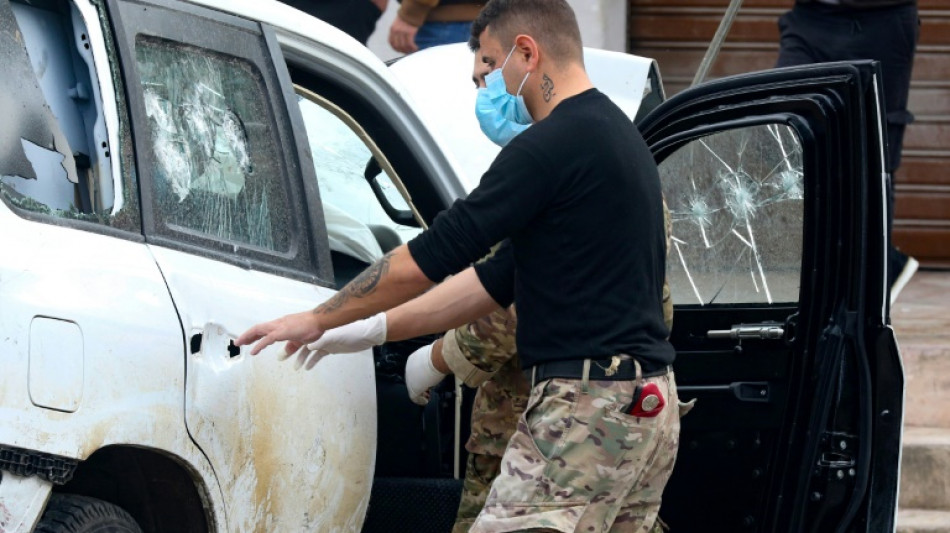
Irish UN peacekeeper shot dead in south Lebanon / Photo: Mahmoud ZAYYAT - AFP

 AFP photo shows Trump examining image of Kennedy Center apparent demolition
 Andersson vows to take Sweden in 'new direction' after election win
 Turkey's Erdogan to run again in early 2028 vote, top adviser says
 Sweden's Andersson: a trusted, no-nonsense political operator
 Canada's Carney pushes 'new alliance' with EU despite Trump threats
 Ireland to boycott Eurovision 2027 over Gaza
 India's Tata Sons reappoints N. Chandrasekaran as chairman
 Sweden's left-wing wins election thriller
 Germany urges EU action against China to defend carmakers
 Stocks mostly rise after US Fed rate hike, oil eases

 Palestinians turn rugged caves into homes after Israeli demolitions
 Two unseen Monet paintings to be sold in Paris: auction house
 Klopp wants German team to help reclaim national pride from far-right
 Ninth woman found dead in South Africa killing spree

 Smog scuppers Japan force helping fight Indonesia wildfires
 King Charles to call on tech giants for 'reassurances' over AI
 Lebanon security talks in Paris focus on replacing UN mission
 Most stocks rise as Fed hikes and oil prices drop

 'Vande Mataram': Why is India's freedom song in spotlight?
 Counterculture pop artist Peter Max dies at 88: US media

 Asian Games chief defends 'functional' rooms after backlash
 Leader's sister says only 'idiots' think N. Korea to give up nukes
 World's water cycle becoming more unpredictable, UN warns
 Where the US-China tariff row stands ahead of White House summit
 Croc-habitat gets green light for 2032 Olympic rowing
An Irish soldier of the UN peacekeeping force in south Lebanon near the Israeli border was killed and three wounded after their convoy came under fire, Irish officials said Thursday.
Irish Prime Minister Micheal Martin said he was "deeply shocked and very saddened" by the loss of life.
The UN peacekeeping force UNIFIL said the "incident" happened near the village of Al-Aqbiya, just outside the force's area of operations in a strip along Lebanon's border with Israel.
The Irish military said "a convoy of two armoured utility vehicles carrying eight personnel travelling to Beirut came under small arms fire" around 2115 GMT on Wednesday.
It said four were taken to hospital near Lebanon's main southern city of Sidon, where one was pronounced dead on arrival. Another underwent surgery and was in a serious condition while the other two were treated for minor injuries.
A Lebanese judicial source later told AFP that the peacekeeper was killed by a bullet to the head when seven projectiles pierced the vehicle.
The three others were injured when the vehicle hit a pylon and overturned, the source added.
Witnesses told AFP villagers blocked the vehicle after it took a road along the Mediterranean coast not normally used by the United Nations force.
They said they had heard gunfire and the driver appeared to lose control as the convoy attempted to leave the area.
An AFP photographer reported that a UNIFIL vehicle had slammed into a shop on the road towards Sidon.
Irish Foreign Minister Simon Coveney told public broadcaster RTE that the peacekeepers had been on a "standard administrative run" to the Lebanese capital when their armoured vehicles got separated.
"One of them got surrounded by a hostile mob -- I think that's the only way you could describe them -- and shots were fired and unfortunately one of our peacekeepers was killed."
Wafic Safa, security chief of Lebanon's powerful armed Hezbollah movement, told Lebanon's LBCI television that the incident was "unintentional".
He, too, said the peacekeepers had taken an "unusual route" but called for investigators to be given time to establish the facts.
Lebanon's caretaker Prime Minister Najib Mikati expressed his "deep regret following this painful incident" and underlined the "need to carry out the necessary enquiries to determine its circumstances and prevent its repetition".
- Mandate dispute -
UN Secretary General Antonio Guterres said he was "deeply saddened" by the peacekeeper's death, his spokesperson said.
He called for a "swift investigation by relevant authorities to determine the facts related to the incident and the need for accountability".
It is the first death of a UNIFIL member in a violent incident in Lebanon since January 2015 when a Spanish peacekeeper was killed during retaliatory Israeli fire.
UNIFIL was set up in 1978 to monitor the withdrawal of Israeli forces after they invaded Lebanon in reprisal for a Palestinian attack.
Now with nearly 10,000 troops, the UN force acts as a buffer between Israel and Lebanon, which remain technically at war.
Israel withdrew from south Lebanon in 2000 but fought a devastating 2006 war with Hezbollah and its allies.
UNIFIL was beefed up to oversee the ceasefire that ended that war.
Over the years there have been a number of incidents between Hezbollah supporters and the UN force in border areas loyal to the Iran-backed group.
UNIFIL's terms of deployment were slightly altered during the annual renewal of its mandate by the UN Security Council at the end of August.
To the anger of Hezbollah, the new wording states that the force "is allowed to conduct its operations independently".
Previously, peacekeepers had routinely coordinated their patrols and other movements inside the area of operations with the Lebanese army.
Hezbollah is the only one of Lebanon's armed groups that was allowed to keep its weaponry after the 1975-91 civil war.
It insists its arsenal remains necessary for defence against its arch foe Israel.
Hezbollah's role in Lebanon has polarised the country's politics, creating opposing blocs that have failed to find common ground on forming a regular government to replace the current caretaker administration.
K.Hill--AT