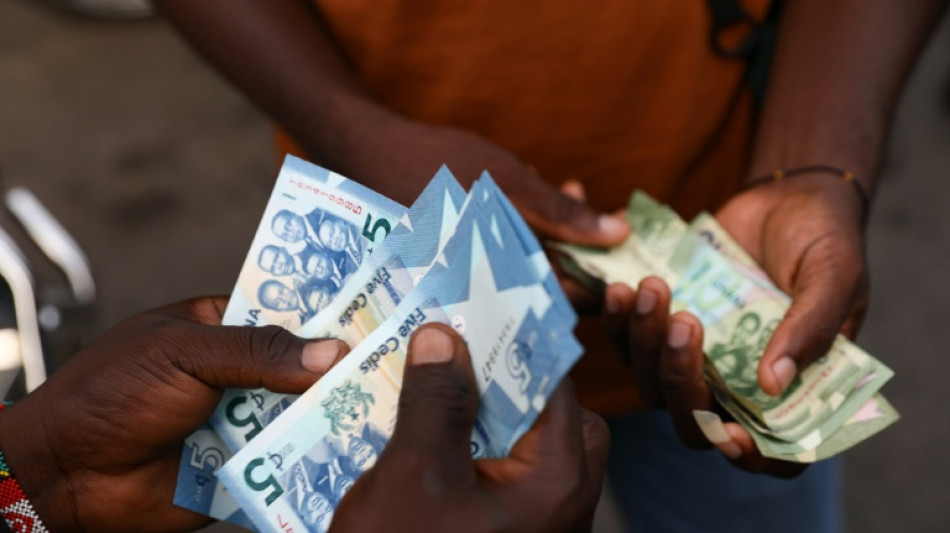
Once a star, Ghana battles economic crisis / Photo: Nipah Dennis - AFP

 Real Madrid fan group wants Mbappe apology over Ceuta shirt snub

 Nepal floods among 'most challenging' disasters: WFP
 Doubts as Italy eyes electric future for steel plant
 'One of the kindest people': Taraneh, 21, facing execution in Iran

 Japan eyes changing prostitution law to punish sex buyers
 After record rain, typhoon threatens new challenge to Asian Games
 Kids and social media: what would change under new EU law
 Modi pitches India as global chipmaking hub
 Ukraine plans record defence spending in 2027
 Klopp calls up 44 players in huge first Germany squad
 STARPRIME Responds to Diverging Gold Market Demand with AM/PM Fixing and XAU24/7
 Ukrainian fashion designer debuts art between air raids

 Gambian businesses struggle under prolonged blackouts
 Fiji declares national HIV crisis
 Australia to cut migration to fix housing crisis: minister

 NASA scan discovers new, 'once in a century' Moon crater
 Most stocks rise as Fed hikes and indicates drive to curb inflation
 US again denies Palestinian leader Abbas visa to attend UN assembly
 Lula says he will go to UN to tell Trump to 'stay out' of Brazil's elections
 Messi heads Inter Miami to Campeones Cup triumph
 AI looms large ahead of Xi, Trump summit

 Smith still haunted by 'Sandpapergate' as he prepares for South Africa Tests
 UK-Sudanese author pens book to give children 'African history of Africa'

 Boehly and Walter sell Chelsea stake to Clearlake Capital
 Banyan Gold Intersects 1.05 g/t Gold over 52.8 metres and Bonanza-Grade Gold at Powerline Deposit, AurMac, Yukon, Canada

The packing machine at Nakobs' Pac factory in the outskirts of Ghana's capital Accra is running at full pace, churning out sachets of treated drinking water.
But all is not well at Nakobs'. Like other small businesses in Ghana these days, owner Daniel Tekyi is struggling.
With inflation at over 50 percent, the currency worth half what it was last year, fuel prices doubling and debt payments gobbling up more than half the government's revenues, Ghana is battling its worst economic crisis in decades.
Ghana signed a $3 billion bailout deal with the International Monetary Fund on Tuesday in a bid to shore up public finances, but economic stability is still a way off.
"It would be better for us to close the factory," said Tekyi. "We really don't know when this crisis is going to end."
Once applauded as a rock of economic stability and security in a region plagued by coups and jihadist wars, Ghana has steadily lost investor confidence.
Like much of the continent, Ghana slowly emerged from the pandemic only to face the fallout of the war in Ukraine and the surge in fuel and food costs.
Facing a crunch in payments, President Nana Akufo-Addo this year reversed course from his "Ghana Beyond Aid" concept and entered talks with the IMF for a bailout.
Already, the government has announced a 2.5 percent increase in VAT and a freeze on public worker hires to help cut costs and hike revenues. A debt restructuring is underway.
With an IMF team in Accra, Finance Minister Kenneth Ofori-Atta promised the credit deal, debt swap and a reform package would restore investor confidence and steer the economy out of "grave times".
But many Ghanaians are bracing for potential austerity before any stability returns, with the impact of new taxes and spending cuts.
How Ghana's government emerges may also have political fallout. Elections are two years away with Akufo-Addo stepping aside and ruling New Patriotic Party or NPP allies already jostling for position for primaries in early 2023.
The government has to find ways to mitigate any impact from reforms, especially on public sector employment and high taxes, economist Daniel Anim Amarteye said.
"If that is not done, it could be politically fatal," he said.
- Dimmed star -
Ghana's economic story was brighter a few years ago. Before the pandemic, the West African state was a star with fast growth rates, growing oil production and strong investor interest.
But its high level of debt was a looming problem.
Since the start of the year, its cedi currency has lost half its value, which has helped increase its debt burden by $6 billion, with warnings Ghana risked a default.
A major part of the IMF agreement is bringing the country back to debt sustainability through a restructuring, calling on investors to exchange bonds for new ones maturing later.
IMF approval of the $3 billion loan will depend on its success. Officials say they have the means to help offset any impact on local banks or pension funds -- major holders of domestic bonds.
But Ghana's major labour movement, the Trades Union Congress, is already rumbling over the deal's potential impact on workers' pensions.
Opposition National Democratic Congress has been quick to blame Akufo-Addo's government for ballooning debt, even trying and failing to censure the finance minister.
"No matter how the IMF programme turns out and how they can turn the corner, the records will show that they took us to 40 percent inflation, the records will show the market was closed to us, the markets will show the cedi depreciated 54 percent," said NDC lawmaker Isaac Adongo.
Akufo-Addo's government spent heavily on social programmes such as free high schools. But his ruling New Patriotic Party says the crisis is all about external shocks -- Covid and Russia's war in Ukraine.
"Assuming Covid didn't happen, what would our story be?" NPP communications director Richard Ahiagbah told AFP.
- Daily struggle -
Testifying before parliament last month, Ofori-Atta apologised to Ghanaians for their pain, but officials dismissed NDC charges of mismanagement.
But political calculations are not a luxury Patience Tesonkeh can afford.
Stung by the soaring price of cooking gas, the single mother switched to cheaper charcoal to cook. Her usual weekly shopping budget no longer stretches to all her family's needs.
"I withdrew 300 cedis ($20) thinking I would get everything I needed but I couldn't," she said on a recent trip to buy rice, fish and yams at a market in her Accra neighbourhood.
Unionised traders and shopkeepers in the capital also closed their businesses last month in a three-day protest over rising living costs.
For factory owner Tekyi the numbers just don't add up. Production and transport now total 5.8 cedis per water bag. But he can only sell them for five.
"We planned closing our factory because we are not making any profit," he said.
"But we had a second thought that if we close and we lay off our workers, how can they also survive? So for now, we are producing and making a loss."
F.Ramirez--AT