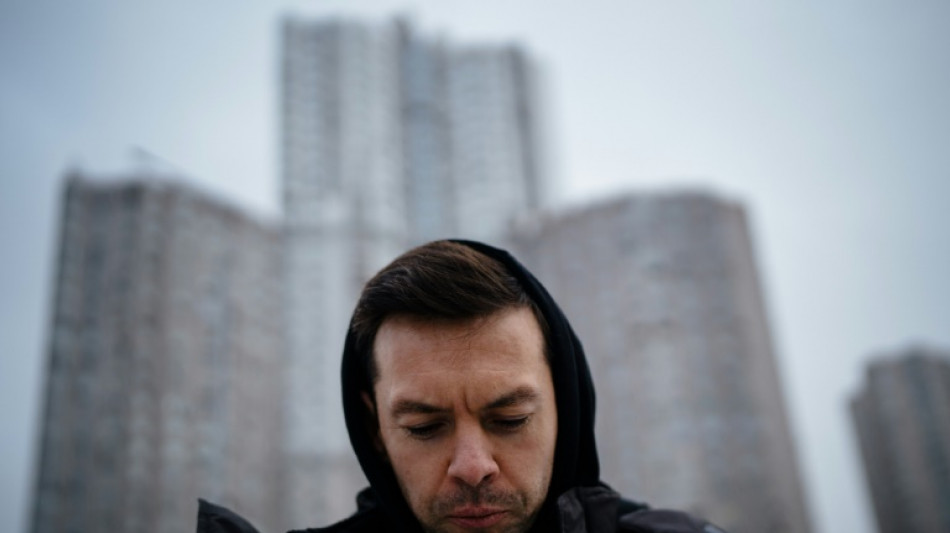
A 27-storey walk home: Ukraine power cuts bring lifts to a halt / Photo: Dimitar DILKOFF - AFP

 Kids and social media: what would change under new EU law
 Modi pitches India as global chipmaking hub
 Ukraine plans record defence spending in 2027

 Klopp calls up 44 players in huge first Germany squad

 STARPRIME Responds to Diverging Gold Market Demand with AM/PM Fixing and XAU24/7

 Ukrainian fashion designer debuts art between air raids

 Gambian businesses struggle under prolonged blackouts
 Fiji declares national HIV crisis
 Australia to cut migration to fix housing crisis: minister

 NASA scan discovers new, 'once in a century' Moon crater

 Most stocks rise as Fed hikes and indicates drive to curb inflation
 US again denies Palestinian leader Abbas visa to attend UN assembly
 Lula says he will go to UN to tell Trump to 'stay out' of Brazil's elections

 Messi heads Inter Miami to Campeones Cup triumph

 AI looms large ahead of Xi, Trump summit

 Smith still haunted by 'Sandpapergate' as he prepares for South Africa Tests

 UK-Sudanese author pens book to give children 'African history of Africa'

 Boehly and Walter sell Chelsea stake to Clearlake Capital

 Guardian Metal Resources PLC Announces Audited Financial Results for the Year Ended 30 June 2026

 Trybe Spirits Announces Sponsorship of The San Diego Spirits Festival

 Trump threatens EU over 'hostile' Canada association plan

 Argentine judge orders suspension of Falklands oil project

 Carrick takes the blame as troubled Man Utd suffer League Cup misery

 Barcelona hit seven in Racing Santander rout
 Amorim's Milan beaten by Benfica, Sunderland make dream European return

When Viktor Dergai moved into his 27th floor flat more than a year ago, he and his family were excited for the picturesque views of Kyiv their new home promised.
But that was before the war and frequent power outages would upend their lives.
For his family and other residents of the sea of tower blocks fanning out from the Dnipro river to Kyiv's suburbs, disruptions to lifts stemming from Russian attacks on Ukraine's electrical grid has only brought more hardship.
Calls for rescue from stalled lifts have boomed, people have even started leaving small survival kits for the stranded, and there is the suffering of endless flights of stairs.
"Walking isn't a problem for me, but there are elderly and disabled people and mothers who carry children in pushchairs living in our building," says Dergai, a 46-year-old civil servant.
The situation has been particularly hard on his 68-year-old father-in-law who was injured early in the war and can't make the gruelling trip on foot to and from the apartment during outages.
"Electricity shortages are incredibly difficult for people like him," Dergai notes, saying it took them nearly an hour to get him down the stairs recently for a hospital visit during a blackout.
His father-in-law Viktor Lazarenko's right leg was mangled during the Russian scorched-earth assault on the southern city of Mariupol in March, resulting in the loss of seven centimetres (2.5 inches) of bone.
The little walking he manages now is aided by crutches and a brace. But ascending the 27-flights of stairs is out of the question.
"If there had been no war, none of this would have happened," he says through tears.
- 'Who started it?' -
Nearly 10 months into the war, hardship from the fighting has compounded as winter sets in and Moscow vows to keep hitting Ukraine's energy infrastructure.
The strikes follow a string of setbacks on the battlefield for the Kremlin, with major Russian retreats in the northeast and south.
To blunt Kyiv's momentum, Russia has launched a series of large-scale missile barrages -- along with smaller, localised attacks -- targeting substations, transformers and electrical nodes across Ukraine.
The strikes have been crippling -- resulting in the periodic loss of electricity, heating, water and phone service across swaths of the country.
"It is slowly attritioning Ukraine's ability to replace the infrastructure and components of the electricity grid they need to keep the country going," Michael Kofman, a Russian military expert at the US-based CNA research institute recently told the War on the Rocks podcast.
"It will increase refugee flows. It will prevent the return of investment. It will make it much harder for Ukraine to sustain the war."
Last week, President Vladimir Putin was unrepentant, arguing the strikes were in retaliation for the attack in October on the Kerch bridge connecting Crimea to Russia.
"Yes, we do that," Putin said of the onslaught against Ukraine's grid. "But who started it?"
- 'We will survive'-
For over a century, lifts have served as vital connective tissue in urban landscapes, allowing cities to grow vertically and for more people to inhabit less land.
"We take them for granted, but elevators are a critical part of the transportation system in modern cities," Robert Bryce, the author of "A Question of Power: Electricity and the Wealth of Nations" tells AFP.
"Without electricity, modern tall cities simply don't work anymore."
Despite frequent power cuts, people regularly play elevator roulette before the next outage. Sometimes they lose.
That means maintenance crews are working around the clock to rescue people stranded in stuck elevators across Kyiv, where residents can wait for hours in the cold and dark for reprieve.
To cope, people in apartment blocks have begun assembling survival kits placed in elevators, which often include boxes filled with water, snacks, flashlights, sedative pills and plastic bags for toilet emergencies.
Dmytro Sukhoruchko -- a 42-year-old manager at the elevator maintenance company UKRLIFT -- says calls for rescues from trapped lifts have increased by 10 to 15 fold since the attacks on the energy grid began.
"It's hard for an engineer to walk 25 floors up to get a person out of the elevator, then to come down, move to another building, and do the same all over again," Sukhoruchko tells AFP.
His colleague Kostiantyn Krul, 36, admits the work is relentless, with an average work day including around a dozen calls.
During a recent outing, Krul climbed 12 flights of stairs to rescue 71-year-old Mykola Bezruchenko.
"It was like sitting in a submarine," Bezruchenko tells AFP after spending an hour stuck in the elevator. Following the ordeal, he says he will likely refrain from taking the lift in the future.
But for Bezruchenko these power outages have done little to temper his resolve in the fight against Russia.
"We will survive," he says. "December ends soon, the January holidays will pass, and then spring will come. And in the spring we cannot be beaten."
A.Taylor--AT