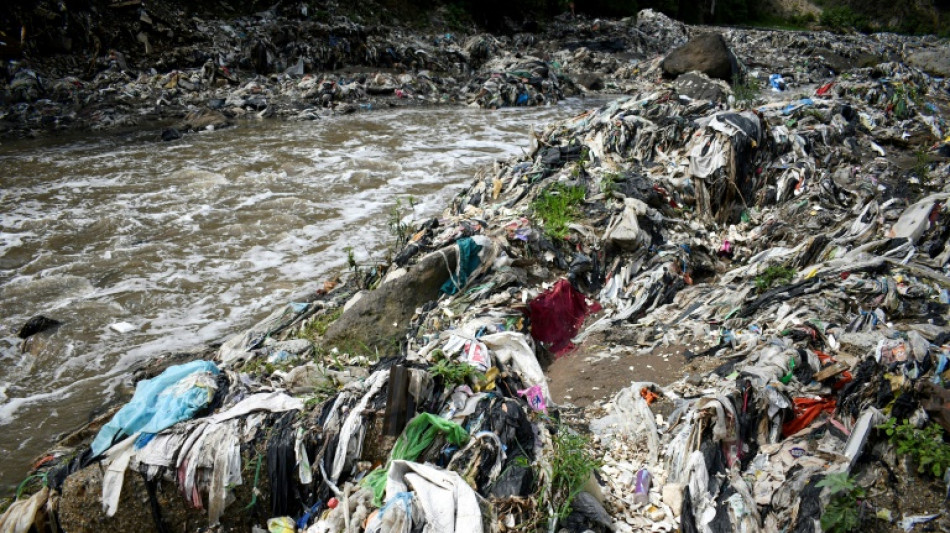
Plastic gobbling enzymes in worm spit may help ease pollution / Photo: Johan ORDONEZ - AFP/File

 France's debt climbs to highest since 1978: ministry

 McIlroy two shots off the lead at Wentworth after eagle on 18

 Martinez brace saves Inter in Serie A top-two clash with Roma

 Rosenior abused but guides Paris FC past old club Strasbourg

 Seven-try Lyon beat Pau, climb to Top 14 summit

 Brighton defeat a 'big lesson' against complacency for Arsenal, says Arteta

 Thousands protest inaction over climate crisis in Switzerland

 Carapaz out of cycling world championships

 'Fragile' Tottenham beaten by Aston Villa despite late rally

 Mourinho hails Real Madrid grit before Atletico derby clash

 Martin wins Austrian MotoGP sprint after Acosta crash

 Japan edge Fiji to win Pacific Nations Cup

 Black smoke, flames rising near Riyadh airport: residents to AFP

 UK actor Naomi Watts honoured at Spain film festival

 Japan emperor declares Asian Games open after turbulent build-up

 Asian Games open with unity message after troubled build-up

 Denmark hails 'binding' Greenland deal with Trump

 We don't want Games host Japan losing money, says Asian Olympic official

 Ed Sheeran returns to stage after Palestinian controversy

 Asian Games to open in Japan after troubled build-up

 Drone owners rush to offload devices ahead of Beijing ban

 Trump's beef policies irk Texas ranchers, testing their loyalty

 New to The Street Broadcasts Tonight at 6:30 PM ET Across the United States, Latin America and MENA, Featuring BioVie, Acurx Pharmaceuticals, Lantern Pharma and SafeSpace Global

 Nvidia, OpenAI CEOs to attend Xi dinner at White House

 Anthropic picks Accenture for in-house AI safety evaluation

Enzymes found in the saliva of wax worms can degrade one of the most common forms of plastic waste, according to research published Tuesday that could open up new ways of dealing with plastic pollution.
Humans produce some 400 million tonnes of plastic waste each year despite international drives to reduce single-use plastics and to increase recycling.
Around a third is polyethylene, a tough plastic thanks to its structure, which traditionally requires heating or radiation before it starts to break down.
There have been several studies showing that microorganisms can release enzymes that start the degradation process on polyethylene, but the process has until now taken months each time.
But those contained in the saliva the wax worm moth (Galleria mellonella) can act in only a few hours, Tuesday's research showed.
Researcher Federica Bertocchini, an avid beekeeper, said she originally stumbled on the idea that this small caterpillar had unusual powers when storing honeycombs a few years ago.
"At the end of the season, usually beekeepers put some empty beehives in a storage room, to put them back in the field in the spring," she told AFP.
"One year I did that, and I found my stored honeycombs plagued with wax worms. In fact, that is their habitat."
Bertocchini cleaned the honeycombs and put the worms in a plastic bag.
When she returned a short time later she found the bag "riddled with holes".
- Poured over plastics -
"That raised the question: is it the result of munching or there is a chemical modification? We checked that, doing proper lab experiments, and we found that the polyethylene had been oxidised," she told AFP.
In her latest research Bertocchini, from Madrid's Margarita Salas Centre for Biological Studies (CIB) and her colleagues analysed proteins in the wax worm saliva and identified two enzymes that could break polyethylene down into small polymers in only a few hours at room temperature.
Writing in the journal Nature Communications they explained how they used another worm's saliva as a control experiment, which produced no degradation compared with the wax worm.
Bertocchini said her team were still trying to figure out precisely how the worms degraded the plastic.
While the study authors stressed that much more research was needed before Tuesday's findings could be implemented at any meaningful scale, there were a number of possible applications.
"We can imagine a scenario where these enzymes are used in an aqueous solution, and litres of this solution is poured over piles of collected plastic in a waste management facility," said Bertocchini, who said her team were still trying to figure out precisely how the worms degraded the plastic.
"We can also imagine small amounts that can reach more remote locations, like villages or small islands, where waste facilities are not available."
She said that further down the line the solution could be used in individual houses, where each family could degrade their own plastic waste.
A.Moore--AT



