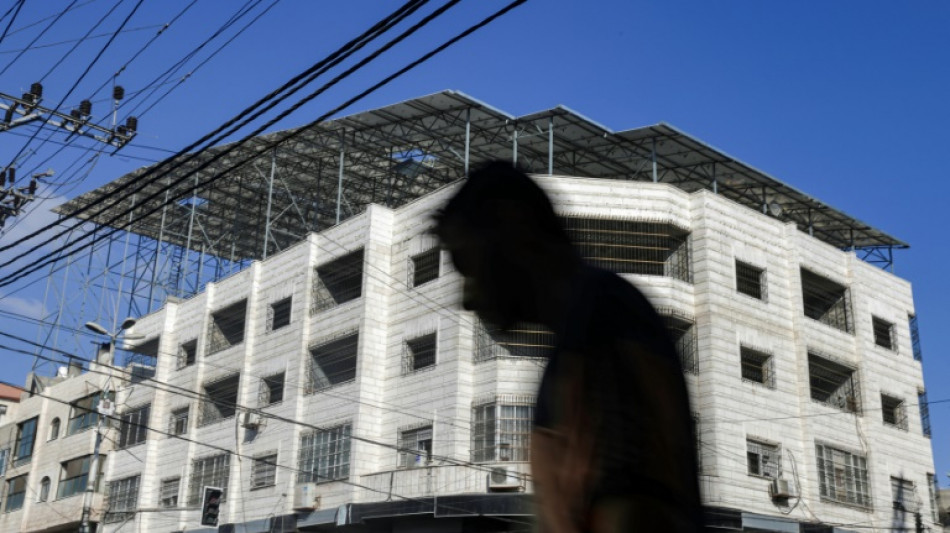
Tired of power cuts, blockaded Gaza turns to solar / Photo: MOHAMMED ABED - AFP

 France's debt climbs to highest since 1978: ministry

 McIlroy two shots off the lead at Wentworth after eagle on 18

 Martinez brace saves Inter in Serie A top-two clash with Roma

 Rosenior abused but guides Paris FC past old club Strasbourg

 Seven-try Lyon beat Pau, climb to Top 14 summit

 Brighton defeat a 'big lesson' against complacency for Arsenal, says Arteta

 Thousands protest inaction over climate crisis in Switzerland

 Carapaz out of cycling world championships

 'Fragile' Tottenham beaten by Aston Villa despite late rally

 Mourinho hails Real Madrid grit before Atletico derby clash

 Martin wins Austrian MotoGP sprint after Acosta crash

 Japan edge Fiji to win Pacific Nations Cup
 Black smoke, flames rising near Riyadh airport: residents to AFP

 UK actor Naomi Watts honoured at Spain film festival

 Japan emperor declares Asian Games open after turbulent build-up

 Asian Games open with unity message after troubled build-up

 Denmark hails 'binding' Greenland deal with Trump

 We don't want Games host Japan losing money, says Asian Olympic official

 Ed Sheeran returns to stage after Palestinian controversy

 Asian Games to open in Japan after troubled build-up
 Drone owners rush to offload devices ahead of Beijing ban

 Trump's beef policies irk Texas ranchers, testing their loyalty

 New to The Street Broadcasts Tonight at 6:30 PM ET Across the United States, Latin America and MENA, Featuring BioVie, Acurx Pharmaceuticals, Lantern Pharma and SafeSpace Global
 Nvidia, OpenAI CEOs to attend Xi dinner at White House

 Anthropic picks Accenture for in-house AI safety evaluation

Palestinians living in the Israeli-blockaded enclave of Gaza have long endured an unstable and costly electricity supply, so Yasser al-Hajj found a different way: solar power.
Looking at the rows of photo-voltaic panels at his beachfront fish farm and seafood restaurant, The Sailor, he said the investment he made six years ago had more than paid off.
"Electricity is the backbone of the project," Hajj said, standing under a blazing Mediterranean sun. "We rely on it to provide oxygen for the fish, as well as to draw and pump water from the sea."
The dozens of solar panels that shade the fish ponds below have brought savings that are now paying to refurbish the business, he said, as labourers loaded sand onto a horse-drawn cart.
Hajj said he used to pay 150,000 shekels ($42,000) per month for electricity, "a huge burden," before solar power slashed his monthly bill to 50,000 shekels.
For most of Gaza's 2.3 million residents, living under Hamas Islamist rule and a 15-year-old Israeli blockade, power cuts are a daily fact of life that impact everything from homes to hospital wards.
While some Gazans pay for a generator to kick in when the mains are cut -- for around half of each day, according to United Nations data -- ever more people are turning to renewables.
From the rooftops of Gaza City, solar panels now stretch out into the horizon.
Green energy advocates say it is a vision for a global future as the world faces the perils of climate change and rising energy costs.
- Swap to green power -
Gaza bakery owner Bishara Shehadeh began the switch to solar this summer, by placing hundreds of gleaming panels on his rooftop.
"We have surplus electricity in the day," he said. "We sell it to the electricity company in exchange for providing us with current during the night."
Solar energy lights up the bright bulbs illuminating the bustling bakery, but the ovens still run on diesel.
"We are working on importing ovens, depending on electrical power, from Israel, to save the cost of diesel," said Shehadeh.
Both the bakery and the fish farm have relied partially on foreign donors to kick-start their switch to solar, although their owners are also investing their own cash.
But in a poverty-stricken territory where nearly 80 percent of residents rely on humanitarian assistance, according to the UN, not everyone can afford to install renewable energy.
Around a fifth of Gazans have installed solar power in their homes, according to an estimate published in April by the "Energy, Sustainability and Society" journal.
Financing options are available for Gazans with some capital, like Shehadeh, who got a four-year loan to fund his bakery project.
- Import restrictions -
At a store selling solar power kits, MegaPower, engineer Shehab Hussein said prices start at around $1,000 and can be paid in instalments.
Clients included a sewing factory and a drinks producer, which see the mostly Chinese-made technology as "a worthwhile investment", he said.
Raya al-Dadah, who heads the University of Birmingham's Sustainable Energy Technology Laboratory, said her family in Gaza has been using simple solar panels that heat water for more than 15 years.
"The pipe is super rusty, the glass is broken... and I just had a shower and the water is super hot," she said during a visit to the territory.
But Dadah encountered obstacles when she tried to import a more sophisticated solar system for a community project in Gaza, where imports are tightly restricted by Israel and Egypt.
"Bringing them to the Gaza Strip has proved to be impossible," she said.
The advanced set-up includes more efficient panels and equipment that tracks the sun's path.
Such technology is being used by Israeli firms such as SolarGik, whose smart control systems factor in weather conditions and can harness up to 20 percent more energy than standard panels, chief executive Gil Kroyzer told AFP.
Across the frontier in Gaza, in the absence of such high-tech equipment, Dadah relies on the standard panels to power a women's centre and surrounding homes in the strip's northern Jabalia area.
Despite the challenges, Dadah said solar energy remains a "brilliant" option for Gaza, with its copious sunlight: "It is really a very promising energy source, and it's available everywhere".
R.Garcia--AT



