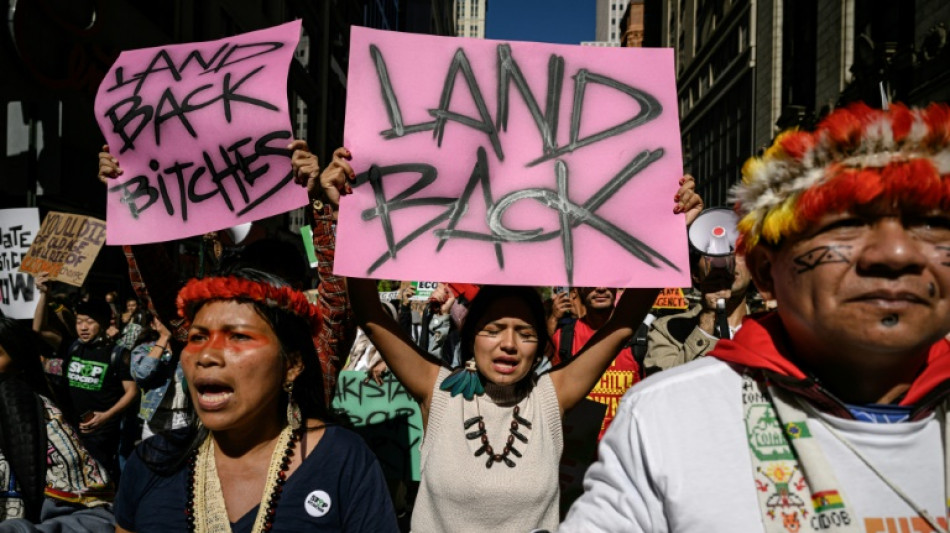
Indigenous activists raise climate awareness on sidelines of UNGA / Photo: Ed JONES - AFP

 Rubio launches Latin America tour to cement US influence

 France tries 14 over deadliest Channel migrant crossing disaster

 Australia threatens hefty fines if big tech fails 'duty of care'
 Zverev romps into quarter-finals as Darderi downed
 Kauai on tornado watch as Hurricane Lowell nears Hawaiian islands
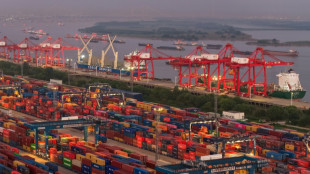
 Pakistan roll the dice in search of consolation win over England

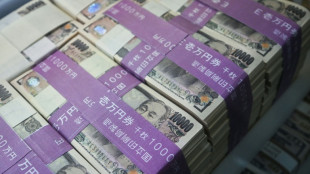 Yen extends gains as traders eye rate hike, tech rallies again
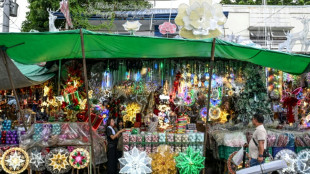 'The ber months': Christmas arrives early in the Philippines
 N. Korea calls Russia bridge a sign of tighter ties

 US sanctions threaten to crush Iranian students' dreams

 Former champ Gauff holds off Jovic to reach US Open quarter-finals

 Guardian Metal Resources PLC Announces Admission to FTSE AIM 50 Index

 InterContinental Hotels Group PLC Announces Transaction in Own Shares - September 08

 Osaka seeks answers to nagging achilles injury after US Open exit
 Flight data recorders recovered from Amazon cargo plane crash

 Super Bowl rematch kicks off NFL season as league expands global reach

 Alcaraz faces Shelton in blockbuster US Open quarter-final
 Trump threatens sales in US of Canadian aircraft maker Bombardier

 Eiffel Tower closed in row over women removed for Hindu group

 Willemse replaces Kolbe for Springboks' All Blacks series decider

 Zheng shocks Swiatek in another incredible US Open comeback

 Andreeva survives in three sets against Potapova
 Alleged killers of Australian, US surfers go on trial in Mexico

 King Charles classes Harry and Meghan as 'private citizens'

 Bowling coach Noffke says Pakistan's off-field issues are nothing new

Uyukar Domingo Peas, an Ecuadorian Indigenous activist, says if there are still "reservoirs of natural resources" in the world, it is "because we have protected them for thousands of years."
Peas has been fighting against the destruction of forests for three decades and regrets that states and companies continue to destroy the Amazon despite the urgency of the climate crisis.
"The Amazon must remain intact for the youth and the rest of humanity," the 58-year-old from the Achuar nation told AFP, lamenting that governments and corporations have not sought the ancestral knowledge of Indigenous peoples to save the planet.
Peas was speaking at Environment Week, a series of independent events involving Indigenous peoples from around the world that is being held in New York on the sidelines of the United Nations General Assembly.
An estimated 80 percent of the world's tropical forests -- about 800 million hectares -- are in Indigenous territories, according to organizations that defend them.
Many Indigenous people blame capitalism for the destruction of their forests.
"We want companies and banks to stop investing for money and invest for the common good" because "climate change harms every human being," he said.
He is calling for funds to implement the Amazon Sacred Headwaters Initiative, which aims to protect 35 million hectares in the Amazon rainforest of Peru and Ecuador, and is home to 30 Indigenous communities with around 600,000 people.
He hopes that the nine countries that share the Amazon -- often referred to as the lungs of the planet, spread over nearly 300 million hectares with three million inhabitants from more than 500 peoples -- will also join this initiative.
- 'Bioeconomy' -
Peas advocates for a new "bioeconomy," with new sources of energy, tourism programs and other initiatives to ensure that Indigenous youth do not migrate away from their homelands.
"We want to take care of the jungle and live off the jungle," he said.
Compared to the large sums needed for the oil and mining projects that pollute their lands and rivers, Peas' initiative requires just $19 million over 10 years.
"Mother Earth does not expect us to save her, she expects us to respect her," said Nemonte Nenquimo, the Ecuadorian chief of the Waorani nation.
- 'Where does the money go?'-
The Covid pandemic and "the collective hysteria of oil-dependent countries" following the conflict in Ukraine have dealt a severe blow to the Indigenous climate struggle, said Levi Sucre, of the Bribri community, an Indigenous people living between Costa Rica and Panama.
With priorities set on economic recovery, Indigenous rights "have regressed alarmingly in the last two, three years," he told AFP.
He said that the most alarming case is that of Brazil, where the government "deliberately ignores the Indigenous peoples."
Indigenous peoples' representatives complain that the resources agreed upon at climate meetings barely ever reached them.
Monica Kristiani Ndoen, a young Indonesian Indigenous leader, said that "the challenge is to access climate funds directly."
"The question is where does the money go?"
For the Venezuelan Gregorio Diaz Mirabal, general coordinator of the Indigenous Organizations of the Amazon Basin (COICA), the problem is that "we are not present in the meetings where the decisions are taken."
"If you want us to continue to provide oxygen, rivers, forests, drinking water, respect our house," he said.
A.Taylor--AT