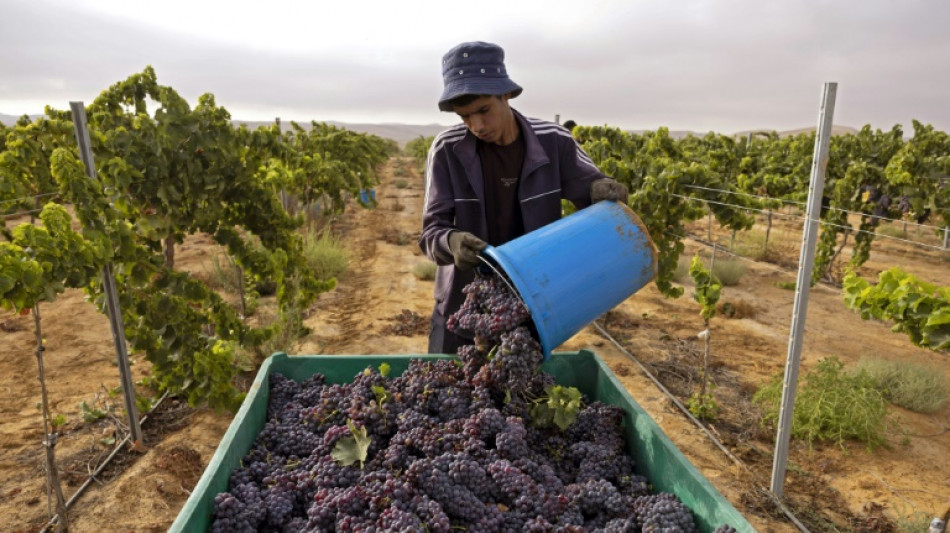
Negev desert winemakers show way ahead in Israel's hot climate / Photo: MENAHEM KAHANA - AFP

 Tiafoe tops Medvedev in straight sets at US Open

 Zverev seeks US Open last eight as Osaka faces Rybakina

 Alcaraz turns up heat to reach US Open quarters

 Gatti salvages Juve draw with AC Milan in Serie A

 Sinayoko stars as unbeaten Paris FC down Marseille

 Still on top: 'Spider-Man' dominates North American box office
 Zelensky in fresh talks with US envoys: Ukraine official

 Noskova edges Kostyuk to reach US Open quarter-finals

 Alonso urges Chelsea to learn from painful defeat at Arsenal

 Defending champion Sabalenka reaches US Open quarter-finals

 Minnows Augsburg sink Frankfurt to top Bundesliga table

 Yamal hits double as 'nearly perfect' Barca thrash Valencia

 Antonelli living 'a dream' after astonishing home win

 Impressive Daryz keeps Arc double dream alive
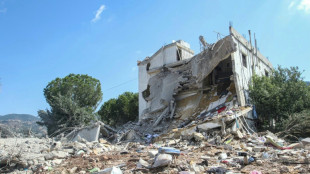
 Strasbourg hit Troyes for six as Amo-Ameyaw sparkles

 German far-right AfD landslide winner in eastern state vote

 Carrick defends Man Utd start despite defensive concerns

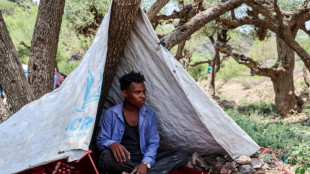 More than 140 killed in latest Yemen clashes: military sources

 Van Aert claims shortened Vuelta stage 15 win in high heat

 Everton shrug off transfer window woes to hold Man Utd

 'Nothing has changed': FIFA confirms Infantino to run for re-election

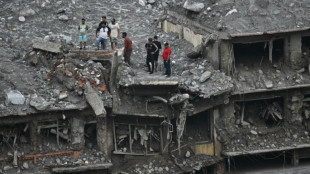 UN's Nepal chief makes emotional plea for flood-ravaged country

 Italian GP red-flagged after massive Leclerc crash

 US envoys hold talks with Zelensky on first Kyiv visit

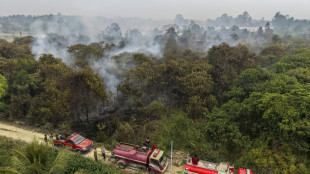 'Truly scared': Blazes outpace firefighters in Indonesian Borneo

In Israel's Negev desert, winemakers are sharing their knowledge of growing vines in the blistering heat with European producers also facing fierce temperatures this summer.
Walking between rows of ripe grapes growing from the scorched land, David Pinto enthuses about how his vineyard has come of age in the past three years.
"We're masters of the conditions, without depending on the whims of the weather," said Pinto, whose estate near the town of Yeruham carries his name.
With nearly year-round sunshine and little rain in the barren Negev, Pinto has adopted a micro-irrigation system to conserve resources and drip water slowly onto the vines.
Such techniques may soon need to be used across the Mediterranean region, with winemakers in France forced to start picking earlier than usual due to an exceptionally dry and hot summer.
"Winemakers from Bordeaux came to visit us following the heatwave in France," said Pinto, who advised his guests on ways to adapt to climate changes.
"Now we share the same challenges, with the extreme climate and the dryness that harms the grapes," he added, while workers plucked grapes in the early morning light.
Israel's greener north has long been the centre of its viniculture, but more pioneering winemakers are discovering its sun-baked south.
Pinto, whose wines sell for 89 shekels ($26), is one of more than 25 wineries now dotted across the desert landscape.
They include Ramat Negev, adjacent to the Egyptian border, and Nana, located near the vast crater-like formation of Makhtesh Ramon.
- Enduring extreme heat -
Ilan Abitbol, who advises various Israeli winemakers, is busy creating a variety of blends on a small plot of land.
"The temperature of the Negev gives a particular identity to the region's wines: more dry, stronger in alcohol," he said.
Pinto's Malbec, for example, brings a weighty 14.5 percent alcohol volume to the table.
"We're used to extreme temperatures, whereas in Europe, the climatic changes have an impact on the vines, because they're not used to these temperatures," said Abitbol.
For Yaakov Oriya, Pinto's winemaker, there are unique opportunities in a desert region, where wine has been produced for centuries since Byzantine times.
"When you're faced with a different land like this, you can create different wines," he said, including dessert and sparkling varieties.
"We're not the first to make wine in this region but making the desert bloom remains a wonderful objective," said Oriya.
On the Pinto estate, where sturdy olive and argan trees also grow, the family is expecting to produce 55,000 bottles this season.
Beyond their own commercial gains, Jimmy Pinto, David's father, said the wine industry can boost the wider economy in the sparsely-populated desert.
"Creating a winery here in Yeruham contributes to our efforts to develop the region," he said.
Jimmy Pinto likened the years-long work in the fields to an educational network he has developed for children in remote areas.
"It's a great challenge, but in the same way that we think that the children of this region can be better, we want to produce a wine that will be the best," he said.
"And in these two areas, it takes time before you see the fruits of your investment."
A.Moore--AT