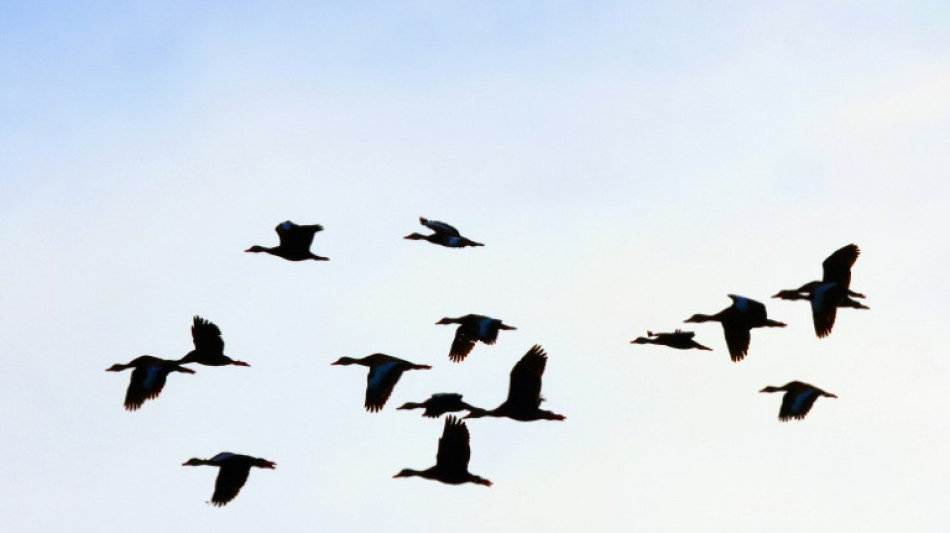
Mercury pollution makes ducks more likely to get bird flu: study / Photo: BRUCE BENNETT - GETTY IMAGES NORTH AMERICA/AFP/File

 Tiafoe tops Medvedev in straight sets at US Open

 Zverev seeks US Open last eight as Osaka faces Rybakina

 Alcaraz turns up heat to reach US Open quarters

 Gatti salvages Juve draw with AC Milan in Serie A

 Sinayoko stars as unbeaten Paris FC down Marseille

 Still on top: 'Spider-Man' dominates North American box office

 Zelensky in fresh talks with US envoys: Ukraine official

 Noskova edges Kostyuk to reach US Open quarter-finals

 Alonso urges Chelsea to learn from painful defeat at Arsenal

 Defending champion Sabalenka reaches US Open quarter-finals

 Minnows Augsburg sink Frankfurt to top Bundesliga table

 Yamal hits double as 'nearly perfect' Barca thrash Valencia

 Antonelli living 'a dream' after astonishing home win

 Impressive Daryz keeps Arc double dream alive

 Strasbourg hit Troyes for six as Amo-Ameyaw sparkles

 German far-right AfD landslide winner in eastern state vote

 Carrick defends Man Utd start despite defensive concerns

 More than 140 killed in latest Yemen clashes: military sources

 Van Aert claims shortened Vuelta stage 15 win in high heat

 Everton shrug off transfer window woes to hold Man Utd

 'Nothing has changed': FIFA confirms Infantino to run for re-election

 UN's Nepal chief makes emotional plea for flood-ravaged country

 Italian GP red-flagged after massive Leclerc crash

 US envoys hold talks with Zelensky on first Kyiv visit

 'Truly scared': Blazes outpace firefighters in Indonesian Borneo

Ducks contaminated by mercury pollution are significantly more likely to get bird flu, a study found Wednesday, pointing towards another way that human-driven changes to the natural world increase the risk of viruses spreading.
Bird flu rarely infects humans but persistent outbreaks in the US and UK among other countries have led to millions of poultry being culled so far this year.
Wild waterfowl such as ducks are believed to be superspreaders of the virus in part because they travel so far as they migrate, potentially infecting other birds along the way.
For the new study, scientists shot down nearly 750 wild ducks from 11 different species in California's San Francisco Bay, which is in a migratory path that stretches from Alaska to Patagonia.
They then tested the ducks for mercury contamination and whether they were infected with bird flu -- or had antibodies for the virus in their system.
The results, published in the journal Proceedings of the Royal Society B, showed that ducks contaminated with mercury were up to 3.5 times more likely to have had bird flu at some point over the last year or so.
The study's lead author, Claire Teitelbaum, a quantitative ecologist at the USGS Eastern Ecological Science Center, said mercury contamination "can suppress the immune system, and that might make infection with anything -- including influenza -- more likely".
The San Francisco Bay is also a "significant hotspot for mercury contamination in North America... largely from historical gold mining, where mercury was part of that process," she told AFP.
The ducks however tested negative to the highly pathogenic H5N1 bird flu strain that has been detected in many parts of the world.
- More bird flu likely -
Teitelbaum said that bird flu outbreaks in the United States had slowed down during the summer "because many of the wild birds are up on their breeding grounds" farther north.
But "as they're starting to come back down, we're probably going to see a lot more activity", she warned.
The spread comes as researchers increasingly sound the alarm that climate change, deforestation, livestock farming and other human-induced factors raise the likelihood of viruses crossing over from animals to humans.
Teitelbaum said that "there are just so many ways in which humans have historically altered and are continuing to alter the natural environment."
How pollution and contamination affect the risk of diseases spreading is "just another link that we need to add in to our more holistic view of what's going on in the world," she said.
Daniel Becker, a biologist at the University of Oklahoma not involved in the research, hailed the "impressive" study.
"There is surprisingly little work looking at contaminant concentrations in wildlife and their relationship to infectious disease," especially for viruses that can cross over to humans like bird flu, he said.
A.Moore--AT