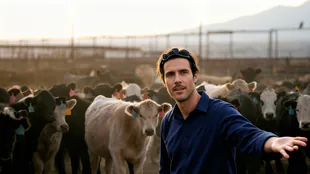
Canada faces one of its most intense fire seasons / Photo: Cole BURSTON - AFP/File

 Galloway accuser could not foresee publishing-sector fallout, lawyer argues

 New York City Center revives In the Heights as a timely community story

 Godzilla Minus Zero shifts focus toward postwar human drama

 Mehbooba Mufti urges dialogue and renewed Central Asia links for Kashmir

 Seacliff Healthcare Seeks Specialist GP in Thirroul

 US stocks fall before midterm Election Day as technology shares weaken

 BLS Polymers makes strong market debut at ₹248 per share

 Petrol and diesel prices remain broadly steady across major Indian cities

 Reliance shares remain in focus after near-12% surge

 2026 Arizona Midterms: Key Races, Ballot Measures, and Voter Deadlines

 Coal India prepares possible $1 billion Mahanadi Coalfields listing

 Julia Stiles and Ezra Sosa Share Emotional Farewell After 'DWTS' Elimination

 US Buildings Threatened by Wildfires Could Triple by 2060

 Why Pregnancy Cost Estimates Fail: A Family’s $9,000 Surprise

 US Strikes Iranian Targets in Strait of Hormuz Ahead of Midterms

 Brodeur’s Overtime Goal Secures Bethlehem’s Second Consecutive Sectional Title

 Rare 1970 Plymouth ‘Cuda 426 Hemi Listed for $400,000

 The Digital Burden: Why Instant Messaging Feels Like a Full-Time Job

 Alberta Tabled Controversial Riding Boundary Maps Amid Gerrymandering Accusations

 Hong Kong court set to sentence activist Joshua Wong in security case

 Australia raises benchmark rate to highest level in 18 years

 'The Remarried Empress' Cast Discusses Bringing Fantasy Royal Drama to Life

 Asian stocks retreat as AI worries outweigh steep oil-price drop

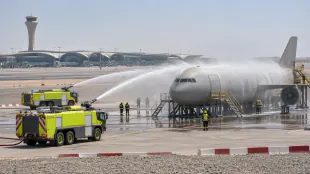 Hamad International Airport stages emergency drills during WATAN 2026

 Global failure to punish attacks leaves journalists at continuing risk

With nearly 1,000 active fires and an area as large as Belgium already burned, Canadian Prime Minister Mark Carney says his country is facing one of the "most intense" wildfire seasons in its history.
Barely halfway through the summer, virtually all Canadian provinces and territories have been affected. The largest fire, in Ontario, has forced mass evacuations and spread smoke as far as the US East Coast.
- Thousands of firefighters -
While recent rainfall has slightly slowed the spread of the fires, more than 200 remained out of control across the country on Monday.
More than 5,000 firefighters and 300 water tankers have been mobilized, as well as the Canadian Armed Forces. So far, three million hectares (7.4 million acres) have burned.
In Quebec, authorities said assistance from the United States and France arrived at the weekend to "address the significant workload" in the northwest of the province.
Still, Yves Bergeron, a professor at the Centre for Forest Studies at the University of Quebec at Montreal, said it is "unrealistic to think we would have enough firefighters to extinguish all these fires," which are mostly in remote areas, inaccessible by road.
"The important thing is to focus our energy on protecting villages and infrastructure," Bergeron told AFP.
- Repeated fires -
Canada's 270 million hectares of boreal forest -- that is forest in high-latitude environments -- comprises 28 percent of the world's boreal zone. It is naturally affected by lightning fires that spread rapidly through the canopy, making them difficult to control.
"Unlike Californian forests, where preventative measures can be taken through thinning, boreal forests, which are very dense, cannot be controlled," Bergeron said.
These trees "need natural disturbances such as fires," according to the government department Environment Canada, but suffer from repeated, intense fires that prevent them from regenerating.
Heat waves, low rainfall, and droughts contribute to the intensification of these violent fire seasons.
"There is real concern that the forest will become less resilient to climate change," said Bergeron, who added it is normal for between 0.5 and 1.0 percent of Canadian forests to burn each year.
- Summer prospects -
While still far from the devastating 2023 fire season, when nearly 18 million hectares went up in smoke, the current season could nevertheless reach new records, particularly due to the low rainfall forecast for Canada's north and west.
Fires further south, near settlements, could force authorities to order new evacuations, as happened on Monday in Ontario.
"In the future, we will need to focus on prevention, for example, by avoiding the possibility of villages being surrounded by forests," Bergeron said, advocating for human adaptation to these fires, which are likely to intensify year after year.
T.Perez--AT