
-
 'It has to stop': runners protest women's murders in S.Africa district
-
Rosenior abused but guides Paris FC past old club Strasbourg

-
 Fire erupts near Riyadh airport as Houthis claim strikes
-
Seven-try Lyon beat Pau, climb to Top 14 summit

-
 Cuba works to restore power after another blackout
-
Brighton defeat a 'big lesson' against complacency for Arsenal, says Arteta

-
 England thrash Sri Lanka again to return to top of T20 rankings
-
Thousands protest inaction over climate crisis in Switzerland

-
 Arsenal thrashed by Brighton, sorry Spurs lose again
-
Carapaz out of cycling world championships

-
 South Korea, Austria qualify for Davis Cup finals
-
'Fragile' Tottenham beaten by Aston Villa despite late rally

-
 Seare shocks Ingebrigtsen to win world 5km gold
-
Mourinho hails Real Madrid grit before Atletico derby clash

-
 Brigitte Bardot widower slams sale of star's belongings
-
Martin wins Austrian MotoGP sprint after Acosta crash

-
 Aston Villa compound Tottenham's misery despite late rally
-
Japan edge Fiji to win Pacific Nations Cup

-
 Asian Games offer 'deepest apologies' for South Korea anthem blunder
-
Black smoke, flames rising near Riyadh airport: residents to AFP
-
 Inter Milan and Italy icon Mazzola dies aged 83
-
UK actor Naomi Watts honoured at Spain film festival

-
 Saudi capital issues first air raid alert since renewed fighting in Yemen
-
Japan emperor declares Asian Games open after turbulent build-up

-
 Martin edges title rival Marquez for Austrian MotoGP pole
-
Asian Games open with unity message after troubled build-up

-
 Indonesia accepts Malaysia's help to tackle wildfires
-
Denmark hails 'binding' Greenland deal with Trump

-
 Indians living in Japan on stand-by to house Asian Games athletes
-
We don't want Games host Japan losing money, says Asian Olympic official

-
 Trump signs bill authorizing sweeping Russia sanctions
-
Ed Sheeran returns to stage after Palestinian controversy

-
 Protesters form human chain at Kennedy Center after Trump threat
-
Asian Games to open in Japan after troubled build-up

-
 Death toll from attack at police HQ in Pakistan rises to 31
-
Drone owners rush to offload devices ahead of Beijing ban

-
 Trump says Denmark to give US 'permanent control' over Greenland security
-
Trump's beef policies irk Texas ranchers, testing their loyalty

-
 New to The Street Broadcasts Tonight at 6:30 PM ET Across the United States, Latin America and MENA, Featuring BioVie, Acurx Pharmaceuticals, Lantern Pharma and SafeSpace Global
-
Batman Appears Atop the Sydney Opera House for Batman Day 2026

-
 Kennedy Center: future unclear for iconic Washington arts hub
-
Nvidia, OpenAI CEOs to attend Xi dinner at White House

-
 Trump claims 'infinite' Greenland security deal with Denmark
-
Anthropic picks Accenture for in-house AI safety evaluation

-
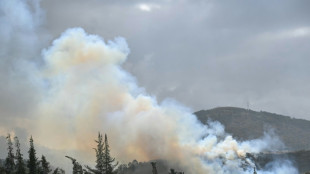 Helicopters battle wildfire threatening Ecuador's capital
-
Balogun returns as Monaco beat Lens to continue strong Ligue 1 start

-
 Brentford batter Chelsea to undo Alonso's promising start
-
'Pause' on overt repression in Venezuela, but reforms still needed: HRW

-
 Kane hits Bundesliga century as Bayern rout Union
-
Global stocks mixed as yen falls despite Bank of Japan rate hike
Pakistan floods 'worst in country's history', aid efforts gather pace
Aid efforts ramped up across flooded Pakistan on Tuesday to help tens of millions of people affected by relentless monsoon rains that have submerged a third of the country and claimed more than 1,100 lives.
Prime Minister Shehbaz Sharif called the flooding "the worst in the history of Pakistan", adding it would cost at least $10 billion to repair damaged infrastructure spread across the country.
The rains that began in June have unleashed powerful floods across the country that have washed away swathes of vital crops and damaged or destroyed more than a million homes.
Authorities and charities are struggling to accelerate aid delivery to more than 33 million people, a challenging task in areas cut off because many roads and bridges have been critically damaged.
Displaced people have been wandering what dry land remains, seeking shelter, food and drinking water.
"For God's sake help us out," said Qadir, 35, who was camped out with his extended family on a road near the southern city of Sukkur.
"We walked along the road for three days to reach here. There's nothing left back at home, we only managed to save our lives."
In the country's south and west, many Pakistanis have crammed onto elevated highways and railroad tracks to escape the flooded plains.
"We don't even have space to cook food. We need help," Rimsha Bibi, a schoolgirl in Dera Ghazi Khan in central Pakistan, told AFP.
Pakistan receives heavy -- often destructive -- rains during its annual monsoon season, which are crucial for agriculture and water supplies.
But such intense downpours have not been seen for three decades.
Pakistani officials have blamed climate change, which is increasing the frequency and intensity of extreme weather around the world.
- 'Mind-boggling devastation' -
"To see the devastation on the ground is really mind-boggling," Pakistan's climate change minister Sherry Rehman told AFP.
"When we send in water pumps, they say, 'Where do we pump the water?' It's all one big ocean, there's no dry land to pump the water out."
She said "literally a third" of the country was under water, comparing scenes from the disaster to a dystopian movie.
The Indus River, which runs the length of the South Asian nation, is threatening to burst its banks as torrents of water rush downstream from its tributaries in the north.
Pakistan as a whole has been deluged with twice the usual monsoon rainfall, the meteorological office said, but Balochistan and Sindh provinces have seen more than four times the average of the last three decades.
- 'Monsoon on steroids' -
The disaster could not have come at a worse time for Pakistan, where the economy is in free fall.
Appealing for international help, the government has declared an emergency.
Aid flights have arrived in recent days from Turkey and the United Arab Emirates, while other countries including Canada, Australia and Japan have also pledged assistance.
The United Nations launched a formal $160 million appeal on Tuesday to fund emergency aid.
"Pakistan is awash in suffering. The Pakistani people are facing a monsoon on steroids -- the relentless impact of epochal levels of rain and flooding," UN Secretary-General Antonio Guterres said in a video statement, calling it a "colossal crisis".
PM Sharif promised donors that any funding would be responsibly spent.
"I want to give my solemn pledge and solemn commitment... every penny will be spent in a very transparent fashion. Every penny will reach the needy," he said.
Pakistan was already desperate for international support and the floods have compounded the challenge.
Prices of basic goods -- particularly onions, tomatoes and chickpeas -- are soaring as vendors bemoan a lack of supplies from the flooded breadbasket provinces of Sindh and Punjab.
There was some relief on Monday when the International Monetary Fund approved the revival of a loan programme for Pakistan, releasing a $1.1 billion tranche.
Makeshift relief camps have sprung up all over Pakistan -- in schools, on motorways and in military bases.
In the northwestern town of Nowshera, a technical college was turned into a shelter for up to 2,500 flood victims.
They sweltered in the summer heat with sporadic food aid and little access to water.
"We have lost our heaven and are now forced to live a miserable life."
N.Mitchell--AT



