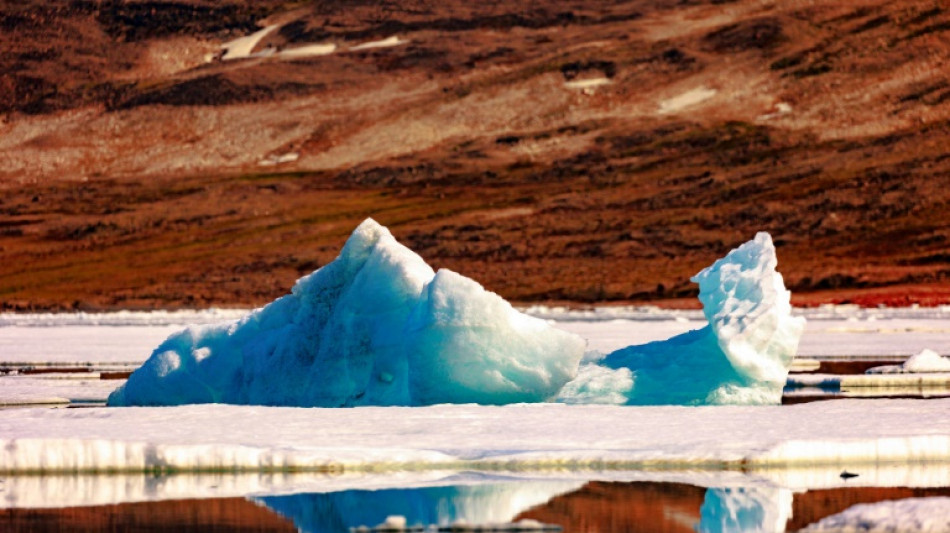
Arctic warming four times faster than rest of Earth: study / Photo: Kerem YUCEL - AFP/File

 Galloway accuser could not foresee publishing-sector fallout, lawyer argues

 New York City Center revives In the Heights as a timely community story

 Godzilla Minus Zero shifts focus toward postwar human drama

 Mehbooba Mufti urges dialogue and renewed Central Asia links for Kashmir

 Seacliff Healthcare Seeks Specialist GP in Thirroul

 US stocks fall before midterm Election Day as technology shares weaken

 BLS Polymers makes strong market debut at ₹248 per share

 Petrol and diesel prices remain broadly steady across major Indian cities

 Reliance shares remain in focus after near-12% surge

 2026 Arizona Midterms: Key Races, Ballot Measures, and Voter Deadlines

 Coal India prepares possible $1 billion Mahanadi Coalfields listing

 Julia Stiles and Ezra Sosa Share Emotional Farewell After 'DWTS' Elimination

 US Buildings Threatened by Wildfires Could Triple by 2060

 Why Pregnancy Cost Estimates Fail: A Family’s $9,000 Surprise

 US Strikes Iranian Targets in Strait of Hormuz Ahead of Midterms

 Brodeur’s Overtime Goal Secures Bethlehem’s Second Consecutive Sectional Title

 Rare 1970 Plymouth ‘Cuda 426 Hemi Listed for $400,000

 The Digital Burden: Why Instant Messaging Feels Like a Full-Time Job

 Alberta Tabled Controversial Riding Boundary Maps Amid Gerrymandering Accusations

 Hong Kong court set to sentence activist Joshua Wong in security case

 Australia raises benchmark rate to highest level in 18 years

 'The Remarried Empress' Cast Discusses Bringing Fantasy Royal Drama to Life

 Asian stocks retreat as AI worries outweigh steep oil-price drop

 Hamad International Airport stages emergency drills during WATAN 2026

 Global failure to punish attacks leaves journalists at continuing risk

The Arctic has warmed nearly four times faster than the rest of the planet over the last 40 years, according to research published Thursday that suggests climate models are underestimating the rate of polar heating.
The United Nations' climate science panel said in a special report in 2019 that the Arctic was warming "by more than double the global average" due to a process known as Arctic amplification.
This occurs when sea ice and snow, which naturally reflect the Sun's heat, melt into sea water, which absorbs it instead.
While there is a long-held consensus among scientists that the Arctic is warming quickly, estimates vary according to the timeframe studied and the definition of what constitutes the geographic area of the Arctic.
A team of researchers based in Norway and Finland analysed four sets of temperature data gathered by satellite studies since 1979 -- the year when satellite data became available -- over the entire Arctic circle.
They found that on average the data showed the Arctic had warmed 0.75C per decade, nearly four times quicker than the rest of the planet.
"The take in the literature is that the Arctic is warming about twice as fast as the globe, so for me it was a bit surprising that ours was so much higher than the usual number," Antti Lipponen, co-author from the Finnish Meteorological Institute, told AFP.
The study, published in the journal Communications Earth & Environment, found significant regional variations in warming rate within the Arctic circle.
For example, the Eurasian sector of the Arctic Ocean, near the Svalbard and Novaya Zemlya archipelagos, has warmed as much as 1.25C per decade -- seven times faster than the rest of the world.
The team found that even state-of-the-art climate models predicted Arctic warming to be approximately one third lower than what the observed data showed.
They said that this discrepancy may be due to previous modelled estimates being rendered out of date by continued Arctic modelling.
"Maybe the next step would be to take a look at the models and I would be really interested in seeing why the models do not reproduce what we see in observations and what impact that is having on future climate projections," said Lipponen.
As well as profoundly impacting local communities and wildlife that rely on sea ice to hunt, intense warming in the Arctic will have worldwide repercussions.
The Greenland ice sheet, which recent studies warn may be approaching a melting "tipping point", contains enough frozen water to lift Earth's oceans some six metres.
"Climate change is caused by humans. As the Arctic warms up its glaciers will melt and this will globally affect sea levels," said Lipponen.
"Something is happening in the Arctic and it will affect us all."
B.Torres--AT