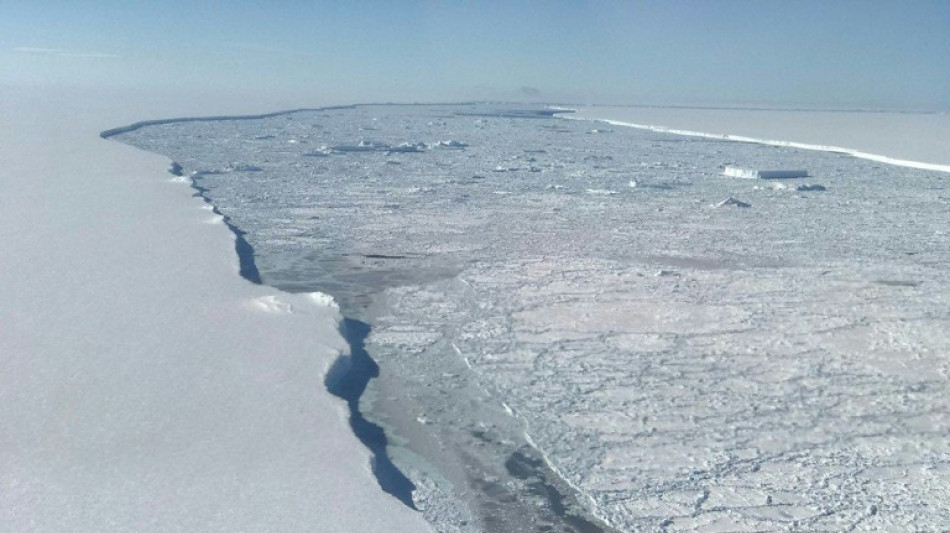
World's biggest ice sheet could cause massive sea rise without action: study / Photo: HO - NASA/AFP/File

 Galloway accuser could not foresee publishing-sector fallout, lawyer argues

 New York City Center revives In the Heights as a timely community story

 Godzilla Minus Zero shifts focus toward postwar human drama

 Mehbooba Mufti urges dialogue and renewed Central Asia links for Kashmir

 Seacliff Healthcare Seeks Specialist GP in Thirroul

 US stocks fall before midterm Election Day as technology shares weaken

 BLS Polymers makes strong market debut at ₹248 per share

 Petrol and diesel prices remain broadly steady across major Indian cities

 Reliance shares remain in focus after near-12% surge

 2026 Arizona Midterms: Key Races, Ballot Measures, and Voter Deadlines

 Coal India prepares possible $1 billion Mahanadi Coalfields listing

 Julia Stiles and Ezra Sosa Share Emotional Farewell After 'DWTS' Elimination

 US Buildings Threatened by Wildfires Could Triple by 2060

 Why Pregnancy Cost Estimates Fail: A Family’s $9,000 Surprise

 US Strikes Iranian Targets in Strait of Hormuz Ahead of Midterms

 Brodeur’s Overtime Goal Secures Bethlehem’s Second Consecutive Sectional Title

 Rare 1970 Plymouth ‘Cuda 426 Hemi Listed for $400,000

 The Digital Burden: Why Instant Messaging Feels Like a Full-Time Job
 Alberta Tabled Controversial Riding Boundary Maps Amid Gerrymandering Accusations

 Hong Kong court set to sentence activist Joshua Wong in security case

 Australia raises benchmark rate to highest level in 18 years

 'The Remarried Empress' Cast Discusses Bringing Fantasy Royal Drama to Life

 Asian stocks retreat as AI worries outweigh steep oil-price drop

 Hamad International Airport stages emergency drills during WATAN 2026

 Global failure to punish attacks leaves journalists at continuing risk

The world's biggest ice sheet could cause "several metres" of sea-level rise over centuries if the global temperature rises more than 2°C, according to a British study published Wednesday.
Researchers at Durham University concluded that if global greenhouse emissions remain high, the melting East Antarctica Ice Sheet (EAIS) could cause nearly half a metre of sea-level rise by 2100. Their analysis was published in the scientific journal Nature.
If emissions remain high beyond that, the EAIS could contribute around one to three metres to global sea levels by 2300, and two to five metres by 2500, they said.
However, if emissions were dramatically reduced, EAIS could contribute around two centimetres of sea level rise by 2100, according to the assessment.
This would represent far less than the ice loss expected from Greenland and West Antarctica.
"A key conclusion from our analysis is that the fate of the East Antarctic Ice Sheet remains very much in our hands," said lead author Chris Stokes, from Durham University's Department of Geography.
"This ice sheet is by far the largest on the planet, containing the equivalent of 52 metres of sea level and it's really important that we do not awaken this sleeping giant.
"Restricting global temperature increases to below the 2°C limit set by the Paris Climate Agreement should mean that we avoid the worst-case scenarios, or perhaps even halt the melting of the East Antarctic Ice Sheet, and therefore limit its impact on global sea level rise," he added.
- Computer simulations -
The study did note that the worst scenarios projected were "very unlikely".
World leaders agreed at the 2015 UN Climate Change Conference in Paris to limit global warming to well below 2°C and pursue efforts to limit the rise to 1.5°C.
The research team, which included scientists from the UK, Australia, France and the US, analysed how the ice sheet responded to past warm periods when making their predictions.
They ran computer simulations to model the effects of different greenhouse gas emission levels and temperatures on the ice sheet by the years 2100, 2300 and 2500.
They found evidence to suggest that three million years ago, when temperatures were around 2-4°C higher than present, part of the EAIS "collapsed and contributed several metres to sea-level rise".
"Even as recently as 400,000 years ago -- not that long ago on geological timescales -- there is evidence that a part of the EAIS retreated 700 km inland in response to only 1-2°C of global warming," they added.
Nerilie Abram, a co-author of the study from the Australian National University in Canberra, warned the sheet "isn't as stable and protected as we once thought."
T.Perez--AT