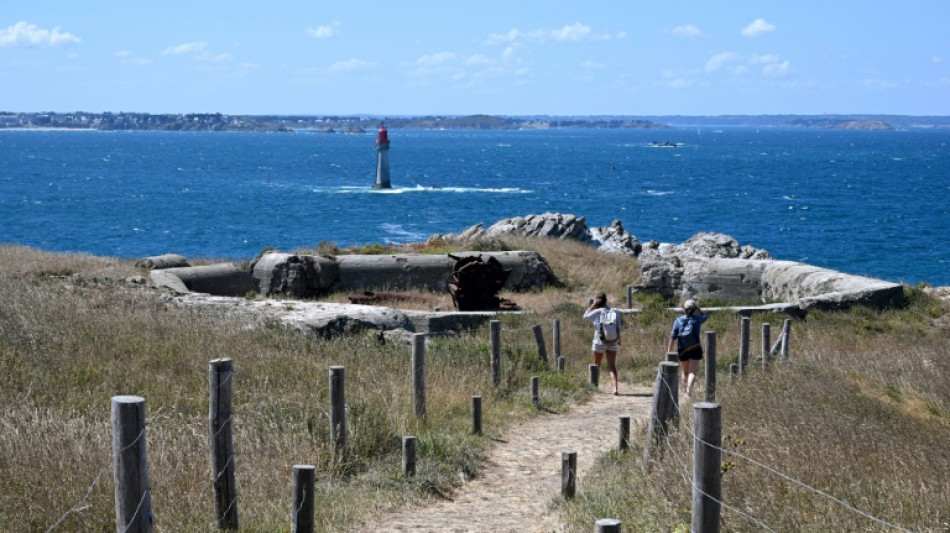
Mine-riddled French island becomes unlikely walkers' paradise / Photo: Damien MEYER - AFP

 'It has to stop': runners protest women's murders in S.Africa district

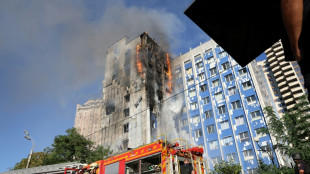
 Fire erupts near Riyadh airport as Houthis claim strikes

 Cuba works to restore power after another blackout

 England thrash Sri Lanka again to return to top of T20 rankings

 Arsenal thrashed by Brighton, sorry Spurs lose again

 South Korea, Austria qualify for Davis Cup finals

 Seare shocks Ingebrigtsen to win world 5km gold

 Brigitte Bardot widower slams sale of star's belongings

 Aston Villa compound Tottenham's misery despite late rally

 Asian Games offer 'deepest apologies' for South Korea anthem blunder

 Inter Milan and Italy icon Mazzola dies aged 83

 Saudi capital issues first air raid alert since renewed fighting in Yemen

 Martin edges title rival Marquez for Austrian MotoGP pole

 Indonesia accepts Malaysia's help to tackle wildfires

 Indians living in Japan on stand-by to house Asian Games athletes

 Trump signs bill authorizing sweeping Russia sanctions

 Protesters form human chain at Kennedy Center after Trump threat

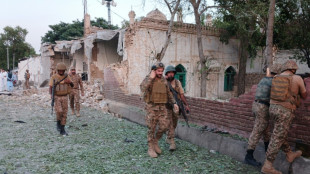 Death toll from attack at police HQ in Pakistan rises to 31

 Trump says Denmark to give US 'permanent control' over Greenland security

 New to The Street Broadcasts Tonight at 6:30 PM ET Across the United States, Latin America and MENA, Featuring BioVie, Acurx Pharmaceuticals, Lantern Pharma and SafeSpace Global

 Kennedy Center: future unclear for iconic Washington arts hub

 Trump claims 'infinite' Greenland security deal with Denmark

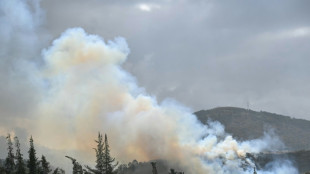 Helicopters battle wildfire threatening Ecuador's capital

 Brentford batter Chelsea to undo Alonso's promising start

 Kane hits Bundesliga century as Bayern rout Union

Every year, thousands of day-trippers make the short boat journey from France's northern coast to the island of Cezembre, marvelling at the spectacular maritime views and flourishing wildlife.
But they better tread carefully and stick to the path, as almost all the island remains perilous due to unexploded munitions from World War II.
Cezembre opened to visits only in 2018, over seven decades after the end of World War II, after extensive demining efforts allowed the opening of a marked path for visitors.
However, the area safe for visitors makes up just three percent of the island, which experts say was the most bombed area of all of World War II in terms of the number of hits per square metre.
"It's magnificent!" enthused Maryse Wilmart, a 60-year-old visitor from the southwestern town of La Rochelle, contemplating the sandy beach with turquoise waters and looking out to the ramparts of the port city of Saint-Malo beyond.
"But when you see all that behind us... Can you even imagine what happened here?" she asked, pointing to the barbed wire and signs warning "Danger! Ground not cleared beyond the fences!"
- 'Like Stalingrad' -
A visitor needs to go back 80 years to understand what happened on this usually uninhabited rocky outcrop.
In 1942, the occupying Nazi German army seized the strategically important island and installed bunkers and artillery pieces.
On August 17, 1944, Saint-Malo was liberated by the Americans but the Nazi commander of Cezembre, leading some 400 men, refused to surrender.
There then followed a devastating bombardment from the air by the Allies.
"It is said that per square metre it sustained the greatest number of bombardments of all the theatres of operation of World War II," said Philippe Delacotte, author of the book "The Secrets of the Island of Cezembre".
"There were between 4,000 and 5,000 bombs dropped", some of which contained napalm, he said.
On September 2, 1944, the white flag was finally raised and some 350 exhausted men surrendered.
"Some survivors claimed it was like Stalingrad," Delacotte said. The island was completely devastated, to the extent that its altitude even dropped because of the bombs.
After the war, the island became the property of the French ministry of defence and access was totally closed, with the first demining efforts starting in the 1950s.
It was handed over to a public coastal conservation body, the Conservatoire du Littoral, in 2017.
- 'Recolonised and revegetated' -
The path of about 800 metres (875 yards) lets visitors wander between rusty cannons and bunkers, with breathtaking views towards Cap Frehel and the Pointe de la Varde.
Since the opening of the path, "there has been no accident" even if "there are always people who want to go beyond the authorised section," said Jean-Christophe Renais, a coast guard.
Over time, colonies of seabirds have reappeared, including seagulls, cormorants, razorbills and guillemots.
"Biodiversity is doing wonderfully, everything has been recolonised and revegetated, birds have taken back possession of the site," said Gwenal Hervouet, who manages the site for Conservatoire du Littoral.
"It's just a joy."
Because of the focus on restoring wildlife, the trail was partially closed in April "to maximise the chances of success and the flight of peregrine falcon chicks," said local conservation activist Manon Simonneau.
Some walkers say they hope the trail will be lengthened to allow a complete tour of the island, but according to the Conservatoire there is little chance of this -- the cost of further demining would be astronomical, so it is now birds and nature that are the masters of Cezembre.
H.Romero--AT



