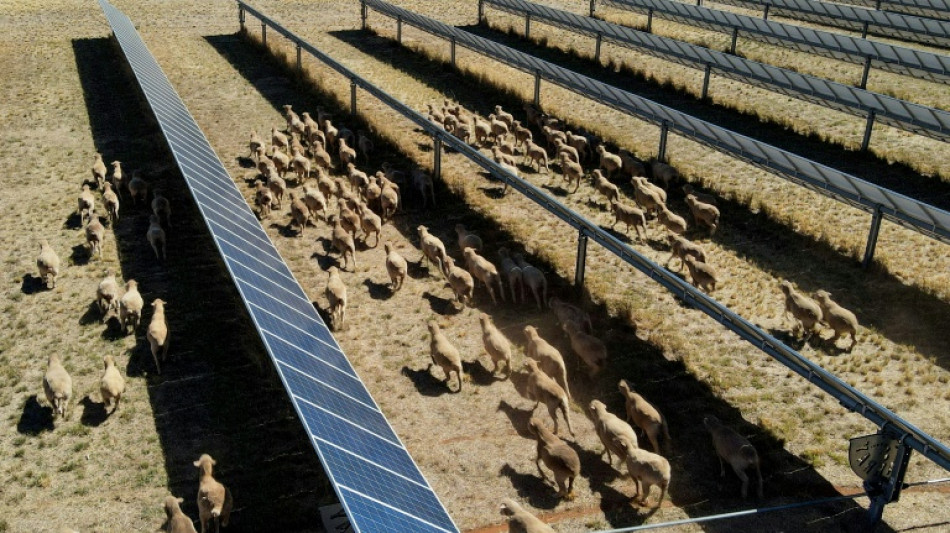
'Solar sheep' help rural Australia go green, one panel at a time / Photo: Gregory Plesse - AFP

 'It has to stop': runners protest women's murders in S.Africa district

 Fire erupts near Riyadh airport as Houthis claim strikes

 Cuba works to restore power after another blackout

 England thrash Sri Lanka again to return to top of T20 rankings

 Arsenal thrashed by Brighton, sorry Spurs lose again

 South Korea, Austria qualify for Davis Cup finals

 Seare shocks Ingebrigtsen to win world 5km gold

 Brigitte Bardot widower slams sale of star's belongings

 Aston Villa compound Tottenham's misery despite late rally

 Asian Games offer 'deepest apologies' for South Korea anthem blunder

 Inter Milan and Italy icon Mazzola dies aged 83

 Saudi capital issues first air raid alert since renewed fighting in Yemen

 Martin edges title rival Marquez for Austrian MotoGP pole

 Indonesia accepts Malaysia's help to tackle wildfires

 Indians living in Japan on stand-by to house Asian Games athletes
 Trump signs bill authorizing sweeping Russia sanctions

 Protesters form human chain at Kennedy Center after Trump threat

 Death toll from attack at police HQ in Pakistan rises to 31

 Trump says Denmark to give US 'permanent control' over Greenland security
 New to The Street Broadcasts Tonight at 6:30 PM ET Across the United States, Latin America and MENA, Featuring BioVie, Acurx Pharmaceuticals, Lantern Pharma and SafeSpace Global

 Kennedy Center: future unclear for iconic Washington arts hub

 Trump claims 'infinite' Greenland security deal with Denmark

 Helicopters battle wildfire threatening Ecuador's capital

 Brentford batter Chelsea to undo Alonso's promising start

 Kane hits Bundesliga century as Bayern rout Union

Australian farmer Tom Warren's solar panels look like any other -- until you spot the dozens of sheep grazing and napping, helping the country transition to green energy and earning him a decent income while doing it.
More than 30,000 solar panels are deployed across approximately 50 hectares at Warren's farm on the outskirts of Dubbo, around 400 kilometres (250 miles) west of Sydney.
The farmer and landowner has been working with renewables firm Neoen for more than a decade and said he was initially worried the panels would restrict his sheep's grazing.
It quickly became clear those fears were unfounded.
"Normally they would seek out trees and camp under the trees, but you can see that the sheep are seeking out the shade of the panels," he told AFP at the farm in Dubbo.
"So, it's a much better environment for them as well."
The farm produces about 20 megawatts of power, he said -- a "substantial amount" of the energy needs of the local area.
While he can't disclose how much he earns from the panels, he said he's taking in much more than he would from just farming.
"The solar farm income is greater than I would ever get off agriculture in this area -- regardless of whether I have sheep running under the panels or not," he said.
- Grass is greener -
The panels have had another surprising side effect: because the grass is shielded from the elements, it's of more consistent quality.
That, in turn, has improved the wool produced by the sheep.
"The wool is actually better and cleaner," Warren said.
"All over, we've had about a 15 percent increase in the gross revenue coming from the sheep running under the solar farm."
Fellow farmer Tony Inder, based around 50 kilometres south in the town of Wellington, agrees.
His flock is much larger -- 6,000 sheep grazing on two plots of land covering 4,000 hectares.
"If you want to grow wool, you just need one constant diet and then the wool will grow evenly," he said.
"Under the panels, because it's constant shade and it's constant green, we're supplying a more constant feed, which in turn gives it a better quality wool."
Unlike Warren, Inder doesn't own the land where the solar panels are installed, but the landowners let him use it for free.
In exchange, "they don't have to mow as often", to ensure the panels function properly, but also, and more importantly, to comply with bushfire prevention regulations.
- Renewables boom -
Sheep, and in particular wool, were a mainstay of the Australian economy for much of the past 150 years, feeding into the notion by the 1950s that Australia "rode on the sheep's back".
The Dubbo farm, however, was a pioneer in the field of agrivoltaics and many others are following its example.
"All of our solar farms in New South Wales now have sheep grazing on them," said Emily Walker, the company's director for the state.
"The industry is moving very quickly into a world where it's not really possible anymore to decouple the historical-agricultural land use from the solar."
Australia remains heavily dependent on its fossil fuel economy for growth despite heavy investment in the renewable sector.
Canberra has pledged to slash planet-warming greenhouse gas emissions by up to 70 percent from 2005 levels over the next decade.
It has also poured billions into solar power, wind turbines and green manufacturing and pledged to make Australia a renewable energy superpower.
Karin Stark, director of the consulting firm Farm Renewables, told AFP that more funding to incentivise this combined use of farmland was needed.
She said the benefits were clear.
"As more farmers are starting to adopt renewable or host large-scale renewable on their land and continuing to farm... the more visible it is in the community," she said.
"Farmers can see that you can continue to farm and be productive."
W.Morales--AT