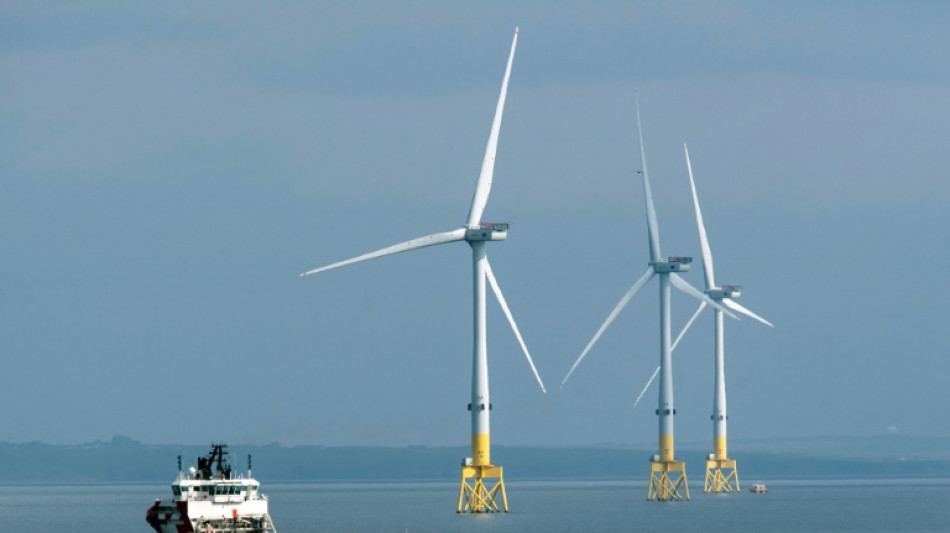
Wind and water: undersea drone readies to aid offshore boom / Photo: Andy Buchanan - AFP

 'It has to stop': runners protest women's murders in S.Africa district

 Fire erupts near Riyadh airport as Houthis claim strikes

 Cuba works to restore power after another blackout

 England thrash Sri Lanka again to return to top of T20 rankings

 Arsenal thrashed by Brighton, sorry Spurs lose again

 South Korea, Austria qualify for Davis Cup finals

 Seare shocks Ingebrigtsen to win world 5km gold

 Brigitte Bardot widower slams sale of star's belongings

 Aston Villa compound Tottenham's misery despite late rally

 Asian Games offer 'deepest apologies' for South Korea anthem blunder
 Inter Milan and Italy icon Mazzola dies aged 83

 Saudi capital issues first air raid alert since renewed fighting in Yemen

 Martin edges title rival Marquez for Austrian MotoGP pole

 Indonesia accepts Malaysia's help to tackle wildfires

 Indians living in Japan on stand-by to house Asian Games athletes
 Trump signs bill authorizing sweeping Russia sanctions

 Protesters form human chain at Kennedy Center after Trump threat

 Death toll from attack at police HQ in Pakistan rises to 31

 Trump says Denmark to give US 'permanent control' over Greenland security

 New to The Street Broadcasts Tonight at 6:30 PM ET Across the United States, Latin America and MENA, Featuring BioVie, Acurx Pharmaceuticals, Lantern Pharma and SafeSpace Global

 Kennedy Center: future unclear for iconic Washington arts hub

 Trump claims 'infinite' Greenland security deal with Denmark

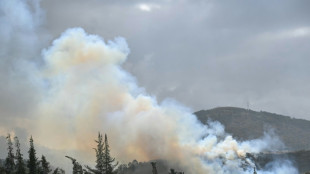 Helicopters battle wildfire threatening Ecuador's capital

 Brentford batter Chelsea to undo Alonso's promising start

 Kane hits Bundesliga century as Bayern rout Union

In a wave tank at a robot laboratory in the Scottish capital Edinburgh, engineers observe in silence as an underwater drone rises stealthily to the surface.
The team, which led the development of the remotely operated vehicle (ROV) at Heriot-Watt university, believe the submersible machine is a game-changer for offshore wind farms, obviating the need for divers.
The engineers reckon it will soon be ready to perform inspections and maintenance at wind farms, transforming the nature of the high-risk and costly endeavours just as the industry is set for huge expansion.
British Prime Minister Boris Johnson has promised to make the UK the "Saudi Arabia" of wind power, with plans to generate enough electricity from offshore to power every UK home by 2030.
While Johnson is on his way out of office, the industry is banking on the expansion plans, especially after Russia's invasion of Ukraine sent the price of traditional carbon energy through the roof.
"We have to imagine that in 10, 15 years time there will be hundreds of wind farms, which means thousands of wind turbines all across the coast of the UK," Yvan Petillot, a robotics and autonomous systems professor at Heriot-Watt, told AFP.
"You also have hydrogen technology being developed and all of this will need to be maintained, inspected and serviced.
"What we are developing is remote technologies where people can inspect and maintain those assets from shore, without putting anyone in harm's way."
- Accumulation of micro-organisms -
In May the ROV, which is equipped with sensors and advanced software, conducted what is believed to be the first ever autonomous offshore wind farm inspection.
The device was deployed at French energy firm EDF's Blyth wind farm, off the coast of Northumberland, northeast England.
It successfully recorded videos that allowed researchers to assess the exterior condition of turbine foundations and cables.
Meanwhile its software created a 3D reconstruction model of parts of the energy company's underwater assets.
Petillot said the 3D model can pick up the accumulation of micro-organisms, plants and algae on the turbine foundations.
If a problem is detected, the ROV system can be deployed with a robotic arm to conduct a repair.
"The system will first do an autonomous inspection of the seabed and the structure, and build the 3D model that someone from shore can look at and say, 'there's a problem here'," Petillot said.
"Typically you would have corrosion on the system, you might have to turn a valve, you might have to connect a cable, you might have to change an anode and clean the surface if there is too much bio-fouling."
Maxime Duchet, an offshore wind research engineer at EDF, said the images and modelling will greatly enhance the ability to conduct operations and maintenance activities on-site.
- 'Safer and faster' -
Further tests are needed to estimate the time required to inspect all of the turbine foundations and to demonstrate the full potential of marine robotic technology, he noted.
"However, it is clear from these initial results that the technology can ensure safer and faster operations and a reduced carbon footprint," Duchet added.
Engineers, who use a joystick to pilot the vehicle, say the ROV can be left alone to perform its primary mapping task for most of the time.
If it becomes stuck, or lingers too long in a particular area, a pilot can commandeer it.
Petillot said a long-term benefit could be allowing more people to join the team managing the ROV remotely, who might not have been willing or able to work offshore.
It is incredibly difficult to find a diver or a qualified pilot for such projects, he noted.
In contrast, finding somebody to help control the system as though they were playing a video game should prove far easier, according to Petillot.
M.White--AT